Grandview, Glendale
Updated · 10,651 residents
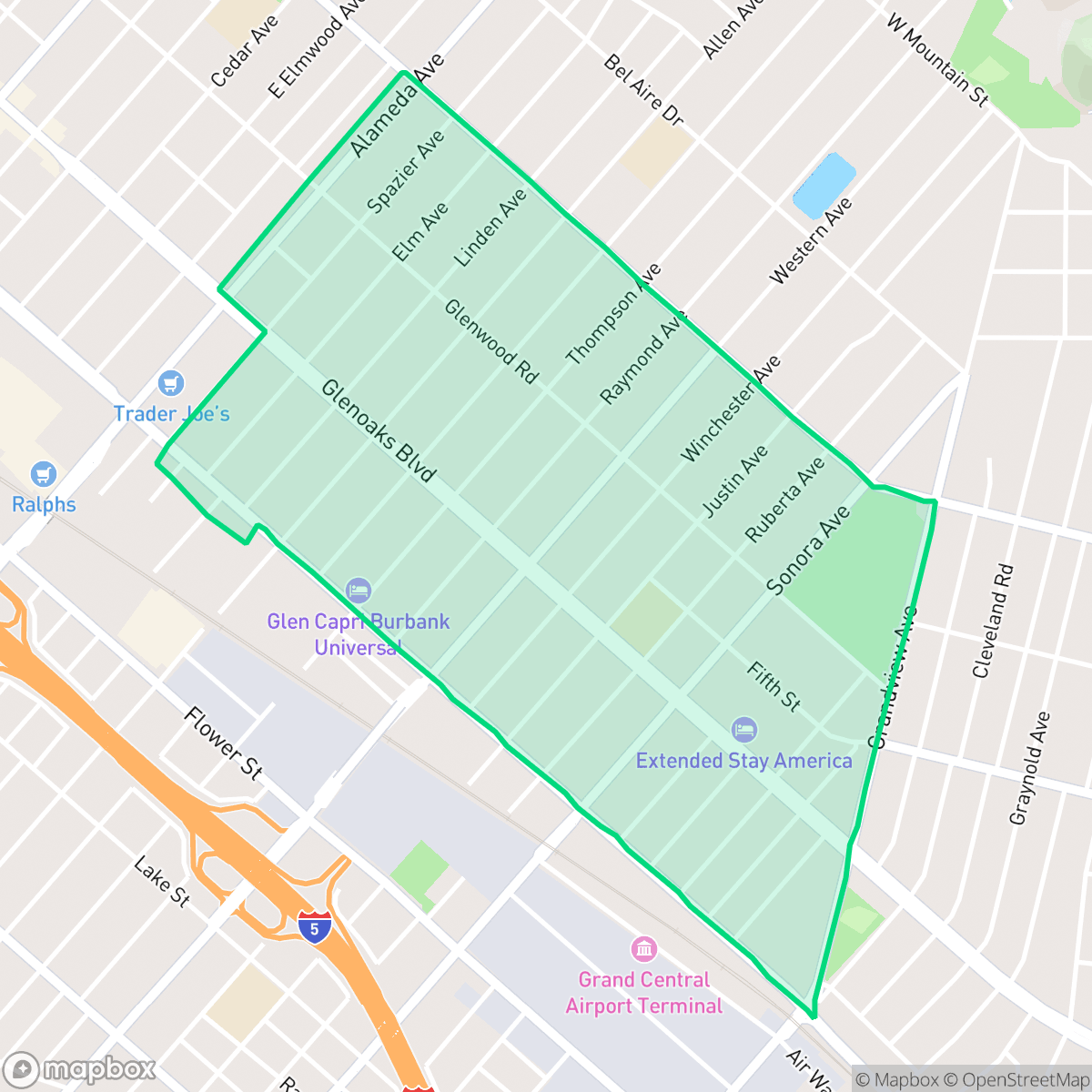
Grandview is a highly walkable neighborhood in Northwest Glendale, characterized by a dense grid of residential streets and convenient access to local amenities. According to iHuus data, the area offers a calm atmosphere with reliable air quality, though residents should expect close proximity to neighbors due to the compact housing layout.
Key Highlights
About Grandview
The Grandview neighborhood in Northwest Glendale, California, originated in the late 19th century as an agricultural area of orchards and farmhouses. Initially associated with neighboring Burbank, the territory was inadvertently omitted when Burbank incorporated in 1911, leading to its annexation by Glendale later that year. The neighborhood is anchored by Grandview Avenue, a historic thoroughfare that once served as the city's western boundary and leads directly to the historic Brand Park. A defining local landmark is the 25-acre Grand View Memorial Park and Crematory, established in 1884 as Glendale Cemetery. This historic cemetery features Spanish Colonial Revival architecture and serves as the final resting place for hundreds of Civil War veterans. Other community fixtures include the Grandview Presbyterian Church and the Grandview Public Library.
The neighborhood is defined by its exceptional walkability, featuring a structured grid system with sidewalks on both sides of nearly every street. This layout provides residents with efficient pedestrian access to local services and commercial corridors. While the area maintains a calm residential environment, the architectural landscape consists of standard suburban housing on small lots, resulting in a dense, low-rise urban fabric. According to iHuus analysis, the neighborhood benefits from good air quality and moderate acoustic comfort, making it a stable environment for daily life.
Residents often navigate trade-offs regarding privacy and environmental safety. The close spacing of homes and limited visual buffers mean that privacy is more restricted compared to less dense suburbs. Furthermore, the area faces specific challenges regarding flood and fire safety, which are important considerations for prospective homeowners. With high health insurance coverage and access to the Glendale Unified School District, the area is well-suited for those who prioritize a walkable lifestyle over expansive private outdoor space.
Neighborhood Scores Across 15 Qualities
Residential structures and industrial blocks are often closely packed with minimal visual buffers between neighbors. According to iHuus data, this level of density and proximity is slightly higher than the average for Glendale.
Pedestrian access is excellent due to a consistent grid of sidewalks and well-defined crosswalks that exceed the Glendale average. Most residential and commercial blocks offer safe, dedicated paths for walking on both sides of the street.
Residential lots are relatively small and feature consistent, boxy architecture. This level of visual variety and greenery is lower than the Glendale city average.
Limited access to large public parks and narrow sidewalk verges make this area less ideal for dog owners compared to the Glendale average. Much of the neighborhood consists of dense pavement and industrial segments with minimal green space for outdoor activity.
Residential streets and green spaces are balanced with industrial warehouses and low-rise commercial zones. This environment is slightly less dense than the Glendale average, offering a mix of single-family homes and multi-unit complexes.
A blend of quiet suburban streets and lively social hubs provides a varied atmosphere, staying consistent with the city average. While some blocks feature accessible dining and essential services, other areas remain more car-oriented and tranquil.
Steady traffic sounds from nearby busy streets are present; however, acoustic levels remain notably more tranquil than the Glendale city average, according to iHuus data.
Air quality remains mostly clean with only rare instances of elevated readings, though levels are slightly below the Glendale average according to iHuus data.
Primarily residential and light commercial, this area avoids the heavy warehouses and freight traffic found in other parts of the city. Residents should note that a nearby EPA Superfund site is listed on the National Priorities List due to groundwater contamination concerns.
Health insurance access is widespread among Grandview residents, appearing slightly higher than the Glendale average according to iHuus data.
Political leanings in this area are predominantly liberal, though this is slightly less pronounced than the average across Glendale. According to iHuus data, a modest opposing presence exists alongside the liberal majority.
Residents live alongside a balanced mix of young professionals, families, and seniors. This demographic spread is consistent with the broader Glendale area, according to iHuus data.
Flood vulnerability is significantly higher here than the Glendale average. Residents should anticipate much more substantial flood risks and potentially prohibitive insurance costs according to iHuus data.
Extremely high fire vulnerability is present in this area, which is notably higher than the Glendale average according to iHuus data.
Address-Level Insights for Grandview


iHuus Neighborhood Intelligence Insights
Get address-level neighborhood insights for Grandview
- Street-level scores — see how individual blocks compare, not just neighborhood averages
- Micro-zone boundaries — identify quiet pockets, flood boundaries, and walkable clusters before you visit
- 15 dimensions in full — walkability, noise, air quality, school quality, insurance coverage, population age profile, urban/rural index, and more
- Boundary risk alerts — know if your address sits near a block boundary where scores drop, the kind of detail no listing will ever mention
- School insights — individual school ratings and insights, not just district-level data
- Compare before you commit — side-by-side data across neighborhoods, down to block precision
No credit card required
Compare with Any Neighborhood
| Dimension | Grandview | Adams Hill |
|---|---|---|
| 🚶 Walkabilityavg 8.69 | ||
| 🔊 Acoustic Comfortavg 3.71 | ||
| 🤫 Privacy Indexavg 4.65 | ||
| 🎨 Visual Appealavg 6.99 | ||
| 🐕 Dog Friendlinessavg 5.3 | ||
| 🗺️ Urban-Rural Indexavg 6.32 | ||
| ✨ Neighborhood Vibeavg 5.1 | ||
| 🏥 Health Insurance Coverageavg 7.89 | ||
| 🌿 Air Qualityavg 8.01 | ||
| 🏭 Industrial Proximityavg 8.92 | ||
| 🌊 Flood Safetyavg 2.96 | ||
| 🗳️ Ideological Leanavg 8.52 | ||
| 👥 Population Age Profileavg 5.28 | ||
| 🔥 Fire Safetyavg 0.5 | ||
| 🏫 School Quality |
Grandview Rankings
School Districts Serving Grandview
School Insights for Grandview
Below average outcomes; significant attendance and academic challenges.
School Insights
See what's really behind every school rating near Grandview
- Individual school ratings — each school's own score with outcome context, not just a district average
- Enrollment & class size data — student-to-teacher ratio and how it compares to the state average
- Full demographics breakdown — ethnicity and gender composition for every school in the enrollment zone
- Every school in the district — all schools within the enrollment boundary ranked by rating, not just the closest one
- Grade levels & benchmarks — elementary through high school, with below/above state-average flags
No credit card required