Glenwood, Glendale
Updated · 9,782 residents
Glenwood is a quiet, highly walkable residential neighborhood in Glendale characterized by its historic architecture and mature magnolia-lined streets. While it offers a peaceful atmosphere and high rates of health insurance coverage, it is primarily a car-oriented area with limited local businesses and a subdued social scene.
Key Highlights
About Glenwood
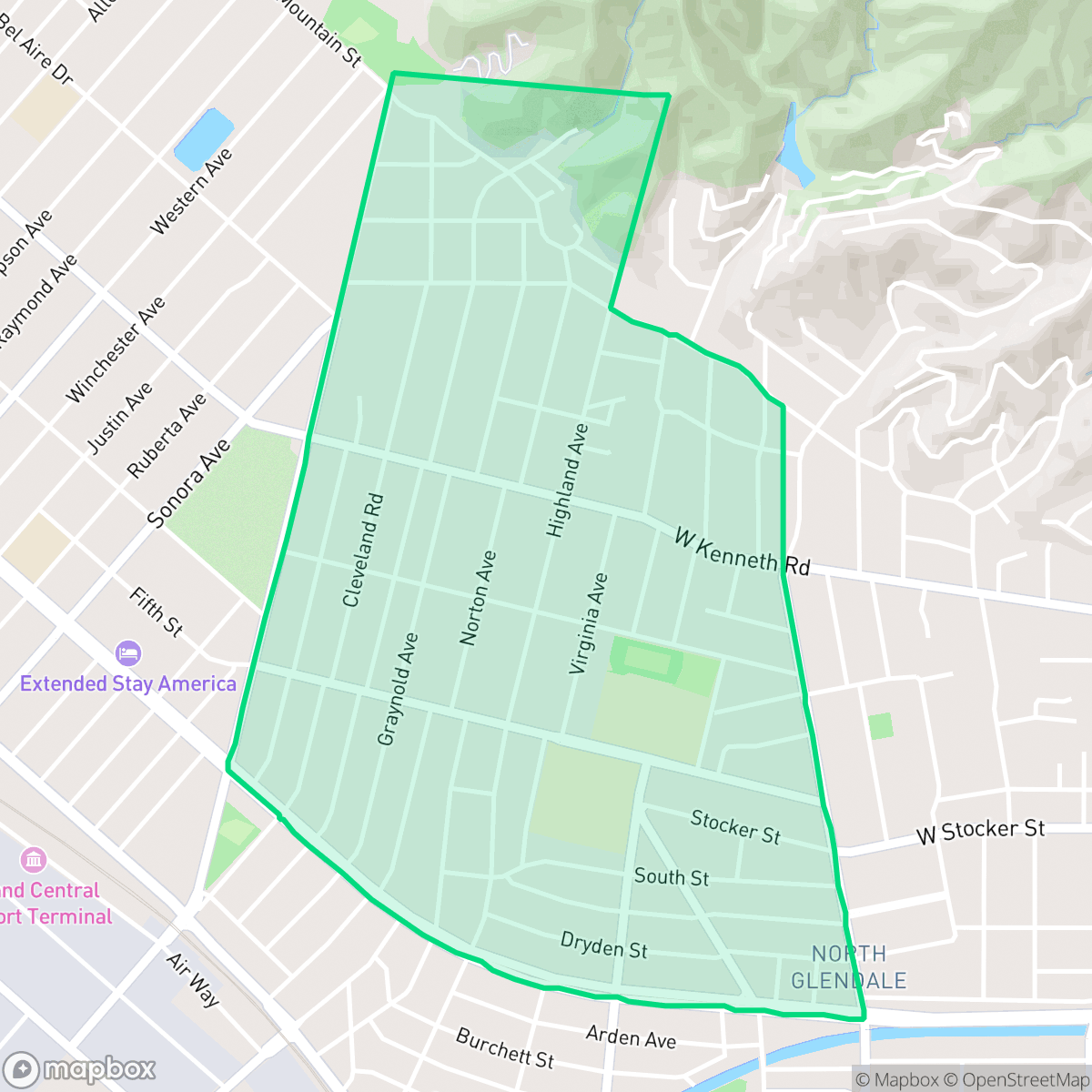
Located in Glendale, California, the Glenwood neighborhood is defined by its deep historic roots and highly preserved residential character, with over 60% of its homes built before 1940. A central landmark of the neighborhood is the Taylor House on Glenwood Road. Built in 1873, this redwood farmhouse is Glendale's oldest surviving wood-frame house. Originally part of a 26-acre ranch owned by Jesse and George Taylor, the property was acquired in 1908 by dairyman James Conner, whose family subsequently subdivided the land to establish the surrounding residential tract. Today, the neighborhood's streets are shaded by mature, giant magnolia trees. Reflecting Glendale's broader demographic shifts, Glenwood has also developed a prominent Armenian-American cultural identity, with a significant portion of its modern population identifying with Armenian heritage.
The neighborhood maintains a distinct suburban character defined by its dense grid of single-family homes and well-manicured properties. According to iHuus data, residents benefit from excellent walkability, featuring continuous sidewalks and signalized crosswalks, though the area remains relatively quiet with few commercial services within immediate walking distance. The local environment is generally pleasant, with good air quality and a moderate noise level primarily attributed to road traffic.
Prospective residents should note that the area is best suited for those seeking a tranquil, established community rather than a bustling urban hub. While the neighborhood boasts high rates of health insurance coverage, it faces specific environmental considerations, including a nearby EPA Superfund site that warrants attention regarding groundwater quality. Additionally, the area is located in a zone with elevated risks for flood and fire events, which is an important factor for homeowners to consider when evaluating long-term property safety.
Neighborhood Scores Across 15 Qualities
Residential spacing varies between detached homes and dense apartment blocks, offering slightly more separation between neighbors than the Glendale average. Some areas feature closely spaced structures with limited visual buffers between property lines.
Continuous sidewalks and signalized crosswalks make navigating the area on foot easy, offering better pedestrian connectivity than the Glendale average. While major freeway infrastructure creates some disruptions, the residential grid maintains a consistent and safe network for walkers.
Large homes and well-maintained properties with frequent private pools characterize this area, making the visual landscape slightly more polished than the Glendale average. According to iHuus data, the presence of manicured yards and upscale amenities contributes to an aesthetically pleasing environment.
Narrow sidewalk verges and a lack of large public parks make for restricted walking options for pet owners. According to iHuus data, the available greenery is primarily confined to private yards, making this area less dog friendly than the Glendale average.
Residential streets and green spaces are distributed fairly evenly across the area. According to iHuus data, this density of housing and commercial space is very similar to the typical layout found throughout Glendale.
Low density and limited business proximity create a tranquil, suburban atmosphere that is less active than the Glendale average. Most residents will find the area mostly car-oriented due to the scarcity of walkable amenities and services.
Steady traffic sounds from nearby busy streets are present, though the level of acoustic disturbance is higher than the Glendale average according to iHuus data.
Air quality in Glenwood is consistently good with rare instances of elevated readings. According to iHuus data, these levels are consistent with the average found throughout Glendale.
The area is predominantly residential and lacks heavy industrial activity, though it is slightly more prone to industrial-related features than the Glendale average. Residents should be aware of a nearby EPA Superfund site and noise from the adjacent freeway and concrete wash channel.
Health insurance enrollment in this area is slightly lower than the Glendale city average, according to iHuus data.
Political leanings in Glenwood are predominantly liberal, though this is slightly less pronounced than the average seen across Glendale according to iHuus data.
Residents live alongside a balanced mix of young professionals, families, and seniors. According to iHuus data, this demographic distribution is slightly more varied than the average found across Glendale.
Flood risk levels in Glenwood are higher than the Glendale average, though detailed FEMA studies for this specific area remain incomplete.
Extreme fire hazards exist within this area, which presents a level of risk similar to the broader Glendale area according to iHuus data.
Address-Level Insights for Glenwood


iHuus Neighborhood Intelligence Insights
Get address-level neighborhood insights for Glenwood
- Street-level scores — see how individual blocks compare, not just neighborhood averages
- Micro-zone boundaries — identify quiet pockets, flood boundaries, and walkable clusters before you visit
- 15 dimensions in full — walkability, noise, air quality, school quality, insurance coverage, population age profile, urban/rural index, and more
- Boundary risk alerts — know if your address sits near a block boundary where scores drop, the kind of detail no listing will ever mention
- School insights — individual school ratings and insights, not just district-level data
- Compare before you commit — side-by-side data across neighborhoods, down to block precision
No credit card required
Compare with Any Neighborhood
| Dimension | Glenwood | Adams Hill |
|---|---|---|
| 🚶 Walkabilityavg 8.69 | ||
| 🔊 Acoustic Comfortavg 3.71 | ||
| 🤫 Privacy Indexavg 4.65 | ||
| 🎨 Visual Appealavg 6.99 | ||
| 🐕 Dog Friendlinessavg 5.3 | ||
| 🗺️ Urban-Rural Indexavg 6.32 | ||
| ✨ Neighborhood Vibeavg 5.1 | ||
| 🏥 Health Insurance Coverageavg 7.89 | ||
| 🌿 Air Qualityavg 8.01 | ||
| 🏭 Industrial Proximityavg 8.92 | ||
| 🌊 Flood Safetyavg 2.96 | ||
| 🗳️ Ideological Leanavg 8.52 | ||
| 👥 Population Age Profileavg 5.28 | ||
| 🔥 Fire Safetyavg 0.5 | ||
| 🏫 School Quality |
Glenwood Rankings
School Districts Serving Glenwood
School Insights for Glenwood
Below average outcomes; significant attendance and academic challenges.
School Insights
See what's really behind every school rating near Glenwood
- Individual school ratings — each school's own score with outcome context, not just a district average
- Enrollment & class size data — student-to-teacher ratio and how it compares to the state average
- Full demographics breakdown — ethnicity and gender composition for every school in the enrollment zone
- Every school in the district — all schools within the enrollment boundary ranked by rating, not just the closest one
- Grade levels & benchmarks — elementary through high school, with below/above state-average flags
No credit card required