Crescenta Highlands, Glendale
Updated · 12,755 residents
Crescenta Highlands is a serene, affluent residential enclave in Glendale known for its well-manicured properties and proximity to scenic hillside topography. While the area offers a highly walkable street grid and excellent air quality, residents should be prepared for significant road noise and the environmental risks associated with its hillside location.
Key Highlights
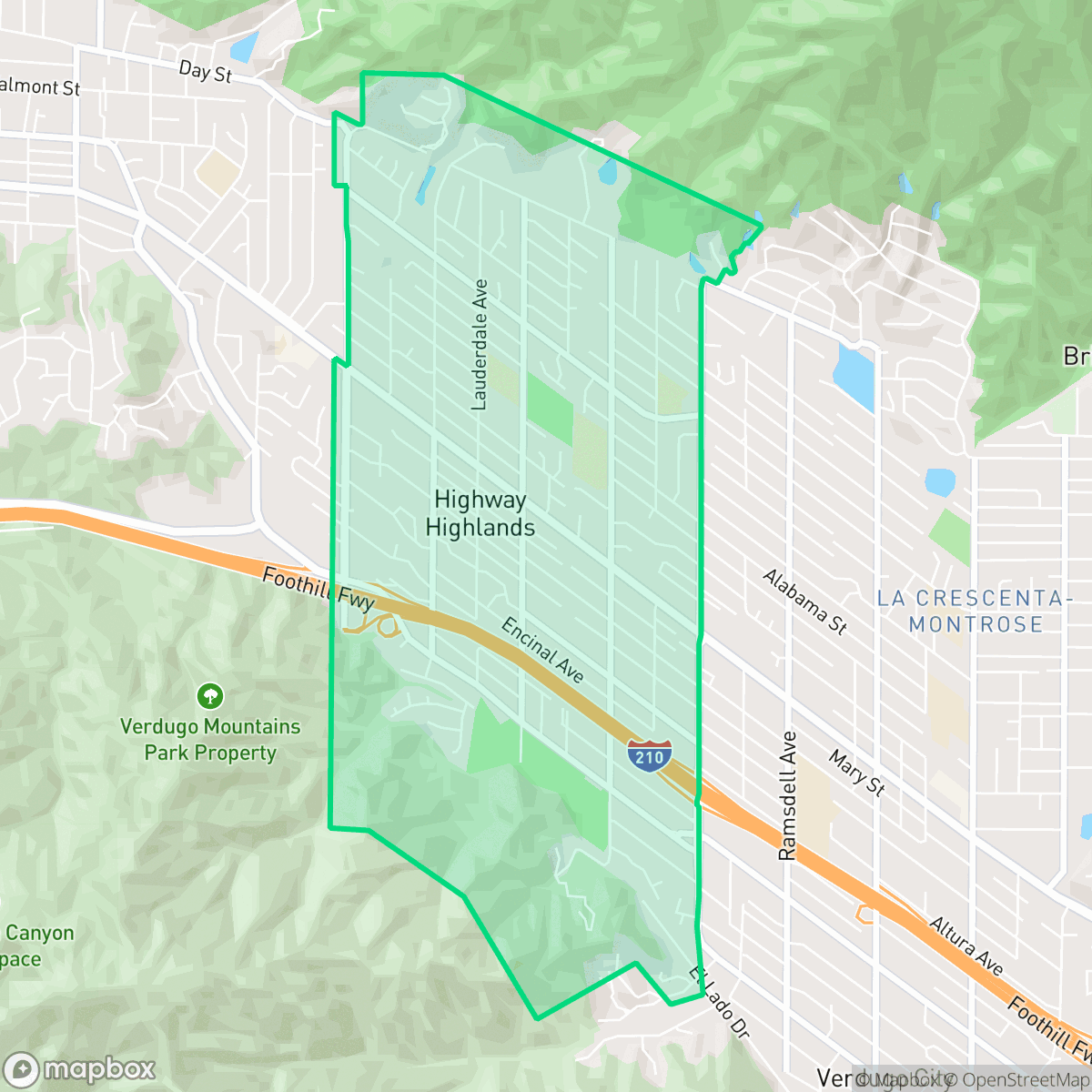
About Crescenta Highlands
Crescenta Highlands, historically known as the "Glendale Annex," was annexed into the city of Glendale in 1952. Nestled in the scenic Crescenta Valley, the neighborhood transitioned from agricultural lands to a suburban enclave during a post-World War II housing boom. A major local landmark is the Crescenta Valley Community Regional Park. From 1934 to 1957, a western section of this park operated as Hindenburg Park, a private German-American League facility that served as a prominent regional hub for German cultural festivals like Oktoberfest before being acquired by Los Angeles County. The neighborhood is also home to "The McFall Oak," a historic heritage oak tree officially recognized for surviving the devastating 2009 Station Fire.
The neighborhood maintains a dense suburban character defined by its uniform single-family homes, mature tree canopy, and consistent sidewalk networks. It serves as a quiet residential retreat that blends established suburban infrastructure with immediate access to natural landscapes. The area is characterized by high visual appeal, featuring numerous private pools and well-maintained lots that reflect the affluence of the community. Residents benefit from a clean environment, with air quality ratings that consistently outperform many other parts of the region, and a complete absence of industrial hazards.
Prospective residents should weigh the area's strong educational offerings, including several top-rated public schools, against specific environmental and lifestyle trade-offs. While the neighborhood is highly walkable for a suburban setting, the overall atmosphere remains quiet with limited local commercial activity, making it better suited for those who prioritize tranquility over nightlife. Acoustic comfort is a notable consideration due to proximity to major traffic corridors, and the hillside geography necessitates careful attention to fire safety protocols. It is an ideal location for families seeking a stable, well-resourced environment with a strong academic foundation.
Neighborhood Scores Across 15 Qualities
Residential spacing is higher than the Glendale average, offering more separation between homes than most parts of the city. While many properties feature detached houses with yard space, some side-yard buffering remains limited in denser pockets.
Established sidewalk networks and clear crossings provide safe pedestrian access through residential streets. While some high-traffic arterials act as barriers, the area remains slightly below the Glendale average for overall connectivity.
Large, well-maintained homes with private pools and manicured landscapes characterize this area. According to iHuus data, the visual quality of the neighborhood sits well above the Glendale average.
Access to large hillside natural areas and connected trails provides much better walking options for pets than the Glendale average. Wide paths and vegetated sidewalk verges offer ample space for exercise, though much of the neighborhood's greenery remains within private yards.
Vast green open spaces and hillside topography dominate the landscape, providing a more rural character than the typical Glendale suburban environment. This area features a mix of detached homes integrated with significant natural woodland and open land.
Residential life here is primarily defined by a serene, low-density landscape with very little commercial character. According to iHuus data, the neighborhood lacks the steady rhythm of services found in more active parts of Glendale.
Frequent noise from nearby freeways and transit corridors makes this area louder than the Glendale average. Residents can expect intermittent auditory disturbances due to proximity to major thoroughfares and flight paths.
Air quality in this area is consistently good, matching the average levels found throughout Glendale. According to iHuus data, residents can expect mostly clean air with only rare instances of elevated readings.
Industrial activity and heavy warehouses are entirely absent from this area. According to iHuus data, the neighborhood is composed exclusively of residential and light commercial zones, which is a more residential-focused environment than the Glendale average.
Health insurance access is widespread among residents, sitting slightly above the Glendale average according to iHuus data.
Political leanings in this area skew liberal, though the community is slightly less progressive than the Glendale average according to iHuus data.
Residents live alongside a diverse mix of young adults, families, and seniors. This demographic spread is consistent with the broader Glendale area according to iHuus data.
Flood risk levels in this area remain undetermined because official studies have not been completed for this specific zone. According to iHuus data, the level of precaution required here is notably higher than the Glendale average.
Wildfire hazards are exceptionally high in this area, presenting a greater danger than most parts of Glendale. According to iHuus data, residents should prioritize maximum fire protection measures due to the extreme level of risk.
Address-Level Insights for Crescenta Highlands


iHuus Neighborhood Intelligence Insights
Get address-level neighborhood insights for Crescenta Highlands
- Street-level scores — see how individual blocks compare, not just neighborhood averages
- Micro-zone boundaries — identify quiet pockets, flood boundaries, and walkable clusters before you visit
- 15 dimensions in full — walkability, noise, air quality, school quality, insurance coverage, population age profile, urban/rural index, and more
- Boundary risk alerts — know if your address sits near a block boundary where scores drop, the kind of detail no listing will ever mention
- School insights — individual school ratings and insights, not just district-level data
- Compare before you commit — side-by-side data across neighborhoods, down to block precision
No credit card required
Compare with Any Neighborhood
| Dimension | Crescenta Highlands | Adams Hill |
|---|---|---|
| 🚶 Walkabilityavg 8.69 | ||
| 🔊 Acoustic Comfortavg 3.71 | ||
| 🤫 Privacy Indexavg 4.65 | ||
| 🎨 Visual Appealavg 6.99 | ||
| 🐕 Dog Friendlinessavg 5.3 | ||
| 🗺️ Urban-Rural Indexavg 6.32 | ||
| ✨ Neighborhood Vibeavg 5.1 | ||
| 🏥 Health Insurance Coverageavg 7.89 | ||
| 🌿 Air Qualityavg 8.01 | ||
| 🏭 Industrial Proximityavg 8.92 | ||
| 🌊 Flood Safetyavg 2.96 | ||
| 🗳️ Ideological Leanavg 8.52 | ||
| 👥 Population Age Profileavg 5.28 | ||
| 🔥 Fire Safetyavg 0.5 | ||
| 🏫 School Quality |
Crescenta Highlands Rankings
School Districts Serving Crescenta Highlands
School Insights for Crescenta Highlands
Below average outcomes; significant attendance and academic challenges.
School Insights
See what's really behind every school rating near Crescenta Highlands
- Individual school ratings — each school's own score with outcome context, not just a district average
- Enrollment & class size data — student-to-teacher ratio and how it compares to the state average
- Full demographics breakdown — ethnicity and gender composition for every school in the enrollment zone
- Every school in the district — all schools within the enrollment boundary ranked by rating, not just the closest one
- Grade levels & benchmarks — elementary through high school, with below/above state-average flags
No credit card required