College HIlls, Glendale
Updated · 1,197 residents
College Hills is a hillside community in the San Rafael Hills of Glendale, offering residents scenic views and a low-density residential environment. While the area is highly regarded for its visual appeal and excellent dog-friendliness, it experiences significant noise levels from nearby highway traffic.
Key Highlights
About College HIlls
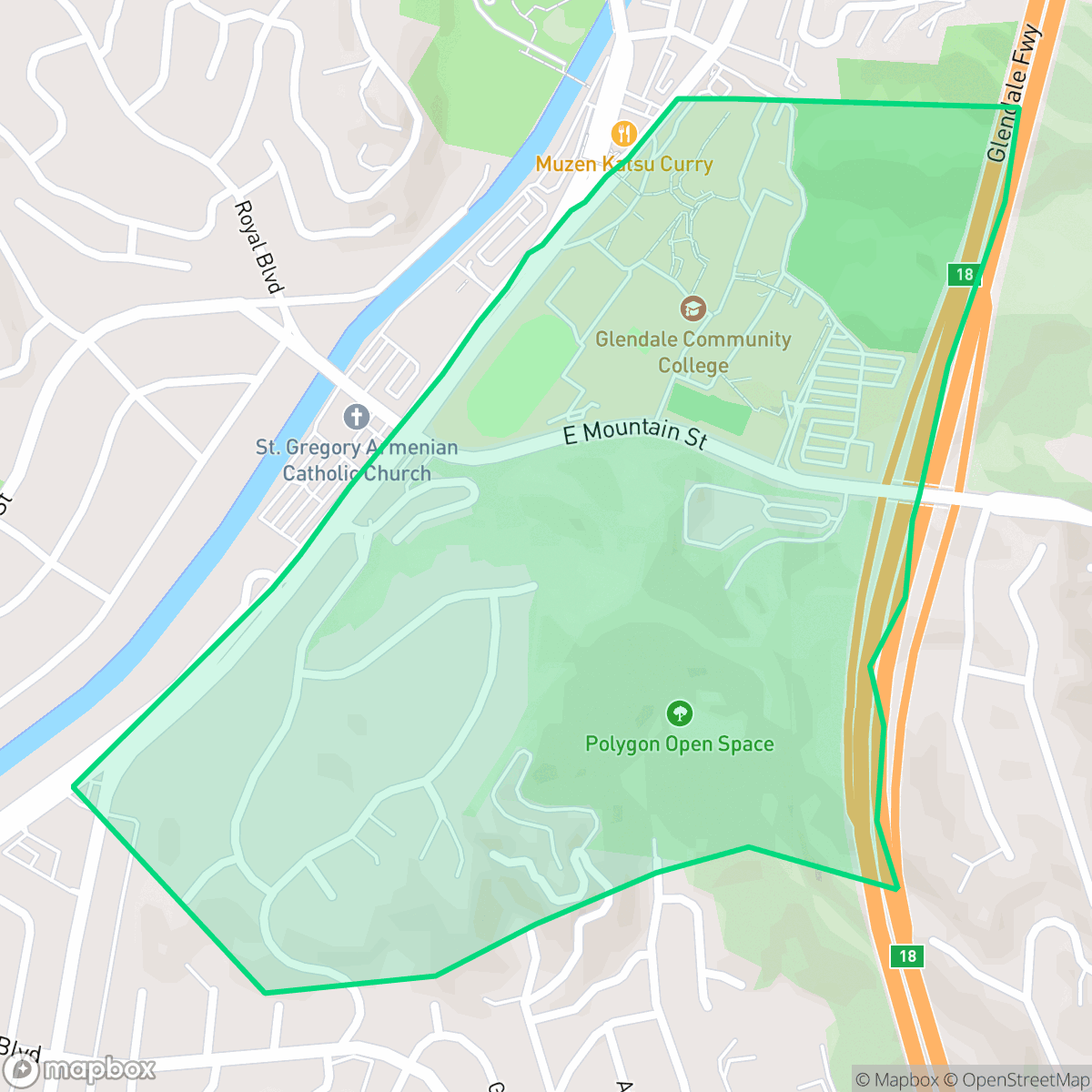
Situated in the San Rafael Hills of Glendale, California, just south of Glendale Community College, College Hills is an upscale hillside neighborhood largely developed in the late 1960s. The area is historically defined by the devastating College Hills Fire of June 27, 1990. Driven by 110-degree temperatures and dry winds, the firestorm destroyed dozens of homes and caused roughly $40 million to $50 million in damage. The disaster was later revealed to be the work of Glendale Fire Captain and notorious serial arsonist John Orr. Culturally, College Hills has evolved into a diverse community with a particularly prominent Armenian-American presence, representing more than 20% of the neighborhood's population.
This upscale neighborhood is defined by its elevated position in the San Rafael Hills, providing residents with expansive views and a secluded, suburban atmosphere. The area is characterized by low-density housing and ample green spaces, creating a distinct separation from the urban core of Glendale. It is positioned near Glendale Community College, making it a convenient location for those connected to the institution. Prospective residents should consider the trade-offs between the area's visual charm and its acoustic environment. Data indicates that the neighborhood faces elevated noise levels from nearby road traffic, which significantly impacts acoustic comfort. Furthermore, while the area is highly rated for its dog-friendliness and overall air quality, it remains in a zone with specific fire safety considerations. It is best suited for those who prioritize scenic, quiet residential streets and pet-friendly amenities over central urban walkability.
Neighborhood Scores Across 15 Qualities
Homes feature varying levels of separation, with hillside properties offering more buffer than denser commercial zones. According to iHuus data, this level of spacing provides more privacy than the typical Glendale neighborhood.
Residential streets feature established sidewalks and low traffic, though hilly terrain and freeway barriers may impact ease of movement. This area is slightly less walkable than the Glendale average.
Large hillside residences with private pools and manicured landscapes characterize the area. According to iHuus data, the visual quality of the neighborhood is notably higher than the Glendale average.
Abundant access to large hillside nature preserves and wooded trails provides significant opportunities for pet exercise. According to iHuus data, these connected green spaces and safe, traffic-free paths make the area much more dog friendly than the Glendale average.
Frequent open land and significant hillside vegetation provide a more open, semi-rural feel than most parts of Glendale. Residents will find scattered homes situated among woodland and hilly terrain according to iHuus data.
Low-density residential blocks and significant open spaces create a tranquil environment, though social activity and commercial density are notably lower than the Glendale average. Most residents will find the area revolves around essential local services and quiet streets rather than high-energy social hubs.
Frequent noise from nearby freeway traffic and rail lines characterizes the area. This level of acoustic disturbance is notably higher than the Glendale average, according to iHuus data.
Air quality in this area is consistently good with only rare instances of elevated readings. This level of air cleanliness is consistent with the average found throughout Glendale.
Industrial activity and warehouses are entirely absent from this area, making it more residential-focused than the Glendale average. According to iHuus data, the neighborhood consists solely of residential and recreational spaces with no detected industrial hazards.
Health insurance access is widespread among residents, sitting well above the Glendale average according to iHuus data.
Political leanings in this area are primarily liberal, though the concentration is slightly lower than the average found throughout Glendale. According to iHuus data, a modest opposing presence exists within the community.
Residents live alongside a balanced mix of young professionals, families, and seniors. This age distribution is consistent with the average seen across Glendale.
Flood risk levels remain undetermined due to a lack of detailed federal studies, though the area shows a slightly higher risk profile than much of Glendale. Residents should remain aware of potential vulnerabilities as official assessments are currently unavailable according to iHuus data.
Fire hazards in this area are significantly higher than the Glendale average, necessitating extreme precaution and robust protection measures. According to iHuus data, the surrounding landscape presents a severe risk level for residents.
Address-Level Insights for College HIlls


iHuus Neighborhood Intelligence Insights
Get address-level neighborhood insights for College HIlls
- Street-level scores — see how individual blocks compare, not just neighborhood averages
- Micro-zone boundaries — identify quiet pockets, flood boundaries, and walkable clusters before you visit
- 15 dimensions in full — walkability, noise, air quality, school quality, insurance coverage, population age profile, urban/rural index, and more
- Boundary risk alerts — know if your address sits near a block boundary where scores drop, the kind of detail no listing will ever mention
- School insights — individual school ratings and insights, not just district-level data
- Compare before you commit — side-by-side data across neighborhoods, down to block precision
No credit card required
Compare with Any Neighborhood
| Dimension | College HIlls | Adams Hill |
|---|---|---|
| 🚶 Walkabilityavg 8.69 | ||
| 🔊 Acoustic Comfortavg 3.71 | ||
| 🤫 Privacy Indexavg 4.65 | ||
| 🎨 Visual Appealavg 6.99 | ||
| 🐕 Dog Friendlinessavg 5.3 | ||
| 🗺️ Urban-Rural Indexavg 6.32 | ||
| ✨ Neighborhood Vibeavg 5.1 | ||
| 🏥 Health Insurance Coverageavg 7.89 | ||
| 🌿 Air Qualityavg 8.01 | ||
| 🏭 Industrial Proximityavg 8.92 | ||
| 🌊 Flood Safetyavg 2.96 | ||
| 🗳️ Ideological Leanavg 8.52 | ||
| 👥 Population Age Profileavg 5.28 | ||
| 🔥 Fire Safetyavg 0.5 | ||
| 🏫 School Quality |
College HIlls Rankings
School Districts Serving College HIlls
School Insights for College HIlls
Below average outcomes; significant attendance and academic challenges.
School Insights
See what's really behind every school rating near College HIlls
- Individual school ratings — each school's own score with outcome context, not just a district average
- Enrollment & class size data — student-to-teacher ratio and how it compares to the state average
- Full demographics breakdown — ethnicity and gender composition for every school in the enrollment zone
- Every school in the district — all schools within the enrollment boundary ranked by rating, not just the closest one
- Grade levels & benchmarks — elementary through high school, with below/above state-average flags
No credit card required