Fresno High Roeding, Fresno
Updated · 64,368 residents
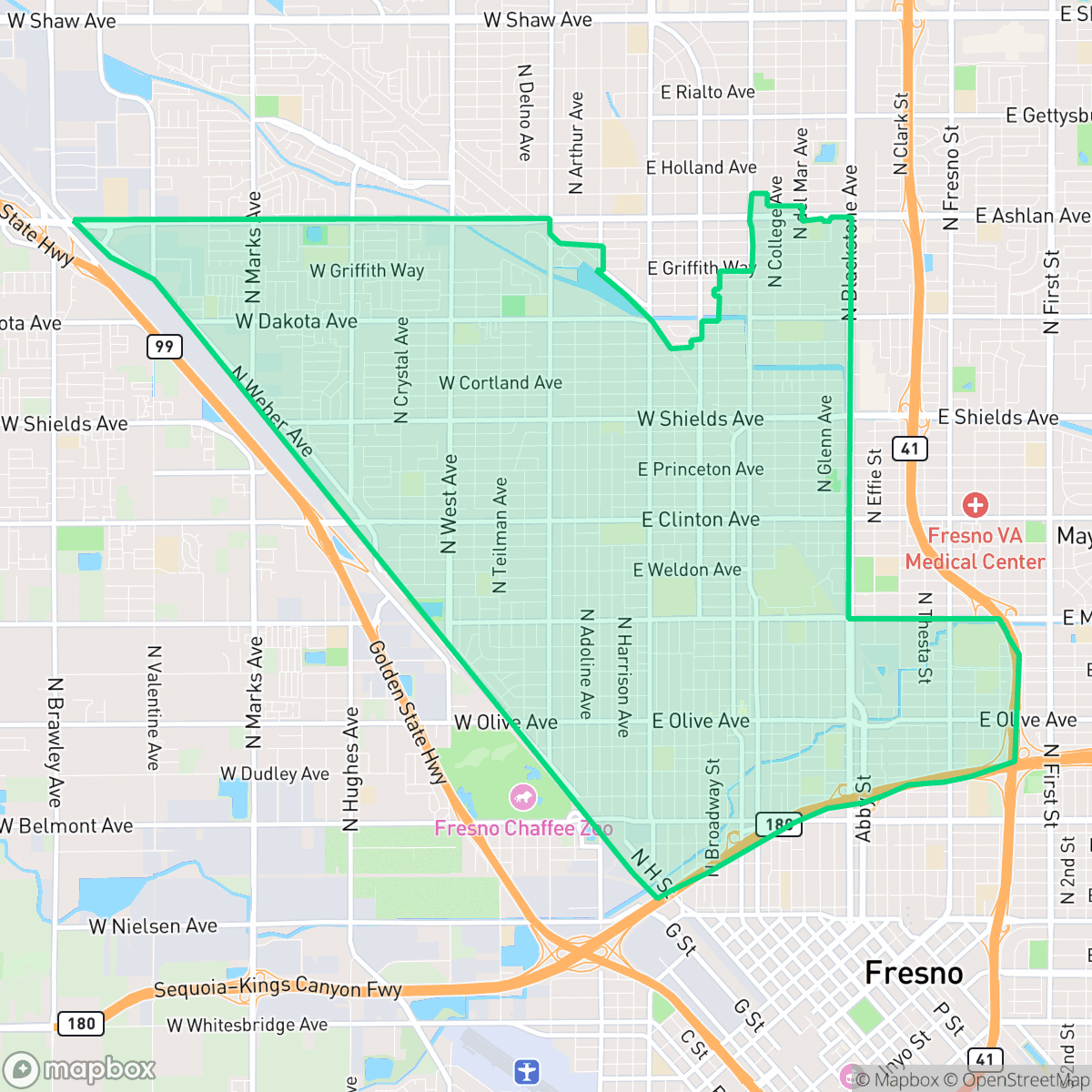
Fresno High Roeding is a historic, highly walkable neighborhood defined by its early 20th-century architectural charm and proximity to the expansive Roeding Park. Residents benefit from a consistent street grid and easy access to the vibrant Tower District, though the area features high-density housing with limited private outdoor space and moderate noise levels from local road traffic.
Key Highlights
About Fresno High Roeding
The Fresno High Roeding neighborhood in Fresno, California, is a historic, walkable community shaped by early 20th-century streetcar expansion. The area’s growth was accelerated by the 1912 opening of the Roeding trolley line, which connected the district to downtown and facilitated residential development. The neighborhood is anchored by Fresno High School, the oldest secondary school in the metropolitan area, which moved to its Echo Avenue campus in 1922, and the 90-acre Roeding Park, established in 1903 and designed by landscape architect Johannes Reimers. Architecturally diverse, the neighborhood features Craftsman bungalows, Spanish Revival, and Tudor homes, many built by the prominent Taylor-Wheeler company. Its southeastern corner transitions into the vibrant Tower District, centered around the landmark 1939 Art Deco Tower Theatre.
The neighborhood functions as a dense suburban environment where residential blocks of Craftsman and period-revival homes are closely spaced, often separated by less than ten meters. While the area offers excellent pedestrian connectivity through a well-maintained sidewalk grid, the overall atmosphere remains quiet and primarily residential. Local amenities are concentrated along major thoroughfares, and while residents enjoy proximity to significant cultural landmarks, most daily errands require a vehicle. The neighborhood maintains a stable, established feel, though it faces challenges typical of older urban-fringe areas, including air quality concerns and noise exposure from nearby transit corridors. The area is best suited for those who value historic character and walkability over expansive private yards or modern suburban amenities. Prospective residents should be aware that while the community is rich in architectural history and provides easy access to public green spaces like Roeding Park, the high-density layout results in limited privacy and shared fence lines. Prospective families may find a range of educational options within the local school district, though institutional performance varies significantly across the region.
Neighborhood Scores Across 15 Qualities
Residential structures are moderately spaced with some neighbors situated quite close together. According to iHuus data, this level of density is roughly in line with the city average.
Comprehensive sidewalk networks and clearly marked crosswalks make most residential streets easy to traverse on foot. While the area is largely comparable to the city average, large arterials and nearby highway infrastructure can create occasional barriers for pedestrians.
Residential scenery consists primarily of dense, uniform tract housing and mobile home parks with small yards. This area features less visual variety and fewer luxury amenities than the Fresno average.
Access to public space for pets is somewhat restricted as most greenery is contained within private fenced backyards. While some school fields and small parks are available, sidewalk verges are generally narrow, making the area slightly less dog friendly than the Fresno average.
Residential blocks feature a consistent pattern of single-family homes and low-rise structures with a level of openness similar to the Fresno average. The area primarily consists of a dense suburban grid rather than more rural, open landscapes.
Suburban blocks and industrial zones create a subdued atmosphere with limited walking options. Most daily errands and dining visits will require a vehicle, as the area sits slightly below the city average for social activity and density.
Proximity to a busy freeway and railroad tracks results in periodic noise disturbances. This level of acoustic disruption is roughly comparable to the average seen across Fresno.
Air quality in this area fluctuates between acceptable and unhealthy levels, appearing slightly lower than the Fresno average according to iHuus data. Sensitive groups may experience occasional health concerns during certain periods.
Residential and light commercial uses dominate the area with no significant heavy industrial presence. According to iHuus data, the neighborhood is slightly more free from large-scale manufacturing and industrial warehouses than the city average.
Health insurance accessibility in this area is slightly below the Fresno average. According to iHuus data, a significant majority of residents maintain active coverage.
Voting patterns and census indicators reflect a significantly more liberal political leaning than the Fresno city average, according to iHuus data.
Residents live alongside a balanced mix of young adults, families, and seniors. This demographic spread is largely consistent with the broader Fresno area according to iHuus data.
Located within a designated 100-year floodplain, this area carries a higher risk of flooding than much of Fresno. According to iHuus data, residents should be aware that flood insurance is typically required for properties in this zone.
Address-Level Insights for Fresno High Roeding


iHuus Neighborhood Intelligence Insights
Get address-level neighborhood insights for Fresno High Roeding
- Street-level scores — see how individual blocks compare, not just neighborhood averages
- Micro-zone boundaries — identify quiet pockets, flood boundaries, and walkable clusters before you visit
- 15 dimensions in full — walkability, noise, air quality, school quality, insurance coverage, population age profile, urban/rural index, and more
- Boundary risk alerts — know if your address sits near a block boundary where scores drop, the kind of detail no listing will ever mention
- School insights — individual school ratings and insights, not just district-level data
- Compare before you commit — side-by-side data across neighborhoods, down to block precision
No credit card required
Compare with Any Neighborhood
| Dimension | Fresno High Roeding | Bullard |
|---|---|---|
| 🚶 Walkabilityavg 8.26 | ||
| 🔊 Acoustic Comfortavg 3.54 | ||
| 🤫 Privacy Indexavg 5.3 | ||
| 🎨 Visual Appealavg 6.38 | ||
| 🐕 Dog Friendlinessavg 5.63 | ||
| 🗺️ Urban-Rural Indexavg 6.71 | ||
| ✨ Neighborhood Vibeavg 4.35 | ||
| 🏥 Health Insurance Coverageavg 7.05 | ||
| 🌿 Air Qualityavg 4.98 | ||
| 🏭 Industrial Proximityavg 7.91 | ||
| 🌊 Flood Safetyavg 2.48 | ||
| 🗳️ Ideological Leanavg 7.13 | ||
| 👥 Population Age Profileavg 4.51 | ||
| 🔥 Fire Safetyavg 0.01 | ||
| 🏫 School Quality |
Fresno High Roeding Rankings
School Districts Serving Fresno High Roeding
School Insights for Fresno High Roeding
Below average outcomes; significant attendance and academic challenges.
School Insights
See what's really behind every school rating near Fresno High Roeding
- Individual school ratings — each school's own score with outcome context, not just a district average
- Enrollment & class size data — student-to-teacher ratio and how it compares to the state average
- Full demographics breakdown — ethnicity and gender composition for every school in the enrollment zone
- Every school in the district — all schools within the enrollment boundary ranked by rating, not just the closest one
- Grade levels & benchmarks — elementary through high school, with below/above state-average flags
No credit card required