Bullard, Fresno
Updated · 111,664 residents
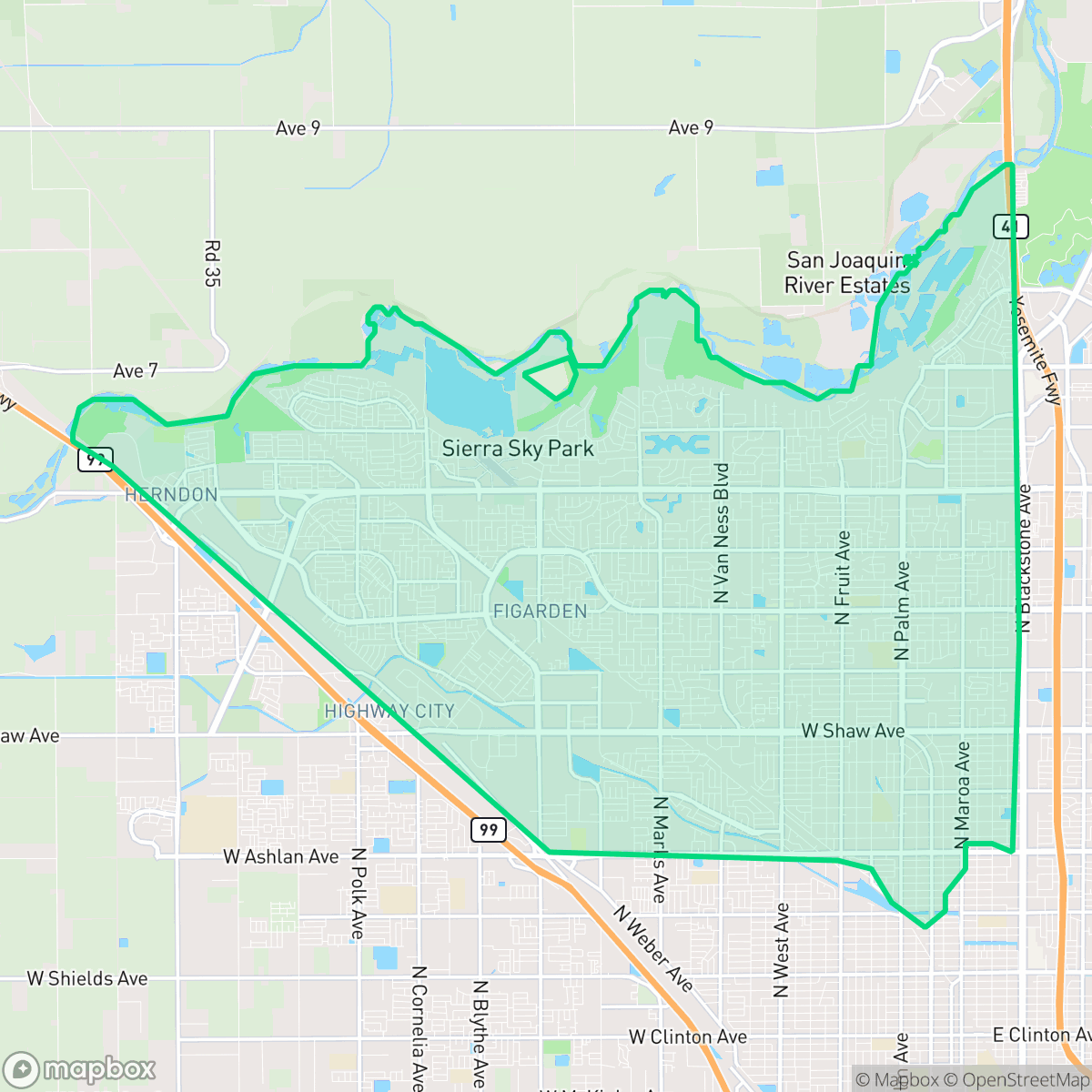
Bullard is an established suburban neighborhood in northwest Fresno, characterized by its dense residential layout and mature tree canopy. The area offers high walkability with a comprehensive sidewalk network, though residents experience standard suburban density with closely spaced homes.
Key Highlights
About Bullard
The Bullard neighborhood in northwest Fresno, California, originated from a vast tract of land acquired in 1891 by Frank Bullard, director of the Fresno Flume and Irrigation Company, and later inherited by his son, Edwin J. Bullard. Long considered a rural "hog wallow" with tough hardpan soil, the area underwent a massive transformation starting in 1912. Real estate developer Jesse Clayton "J.C." Forkner purchased the Bullard lands, using dynamite to blast through the hardpan to plant over 600,000 Calimyrna and Kadota fig trees, establishing the famed J.C. Forkner Fig Gardens. This agricultural-residential hybrid allowed suburbanites to own small, managed orchards. Originally served by its own independent school district, the Bullard area was annexed into the Fresno Unified School District in 1958. Today, the established neighborhood is defined by its historic agricultural roots and its central hub, Bullard High School, founded in 1955.
The neighborhood functions as a classic dense suburban environment, featuring a mix of single-family homes and apartment complexes. It maintains a well-developed sidewalk network that supports pedestrian activity, though the layout remains largely car-centric for reaching most commercial services. The visual landscape is marked by affluent homes with private pools and well-maintained landscaping, which contributes to a cohesive aesthetic across the residential blocks. The area is generally free from heavy industrial hazards, focusing instead on residential and light commercial use.
Residents benefit from high health insurance coverage and access to a variety of educational institutions, ranging from highly rated elementary schools to the central high school hub. While the area provides a calm residential rhythm, it is subject to standard suburban noise levels primarily from road traffic. Prospective residents should note that while the neighborhood is highly walkable, most daily errands require vehicle travel due to the distribution of local businesses. It is well-suited for families and individuals seeking a stable, established community with strong infrastructure.
Neighborhood Scores Across 15 Qualities
Residential spacing is typical for a suburban area, offering a moderate level of separation between neighbors. This density is slightly higher than the Fresno average, with some pockets featuring closely spaced homes and shared-wall structures.
Comprehensive sidewalk networks and marked crosswalks are present on both sides of most residential streets and arterial roads. This level of pedestrian infrastructure is slightly above the Fresno city average, providing reliable paths through residential blocks and park areas.
Manicured lawns and large homes with private pools characterize much of the area, providing a more polished aesthetic than the Fresno average. According to iHuus data, the presence of expansive driveways and well-maintained landscaping contributes to a premium visual environment.
Large central parks and wide residential grass verges provide ample opportunities for dog walking. According to iHuus data, these features make the area slightly more dog friendly than the Fresno average.
Residential tracts blend with open landscapes and agricultural areas, mirroring the broader Fresno urban-rural balance. Residents will find a mix of established suburban layouts and pockets of undeveloped land throughout the area.
A balanced mix of residential streets and green spaces provides a consistent pace of life. While local dining and essential services are present, many errands may require a car due to the low density of nearby businesses.
Steady traffic hum from nearby busy streets provides a level of acoustic activity slightly above the Fresno average. According to iHuus data, this creates a consistent background sound for residents.
Air quality in this area fluctuates between acceptable and unhealthy levels, performing slightly below the Fresno city average. Sensitive groups may experience occasional concern during periods of poor air circulation, according to iHuus data.
Largely composed of residential and light commercial spaces, this area lacks heavy industrial activity. While some parts of the neighborhood are near utility corridors or an EPA Superfund site, the overall industrial presence is slightly lower than the Fresno city average.
Health insurance accessibility is notably higher than the Fresno average, indicating a well-covered population according to iHuus data.
Political leanings in this area are more evenly split than the Fresno average, presenting a mix of conservative and liberal perspectives.
A balanced mix of young adults, families, and older residents characterizes the area, showing a slightly more varied age distribution than the Fresno average according to iHuus data.
Flood risk in this area is higher than the Fresno average, as portions of the neighborhood fall within a designated floodplain. Residents should be aware that flood insurance is typically required for properties in this zone, according to iHuus data.
Fire safety infrastructure and accessibility in this area is very low, sitting slightly below the city average according to iHuus data.
Address-Level Insights for Bullard


iHuus Neighborhood Intelligence Insights
Get address-level neighborhood insights for Bullard
- Street-level scores — see how individual blocks compare, not just neighborhood averages
- Micro-zone boundaries — identify quiet pockets, flood boundaries, and walkable clusters before you visit
- 15 dimensions in full — walkability, noise, air quality, school quality, insurance coverage, population age profile, urban/rural index, and more
- Boundary risk alerts — know if your address sits near a block boundary where scores drop, the kind of detail no listing will ever mention
- School insights — individual school ratings and insights, not just district-level data
- Compare before you commit — side-by-side data across neighborhoods, down to block precision
No credit card required
Compare with Any Neighborhood
| Dimension | Bullard | Central |
|---|---|---|
| 🚶 Walkabilityavg 8.26 | ||
| 🔊 Acoustic Comfortavg 3.54 | ||
| 🤫 Privacy Indexavg 5.3 | ||
| 🎨 Visual Appealavg 6.38 | ||
| 🐕 Dog Friendlinessavg 5.63 | ||
| 🗺️ Urban-Rural Indexavg 6.71 | ||
| ✨ Neighborhood Vibeavg 4.35 | ||
| 🏥 Health Insurance Coverageavg 7.05 | ||
| 🌿 Air Qualityavg 4.98 | ||
| 🏭 Industrial Proximityavg 7.91 | ||
| 🌊 Flood Safetyavg 2.48 | ||
| 🗳️ Ideological Leanavg 7.13 | ||
| 👥 Population Age Profileavg 4.51 | ||
| 🔥 Fire Safetyavg 0.01 | ||
| 🏫 School Quality |
Bullard Rankings
School Districts Serving Bullard
School Insights for Bullard
Below average outcomes; significant attendance and academic challenges.
School Insights
See what's really behind every school rating near Bullard
- Individual school ratings — each school's own score with outcome context, not just a district average
- Enrollment & class size data — student-to-teacher ratio and how it compares to the state average
- Full demographics breakdown — ethnicity and gender composition for every school in the enrollment zone
- Every school in the district — all schools within the enrollment boundary ranked by rating, not just the closest one
- Grade levels & benchmarks — elementary through high school, with below/above state-average flags
No credit card required