Weibel, Fremont
Updated · 3,664 residents
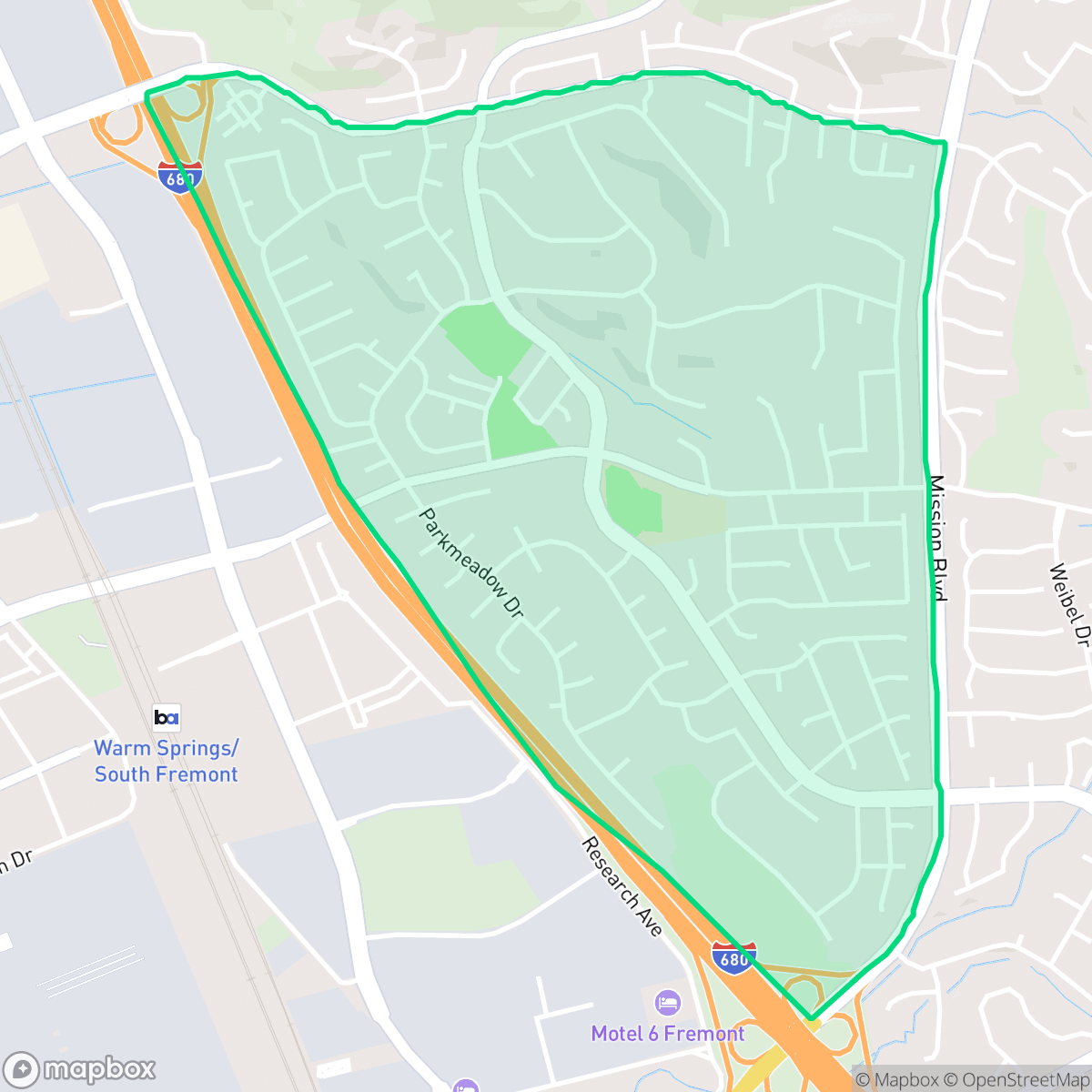
Weibel is a quiet residential enclave in southeastern Fremont characterized by its mid-century ranch and split-level homes. While the area offers high visual appeal and access to top-rated local schools, residents should expect moderate noise levels from nearby road traffic. It serves as a stable, well-insured community suited for those seeking a suburban environment with limited commercial density.
Key Highlights
About Weibel
Located in southeastern Fremont, the Weibel neighborhood is deeply rooted in California’s viticultural history. The area was originally home to the historic Leland Stanford Winery, founded in 1869 by California Governor Leland Stanford. In 1946, Swiss immigrant Fred E. Weibel Sr. purchased the decaying 100-acre vineyard, revitalizing it into the renowned Weibel Champagne Vineyards. The winery operated as the last vestige of the area's agricultural past until 1996, when operations relocated. Following this, the historic vineyards were transformed into an upscale residential community featuring California ranch and split-level homes built primarily between 1961 and 1989, alongside the 1995 Vintage Grove development. Today, the neighborhood's heritage is preserved in the name of Fred E. Weibel Elementary School and the original Stanford-era brick winery, which still stands at the end of Stanford Lane.
The neighborhood functions as a predominantly residential pocket that balances suburban quiet with proximity to major commuting routes. It benefits from high aesthetic standards and a strong sense of community stability, reflected in near-universal health insurance coverage among residents. The streetscape is defined by well-maintained homes and open green spaces, providing a visually pleasing environment that ranks above the city average. This area remains a stable choice for those prioritizing a settled residential character over immediate access to urban services.
Prospective residents should note that the area is car-dependent, as local amenities are sparse and there is no dense commercial core. Acoustic comfort is influenced by road traffic, which contributes to an average noise level of 61 decibels. While the neighborhood offers a peaceful atmosphere, it is best suited for families or professionals who prioritize access to high-performing schools and a consistent, quiet living environment.
Neighborhood Scores Across 15 Qualities
Housing layouts offer a balanced mix of spacing and buffer zones between neighbors. According to iHuus data, this level of separation is higher than the typical density found elsewhere in Fremont.
Pedestrian infrastructure is excellent, featuring wide sidewalks on both sides of the street and numerous ample crossings. This level of accessibility is nearly identical to the Fremont average, according to iHuus data.
Spacious driveways and large homes characterize the area, providing a more polished streetscape than the Fremont average. Frequent access to upscale amenities contributes to an aesthetically pleasing environment according to iHuus data.
Connected green spaces and wide, traffic-safe paths make this area more suitable for pet owners than the Fremont average, according to iHuus data.
Frequent open land and scattered homes amid woodlands characterize this area. This landscape offers a more open environment than much of Fremont, according to iHuus data.
Low-density residential blocks and light industrial zones create a quiet atmosphere, but a lack of local commercial hubs makes the area notably less lively than the Fremont average. Residents will primarily rely on vehicles for most errands due to the sparse distribution of businesses and services.
Frequent sounds from nearby railroad tracks and major freeways characterize the area. According to iHuus data, acoustic comfort is notably lower than the average for Fremont.
Air quality levels in Weibel are generally acceptable, though they occasionally reach levels that may cause concern for sensitive groups. According to iHuus data, the air quality in this area is slightly better than the Fremont city average.
Industrial activity is virtually non-existent in this area, as the neighborhood contains no detected warehouses or hazard sites. This lack of industrial presence is slightly lower than the Fremont average, though the area remains almost exclusively residential.
Health insurance access is nearly universal among residents in Weibel, representing a higher rate of coverage than the Fremont city average according to iHuus data.
Voting patterns and census indicators in Weibel reflect a predominantly liberal political leaning, which is consistent with the broader Fremont area according to iHuus data.
A balanced mix of young adults, families, and seniors characterizes the local demographic. This population distribution is slightly more varied than the average found across Fremont.
Properties in this area are located within a designated floodplain, which may necessitate flood insurance. According to iHuus data, the risk level is slightly higher than the Fremont average.
Address-Level Insights for Weibel


iHuus Neighborhood Intelligence Insights
Get address-level neighborhood insights for Weibel
- Street-level scores — see how individual blocks compare, not just neighborhood averages
- Micro-zone boundaries — identify quiet pockets, flood boundaries, and walkable clusters before you visit
- 15 dimensions in full — walkability, noise, air quality, school quality, insurance coverage, population age profile, urban/rural index, and more
- Boundary risk alerts — know if your address sits near a block boundary where scores drop, the kind of detail no listing will ever mention
- School insights — individual school ratings and insights, not just district-level data
- Compare before you commit — side-by-side data across neighborhoods, down to block precision
No credit card required
Compare with Any Neighborhood
| Dimension | Weibel | 28 Palms |
|---|---|---|
| 🚶 Walkabilityavg 9.3 | ||
| 🔊 Acoustic Comfortavg 3.38 | ||
| 🤫 Privacy Indexavg 5.09 | ||
| 🎨 Visual Appealavg 6.63 | ||
| 🐕 Dog Friendlinessavg 7.76 | ||
| 🗺️ Urban-Rural Indexavg 6.78 | ||
| ✨ Neighborhood Vibeavg 4.75 | ||
| 🏥 Health Insurance Coverageavg 8.99 | ||
| 🌿 Air Qualityavg 5.76 | ||
| 🏭 Industrial Proximityavg 8.97 | ||
| 🌊 Flood Safetyavg 3.62 | ||
| 🗳️ Ideological Leanavg 9.57 | ||
| 👥 Population Age Profileavg 4.91 | ||
| 🔥 Fire Safetyavg 0.2 | ||
| 🏫 School Quality |
Weibel Rankings
School Districts Serving Weibel
School Insights for Weibel
Below average outcomes; significant attendance and academic challenges.
School Insights
See what's really behind every school rating near Weibel
- Individual school ratings — each school's own score with outcome context, not just a district average
- Enrollment & class size data — student-to-teacher ratio and how it compares to the state average
- Full demographics breakdown — ethnicity and gender composition for every school in the enrollment zone
- Every school in the district — all schools within the enrollment boundary ranked by rating, not just the closest one
- Grade levels & benchmarks — elementary through high school, with below/above state-average flags
No credit card required