Warm Springs, Fremont
Updated · 7,583 residents
Warm Springs is a highly walkable neighborhood in Fremont that blends suburban living with modern transit access. While it offers residents excellent proximity to top-rated schools and regional employment hubs, the area experiences significant noise from nearby road traffic.
Key Highlights
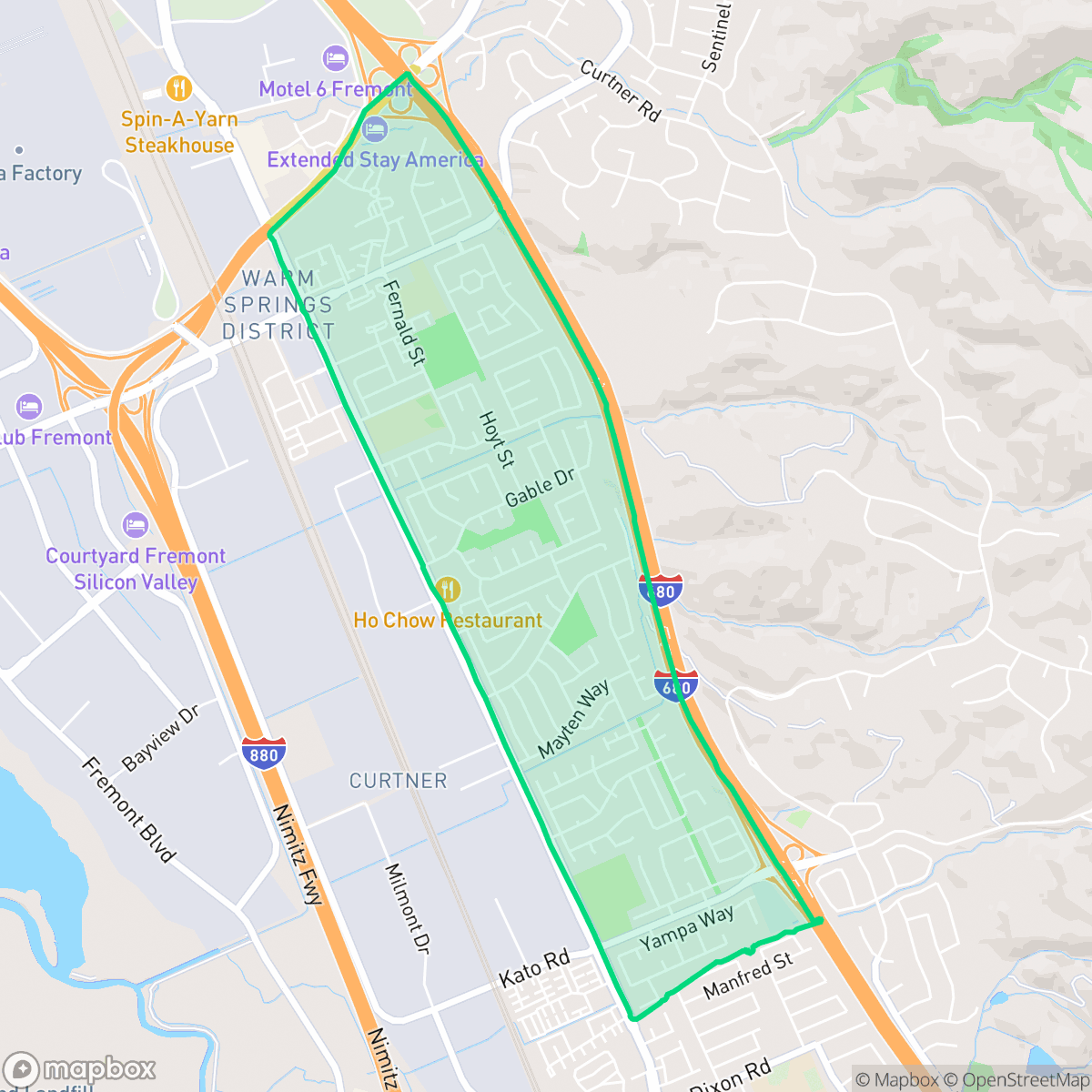
About Warm Springs
Long before European settlement, the Ohlone people utilized the local thermal waters of the Warm Springs area for medicinal purposes. In 1839, the land became part of Fulgencio Higuera’s Rancho del Agua Caliente. Entrepreneur Clemente Columbet purchased the property in 1850 and established the Warm Springs Hotel, a premier West Coast spa resort that attracted wealthy San Franciscans, including Domingo Ghirardelli and Pio Pico. Leland Stanford later purchased the property in 1870, where his brother Josiah developed extensive vineyards and a winery. Warm Springs was one of five individual townships that incorporated in 1956 to form the city of Fremont. Today, the neighborhood preserves its heritage through landmarks like the Rancho Higuera Adobe and the Curtner Mansion, while evolving into a modern innovation hub anchored by the Tesla Fremont Factory and the Warm Springs/South Fremont BART station.
The neighborhood serves as a key innovation center in Fremont, anchored by the Warm Springs/South Fremont BART station and the presence of major technology manufacturing facilities. The landscape features a mix of standard tract housing and apartment complexes, creating a dense suburban environment that prioritizes pedestrian connectivity. According to iHuus data, the area maintains a high level of walkability, allowing residents to navigate between residential zones and retail centers with ease. Families are particularly drawn to the region for its access to high-performing schools, including several institutions that consistently achieve top academic ratings.
Living in this area involves specific trade-offs regarding the environment and infrastructure. While the community is well-connected, the proximity to major transit corridors results in elevated noise levels from road traffic throughout the day. Residents should also be aware that the neighborhood faces challenges related to flood and fire safety, which are important considerations for long-term housing decisions. Despite these factors, the combination of strong educational resources and transit accessibility makes the area a notable choice for professionals and families seeking a central Silicon Valley location. iHuus data reflects a community that balances its industrial history with a modern, commuter-focused lifestyle.
Neighborhood Scores Across 15 Qualities
Residential spacing is varied, with some houses situated closely together. According to iHuus data, this level of separation is slightly lower than the Fremont average.
Continuous sidewalk networks and clear crosswalks connect residential streets to local commercial zones. According to iHuus data, the pedestrian infrastructure in Warm Springs is nearly identical to the city average.
Property aesthetics range from large homes with manicured landscapes and private pools to denser, more uniform tract housing. Overall visual appeal is slightly below the Fremont average according to iHuus data.
Abundant public parks and connected green buffers provide ample space for walking pets. According to iHuus data, these accessible walking paths and grass fields offer a level of dog friendliness that is nearly on par with the Fremont average.
Residential tracts feature a mix of single-family homes and industrial warehouses, reflecting a landscape that is consistent with the Fremont average. According to iHuus data, the area provides a transition between dense suburban developments and larger commercial zones.
Low-density residential blocks and industrial units create a tranquil atmosphere, though the area lacks the consistent commercial energy found elsewhere in Fremont. While some social hubs and dining options are accessible, the neighborhood's layout relies heavily on vehicle use for most errands.
Frequent noise from nearby railroad tracks and heavy freeway traffic characterizes this area. According to iHuus data, acoustic comfort is significantly lower than the Fremont city average.
Air quality in this area fluctuates between acceptable and unhealthy levels, which is slightly lower than the Fremont average. Sensitive individuals should monitor local conditions, as occasional periods of concern are noted in iHuus data.
Residential and light commercial areas dominate the landscape, offering an environment largely free from heavy manufacturing. While some logistics hubs and warehouses are visible on the western edges, the area is slightly more exposed to light industrial activity than the Fremont average.
Health insurance access is widespread among residents, aligning with the broader Fremont average according to iHuus data.
Voting patterns and census indicators reflect a predominantly liberal political landscape, mirroring the broader trends seen across Fremont.
Residents live among a diverse mix of young adults, families, and seniors. This age distribution is consistent with the broader Fremont area, according to iHuus data.
Significant flood risk exists here because parts of the area fall within a designated floodplain; according to iHuus data, this risk is notably higher than the Fremont city average.
Extreme fire hazards are present in this area, representing a significantly higher risk level than the Fremont average according to iHuus data.
Address-Level Insights for Warm Springs


iHuus Neighborhood Intelligence Insights
Get address-level neighborhood insights for Warm Springs
- Street-level scores — see how individual blocks compare, not just neighborhood averages
- Micro-zone boundaries — identify quiet pockets, flood boundaries, and walkable clusters before you visit
- 15 dimensions in full — walkability, noise, air quality, school quality, insurance coverage, population age profile, urban/rural index, and more
- Boundary risk alerts — know if your address sits near a block boundary where scores drop, the kind of detail no listing will ever mention
- School insights — individual school ratings and insights, not just district-level data
- Compare before you commit — side-by-side data across neighborhoods, down to block precision
No credit card required
Compare with Any Neighborhood
| Dimension | Warm Springs | 28 Palms |
|---|---|---|
| 🚶 Walkabilityavg 9.3 | ||
| 🔊 Acoustic Comfortavg 3.38 | ||
| 🤫 Privacy Indexavg 5.09 | ||
| 🎨 Visual Appealavg 6.63 | ||
| 🐕 Dog Friendlinessavg 7.76 | ||
| 🗺️ Urban-Rural Indexavg 6.78 | ||
| ✨ Neighborhood Vibeavg 4.75 | ||
| 🏥 Health Insurance Coverageavg 8.99 | ||
| 🌿 Air Qualityavg 5.76 | ||
| 🏭 Industrial Proximityavg 8.97 | ||
| 🌊 Flood Safetyavg 3.62 | ||
| 🗳️ Ideological Leanavg 9.57 | ||
| 👥 Population Age Profileavg 4.91 | ||
| 🔥 Fire Safetyavg 0.2 | ||
| 🏫 School Quality |
Warm Springs Rankings
School Districts Serving Warm Springs
School Insights for Warm Springs
Below average outcomes; significant attendance and academic challenges.
School Insights
See what's really behind every school rating near Warm Springs
- Individual school ratings — each school's own score with outcome context, not just a district average
- Enrollment & class size data — student-to-teacher ratio and how it compares to the state average
- Full demographics breakdown — ethnicity and gender composition for every school in the enrollment zone
- Every school in the district — all schools within the enrollment boundary ranked by rating, not just the closest one
- Grade levels & benchmarks — elementary through high school, with below/above state-average flags
No credit card required