Vineyards-Avalon, Fremont
Updated · 7,213 residents
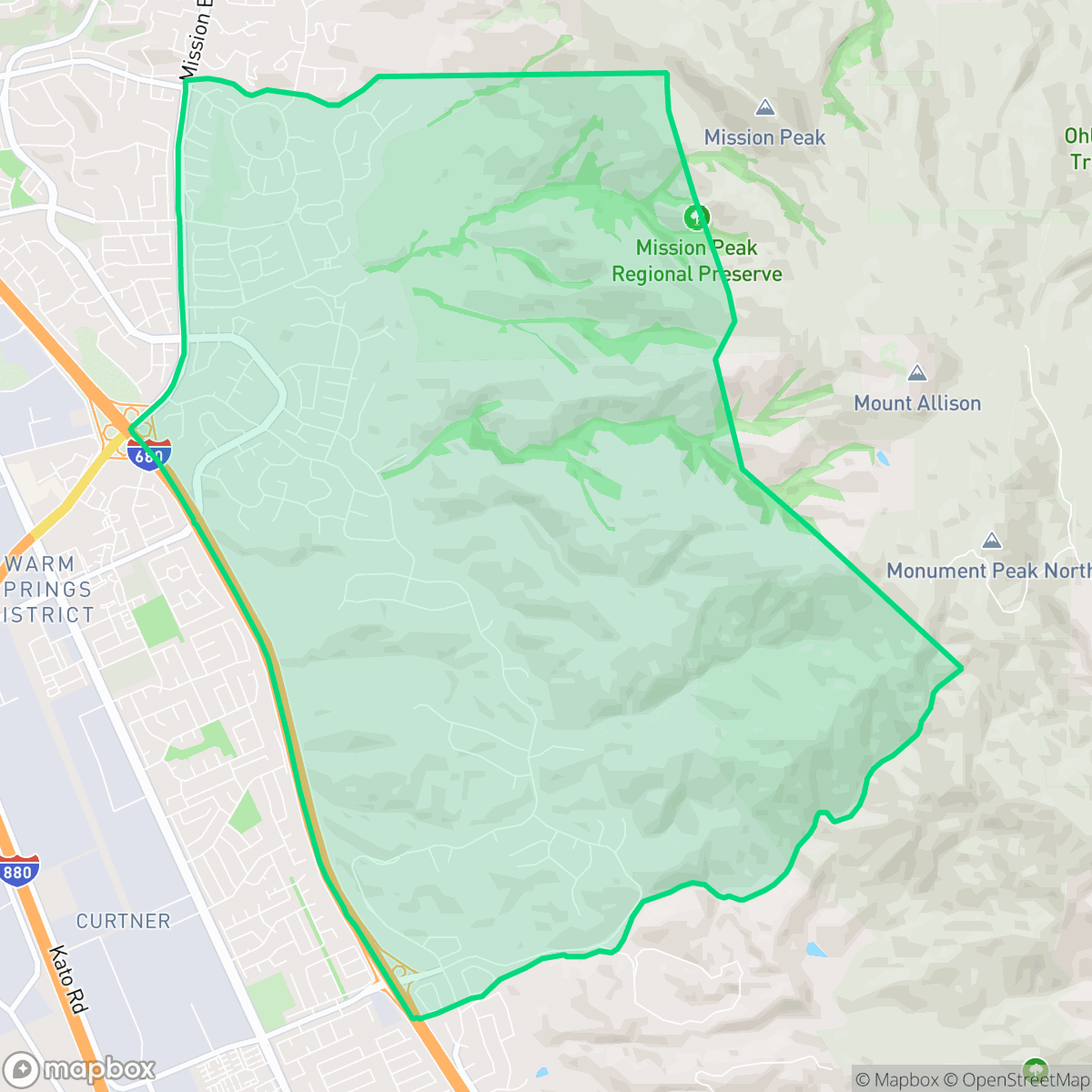
Vineyards-Avalon is a quiet, low-density residential neighborhood in southern Fremont defined by its expansive open spaces and suburban character. While the area offers high walkability and excellent access to health insurance, residents should be aware of significant road noise and elevated fire safety risks.
Key Highlights
About Vineyards-Avalon
Nestled in the hills of south Fremont, the upscale Vineyards-Avalon neighborhood occupies land steeped in California’s early viticultural and rancho history. The area was originally part of an 1840s land grant to Fulgencio Higuera. Today, the neighborhood's Rancho Higuera Historical Park preserves the historic Galindo-Higuera Adobe, one of the last remaining Spanish-Mexican era structures in the region. In 1869, railroad tycoon Leland Stanford purchased property here to establish the Leland Stanford Winery, which produced California’s first sparkling wine. The estate was acquired in 1945 by Weibel Champagne Vineyards, which operated on-site until relocating in 1996. The historic vineyards were subsequently cleared to build the luxurious Avalon residential subdivision, giving the modern neighborhood its name.
The neighborhood maintains a serene, rural-leaning aesthetic despite its proximity to major industrial zones and transit corridors. It is characterized by spacious, low-density housing blocks that provide a quiet environment for residents, though this comes at the cost of limited local commercial activity. The area is highly regarded for its visual appeal and is well-suited for dog owners, thanks to the abundance of open space and greenery integrated into the residential layout.
Prospective residents should note that the area experiences high levels of traffic noise, which may impact acoustic comfort. While the neighborhood is physically walkable, the lack of local services means that daily errands often require a vehicle. The community is well-served by nearby high-performing school districts, making it a stable choice for families, though the elevated fire safety risk is a factor to consider for long-term planning.
Neighborhood Scores Across 15 Qualities
Residential spacing is mixed, with some homes situated closely together while others maintain a buffer from neighbors. According to iHuus data, the level of privacy in this area is slightly higher than the Fremont average.
Continuous sidewalks and clear crosswalks make navigating the area on foot easy and safe. This level of pedestrian accessibility is comparable to the broader Fremont area.
Large homes with manicured landscapes and private pools characterize the area, providing a level of visual appeal that is notably higher than the Fremont average.
Extensive public parks and connected green spaces provide ample area for pet exercise. According to iHuus data, the abundance of wide paths and sidewalk verges makes this neighborhood more dog friendly than the Fremont average.
Frequent open land and scattered homes amid greenery provide a more semi-rural atmosphere than the typical suburban sprawl found elsewhere in Fremont. This layout offers significant green buffers and a sense of space that is more pronounced than the city average, according to iHuus data.
Low-density residential blocks and vast open spaces create a serene environment, but the lack of local businesses makes the area significantly less lively than the Fremont average. Most daily needs require driving, as the neighborhood features very few commercial hubs or walkable social centers.
Frequent noise from a nearby freeway and railroad tracks makes this area significantly louder than the Fremont average, according to iHuus data.
Air quality in this area fluctuates between acceptable and unhealthy levels, sitting slightly below the Fremont average. Sensitive groups may experience occasional concerns during certain periods, according to iHuus data.
Industrial presence is virtually nonexistent here, offering a quiet environment free from warehouses or heavy manufacturing. According to iHuus data, this area is slightly more secluded from industrial activity than the rest of Fremont.
Health insurance access is nearly universal among residents, standing well above the Fremont city average according to iHuus data.
Voting patterns and census indicators reflect a predominantly liberal community, which is very similar to the broader Fremont area according to iHuus data.
Residents live alongside a balanced mix of young professionals, families, and seniors. According to iHuus data, this demographic variety is slightly higher than the Fremont average.
Flood risk in this area is currently considered moderate because a detailed study has not yet been completed by FEMA. According to iHuus data, the level of uncertainty here is slightly higher than the average for Fremont.
Extreme fire hazards exist within this area, representing a significantly higher danger level than the Fremont average. Residents should prioritize maximum protection measures and emergency preparedness according to iHuus data.
Address-Level Insights for Vineyards-Avalon


iHuus Neighborhood Intelligence Insights
Get address-level neighborhood insights for Vineyards-Avalon
- Street-level scores — see how individual blocks compare, not just neighborhood averages
- Micro-zone boundaries — identify quiet pockets, flood boundaries, and walkable clusters before you visit
- 15 dimensions in full — walkability, noise, air quality, school quality, insurance coverage, population age profile, urban/rural index, and more
- Boundary risk alerts — know if your address sits near a block boundary where scores drop, the kind of detail no listing will ever mention
- School insights — individual school ratings and insights, not just district-level data
- Compare before you commit — side-by-side data across neighborhoods, down to block precision
No credit card required
Compare with Any Neighborhood
| Dimension | Vineyards-Avalon | 28 Palms |
|---|---|---|
| 🚶 Walkabilityavg 9.3 | ||
| 🔊 Acoustic Comfortavg 3.38 | ||
| 🤫 Privacy Indexavg 5.09 | ||
| 🎨 Visual Appealavg 6.63 | ||
| 🐕 Dog Friendlinessavg 7.76 | ||
| 🗺️ Urban-Rural Indexavg 6.78 | ||
| ✨ Neighborhood Vibeavg 4.75 | ||
| 🏥 Health Insurance Coverageavg 8.99 | ||
| 🌿 Air Qualityavg 5.76 | ||
| 🏭 Industrial Proximityavg 8.97 | ||
| 🌊 Flood Safetyavg 3.62 | ||
| 🗳️ Ideological Leanavg 9.57 | ||
| 👥 Population Age Profileavg 4.91 | ||
| 🔥 Fire Safetyavg 0.2 | ||
| 🏫 School Quality |
Vineyards-Avalon Rankings
School Districts Serving Vineyards-Avalon
School Insights for Vineyards-Avalon
Below average outcomes; significant attendance and academic challenges.
School Insights
See what's really behind every school rating near Vineyards-Avalon
- Individual school ratings — each school's own score with outcome context, not just a district average
- Enrollment & class size data — student-to-teacher ratio and how it compares to the state average
- Full demographics breakdown — ethnicity and gender composition for every school in the enrollment zone
- Every school in the district — all schools within the enrollment boundary ranked by rating, not just the closest one
- Grade levels & benchmarks — elementary through high school, with below/above state-average flags
No credit card required