Niles, Fremont
Updated · 7,645 residents
Niles is a historic, quiet neighborhood in Fremont defined by its blend of rural landscapes and suburban charm. It features high walkability and exceptional dog-friendliness, though residents should note the elevated noise levels from nearby rail traffic and specific fire safety considerations.
Key Highlights
About Niles
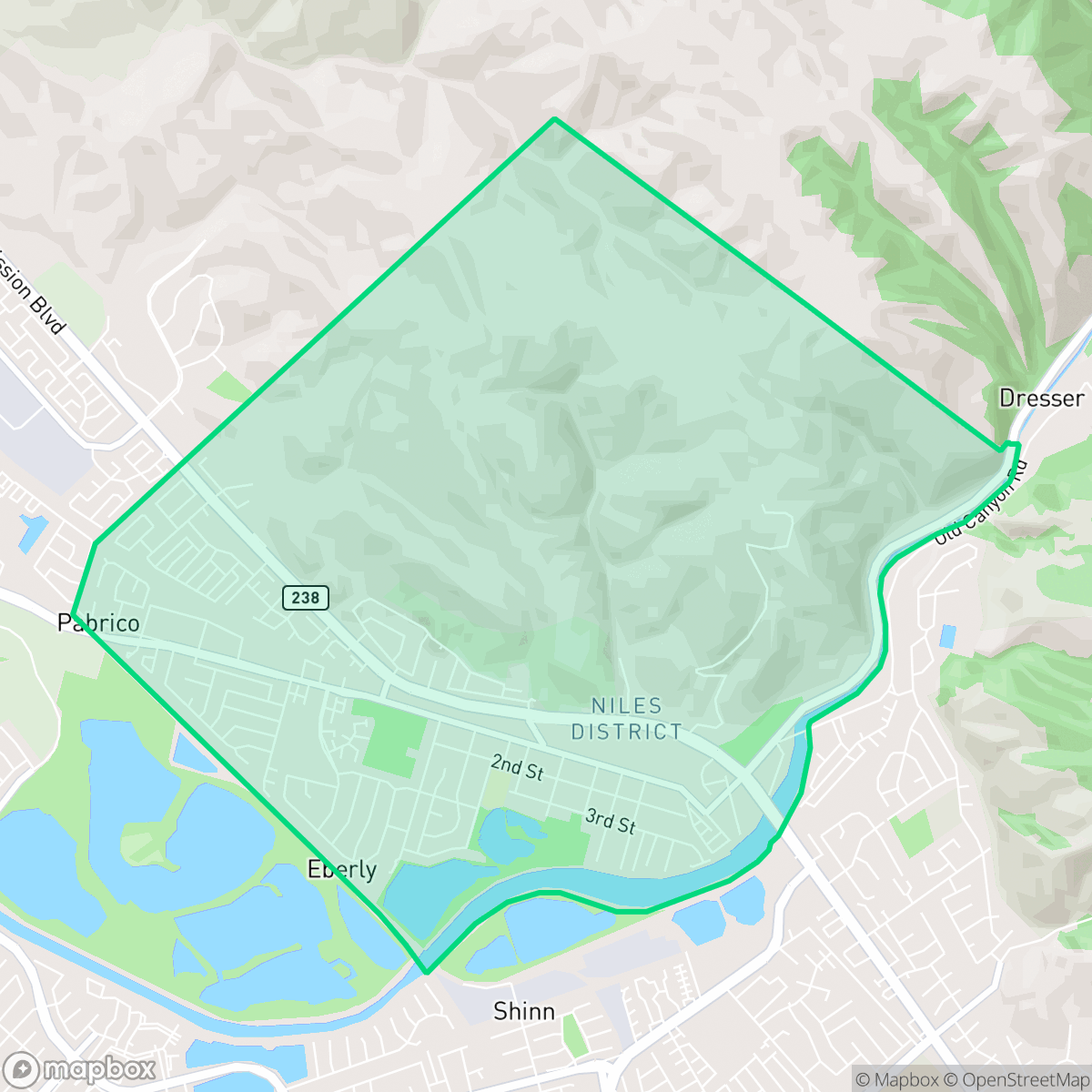
Established in the 1850s around Vallejo’s Mill, the Niles neighborhood of Fremont, California, developed as a crucial 19th-century railroad junction for the Southern Pacific Railroad. In 1912, it became a pioneer of California's early motion picture industry when the Essanay Film Manufacturing Company opened its West Coast studio here. Silent film legends like Charlie Chaplin and Gilbert “Broncho Billy” Anderson utilized the scenic Niles Canyon for films like *The Tramp*. Niles was also home to the massive California Nursery Company, which supplied plants for landmarks like Hearst Castle. Incorporated into Fremont in 1956, the neighborhood preserves its distinct historic character along Niles Boulevard, a walkable four-block stretch filled with antique shops, the Niles Town Plaza, a historic train depot, and the Niles Essanay Silent Film Museum.
The area maintains a calm, low-density atmosphere where residential blocks are interspersed with significant open green space and light industrial units. Local life centers around accessible social spots like Niles Community Park and neighborhood cafes, providing a serene environment that contrasts with the busier parts of Fremont. The landscape is characterized by a mix of quiet streets and proximity to the railway, creating a distinct, slower-paced lifestyle that prioritizes community and outdoor access.
For those considering a move to the area, it is important to weigh the benefits of a highly walkable, pet-friendly environment against certain livability trade-offs. While the neighborhood boasts a top-tier elementary school, potential residents should be aware of the noise profile associated with nearby train activity and the local fire safety index. The area is particularly well-suited for individuals and families who value a tranquil, historic setting and proximity to nature over the convenience of a dense commercial district.
Neighborhood Scores Across 15 Qualities
Housing density is moderate with varying levels of separation between properties. While some areas feature shared walls in townhomes, most residents benefit from a slightly higher degree of spatial buffering compared to the Fremont average.
Safe, dedicated pedestrian paths and low-traffic cul-de-sacs make navigating the area on foot easy. This level of walkability is nearly on par with the rest of Fremont.
Residential areas feature a mix of standard suburban tract housing and larger homes with spacious driveways. According to iHuus data, the visual landscape is largely consistent with the city average.
Extensive greenbelts and trails provide significantly more space for pets than the Fremont average. While some residential sidewalks are narrow, the abundance of large parks makes the area highly suitable for dog owners.
Frequent open land and scattered homes amidst greenery provide a more open feel than the Fremont average. Residents will find a mix of dense suburban pockets and vast, undeveloped green spaces throughout the area.
Low-density residential blocks and significant open space create a tranquil environment, though the area offers less commercial activity than the Fremont average according to iHuus data.
Frequent noise from nearby railroad tracks and major freeway proximity creates a louder environment than the Fremont average, according to iHuus data.
Air quality in this area presents occasional concerns for sensitive groups, as levels are generally lower than the Fremont average according to iHuus data.
Residential life is largely undisturbed by heavy industry, though some warehouses and truck yards in the northern sector contribute to localized traffic and noise. This area maintains a lower level of industrial activity compared to the Fremont average, according to iHuus data.
Health insurance access is nearly universal among residents, staying slightly above the Fremont average according to iHuus data.
Voting patterns and census indicators reflect a predominantly liberal community, consistent with the broader political landscape of Fremont.
Residents of all ages live in this area, with a distribution of young adults, families, and seniors that is slightly more balanced than the Fremont average according to iHuus data.
Flood risk in this area is higher than the Fremont average, though precise levels remain undetermined because FEMA has not completed a detailed study for this specific location. Residents should exercise caution as official risk assessments for the area are currently unavailable according to iHuus data.
High wildfire hazards are present in this area, significantly higher than the Fremont average. Residents should prioritize maximum fire protection measures and emergency preparedness according to iHuus data.
Address-Level Insights for Niles


iHuus Neighborhood Intelligence Insights
Get address-level neighborhood insights for Niles
- Street-level scores — see how individual blocks compare, not just neighborhood averages
- Micro-zone boundaries — identify quiet pockets, flood boundaries, and walkable clusters before you visit
- 15 dimensions in full — walkability, noise, air quality, school quality, insurance coverage, population age profile, urban/rural index, and more
- Boundary risk alerts — know if your address sits near a block boundary where scores drop, the kind of detail no listing will ever mention
- School insights — individual school ratings and insights, not just district-level data
- Compare before you commit — side-by-side data across neighborhoods, down to block precision
No credit card required
Compare with Any Neighborhood
| Dimension | Niles | 28 Palms |
|---|---|---|
| 🚶 Walkabilityavg 9.3 | ||
| 🔊 Acoustic Comfortavg 3.38 | ||
| 🤫 Privacy Indexavg 5.09 | ||
| 🎨 Visual Appealavg 6.63 | ||
| 🐕 Dog Friendlinessavg 7.76 | ||
| 🗺️ Urban-Rural Indexavg 6.78 | ||
| ✨ Neighborhood Vibeavg 4.75 | ||
| 🏥 Health Insurance Coverageavg 8.99 | ||
| 🌿 Air Qualityavg 5.76 | ||
| 🏭 Industrial Proximityavg 8.97 | ||
| 🌊 Flood Safetyavg 3.62 | ||
| 🗳️ Ideological Leanavg 9.57 | ||
| 👥 Population Age Profileavg 4.91 | ||
| 🔥 Fire Safetyavg 0.2 | ||
| 🏫 School Quality |
Niles Rankings
School Districts Serving Niles
School Insights for Niles
Below average outcomes; significant attendance and academic challenges.
School Insights
See what's really behind every school rating near Niles
- Individual school ratings — each school's own score with outcome context, not just a district average
- Enrollment & class size data — student-to-teacher ratio and how it compares to the state average
- Full demographics breakdown — ethnicity and gender composition for every school in the enrollment zone
- Every school in the district — all schools within the enrollment boundary ranked by rating, not just the closest one
- Grade levels & benchmarks — elementary through high school, with below/above state-average flags
No credit card required