Lakes and Birds, Fremont
Updated · 4,778 residents
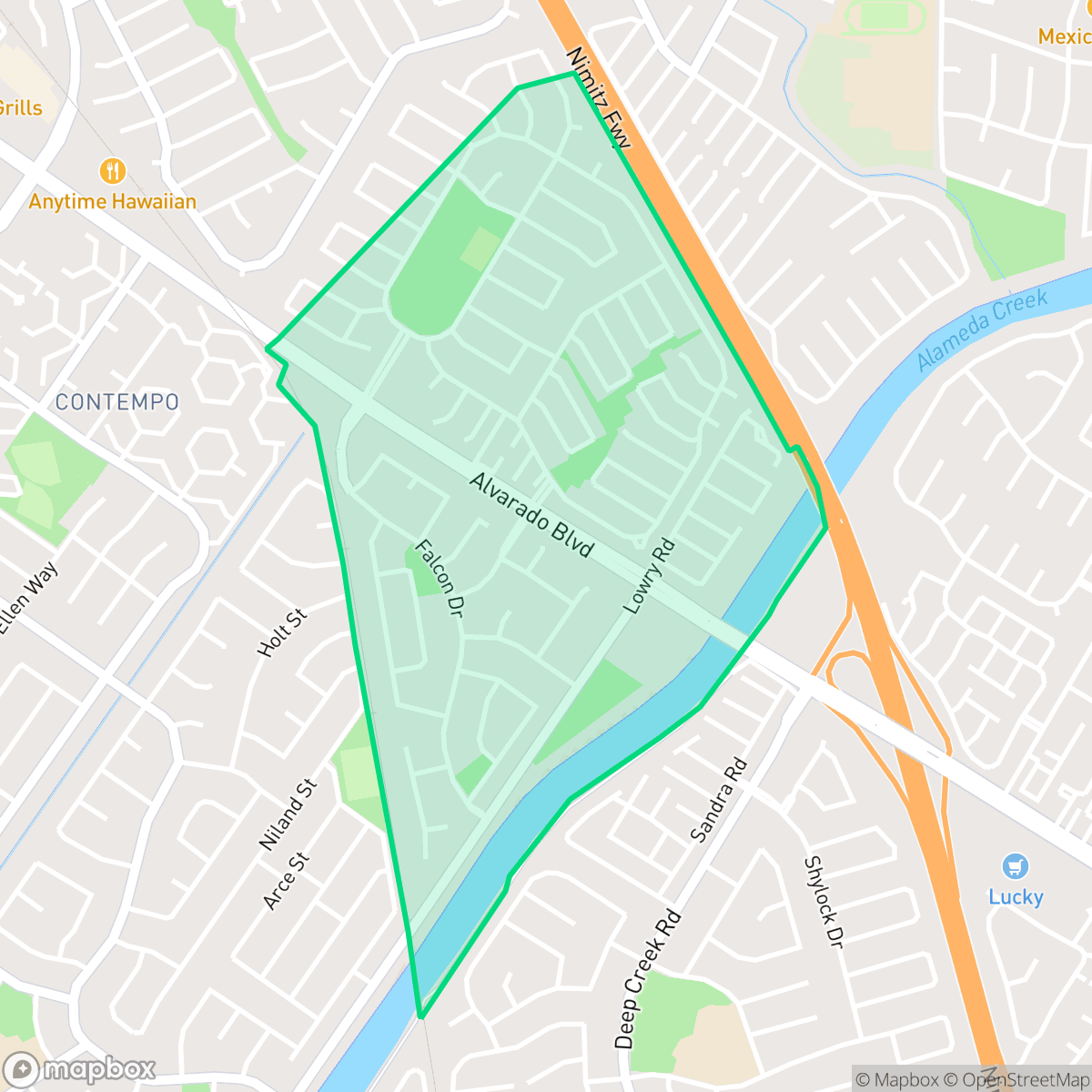
Lakes and Birds is a residential community in northern Fremont defined by its extensive sidewalk network and proximity to local green spaces. While the area provides excellent pedestrian access, it experiences significant ambient noise levels primarily driven by local road traffic.
Key Highlights
About Lakes and Birds
Developed primarily during the 1970s and 1980s, the Lakes and Birds neighborhood in northern Fremont, California, is a distinct residential community defined by its natural water features and avian-themed identity. The neighborhood’s name derives from the small lakes, ponds, and green spaces dispersed throughout the area, which attract diverse bird life and birdwatchers. This nature-centric theme is reflected in its signature street names, such as Bass Lake Street and Warbler Loop. Architecturally, the neighborhood features a mix of low-profile, block-built attached homes constructed by Gentry Homes and larger, raised-foundation detached houses built by Ponderosa Homes. Situated in the 94555 area near Paseo Padre Parkway, Lakes and Birds is closely associated with Warwick Elementary School and is valued for its proximity to Ardenwood Historic Farm and local regional parks.
The neighborhood is defined by a dense suburban layout with uniform single-family homes and an organized street grid. It maintains a strictly residential environment that is free from industrial warehouses or hazards. Residents benefit from a comprehensive sidewalk network that makes the area exceptionally walkable, while a large central park provides ample green space for outdoor activities and pet owners.
While the area offers high levels of health insurance coverage and a stable, community-focused environment, prospective residents should note the acoustic profile. Data from iHuus indicates an average noise level of 69 dB due to road traffic. The neighborhood is best suited for families and individuals who prioritize school district access and pedestrian-friendly streets over absolute acoustic silence.
Neighborhood Scores Across 15 Qualities
Residential spacing varies across the area, ranging from closely positioned homes with minimal buffers to standard suburban lots. According to iHuus data, privacy levels are roughly in line with the Fremont average.
Extensive sidewalk networks and marked crosswalks provide a safe environment for walking, though the nearby highway and canal can act as physical barriers. This level of connectivity is nearly on par with the rest of Fremont.
Standard tract housing and apartment complexes define the landscape, featuring uniform rooflines and small yards. This level of visual variety is slightly lower than the Fremont average, according to iHuus data.
Expansive greenways, connected parklands, and wide sidewalk verges offer superior space for pet exercise. According to iHuus data, these continuous paths and large central fields provide more accessible walking opportunities than the Fremont average.
Residential pockets consist of tightly packed single-family tracts and high-density apartment clusters, presenting a more developed suburban feel than the city average. According to iHuus data, the area lacks significant open land and is characterized by organized street grids and uniform housing density.
Suburban blocks offer a mix of quiet residential streets and pockets of activity, featuring a slightly higher level of dining and amenities than the Fremont average. While some areas are primarily residential and car-dependent, other sections provide access to various local eateries and parks.
Constant noise from nearby airport runways and heavy rail infrastructure makes this area significantly louder than most of Fremont. Residents should expect minimal acoustic comfort due to this immediate proximity to major transportation corridors.
Air quality levels are consistent with the Fremont average, featuring a mix of acceptable and occasionally unhealthy days for sensitive groups according to iHuus data.
Industrial activity and heavy warehouses are entirely absent from this area. According to iHuus data, this neighborhood is even more free of industrial proximity than the Fremont average.
Health insurance accessibility is exceptionally high in this area, trending above the Fremont city average according to iHuus data.
Voting patterns and census indicators show a deeply liberal leaning that is slightly more pronounced than the Fremont city average, according to iHuus data.
Residents live alongside a varied mix of young professionals, families, and seniors. According to iHuus data, the population distribution is slightly more balanced across age demographics than the Fremont average.
Properties in this area are situated within a 100-year floodplain, making flood insurance a typical requirement for residents. According to iHuus data, the risk level in this neighborhood is notably higher than the average for Fremont.
Address-Level Insights for Lakes and Birds


iHuus Neighborhood Intelligence Insights
Get address-level neighborhood insights for Lakes and Birds
- Street-level scores — see how individual blocks compare, not just neighborhood averages
- Micro-zone boundaries — identify quiet pockets, flood boundaries, and walkable clusters before you visit
- 15 dimensions in full — walkability, noise, air quality, school quality, insurance coverage, population age profile, urban/rural index, and more
- Boundary risk alerts — know if your address sits near a block boundary where scores drop, the kind of detail no listing will ever mention
- School insights — individual school ratings and insights, not just district-level data
- Compare before you commit — side-by-side data across neighborhoods, down to block precision
No credit card required
Compare with Any Neighborhood
| Dimension | Lakes and Birds | 28 Palms |
|---|---|---|
| 🚶 Walkabilityavg 9.3 | ||
| 🔊 Acoustic Comfortavg 3.38 | ||
| 🤫 Privacy Indexavg 5.09 | ||
| 🎨 Visual Appealavg 6.63 | ||
| 🐕 Dog Friendlinessavg 7.76 | ||
| 🗺️ Urban-Rural Indexavg 6.78 | ||
| ✨ Neighborhood Vibeavg 4.75 | ||
| 🏥 Health Insurance Coverageavg 8.99 | ||
| 🌿 Air Qualityavg 5.76 | ||
| 🏭 Industrial Proximityavg 8.97 | ||
| 🌊 Flood Safetyavg 3.62 | ||
| 🗳️ Ideological Leanavg 9.57 | ||
| 👥 Population Age Profileavg 4.91 | ||
| 🔥 Fire Safetyavg 0.2 | ||
| 🏫 School Quality |
Lakes and Birds Rankings
School Districts Serving Lakes and Birds
School Insights for Lakes and Birds
Below average outcomes; significant attendance and academic challenges.
School Insights
See what's really behind every school rating near Lakes and Birds
- Individual school ratings — each school's own score with outcome context, not just a district average
- Enrollment & class size data — student-to-teacher ratio and how it compares to the state average
- Full demographics breakdown — ethnicity and gender composition for every school in the enrollment zone
- Every school in the district — all schools within the enrollment boundary ranked by rating, not just the closest one
- Grade levels & benchmarks — elementary through high school, with below/above state-average flags
No credit card required