Irvington, Fremont
Updated · 8,982 residents
Irvington is a dense suburban neighborhood in Fremont defined by its high-performing schools and diverse local dining options. Residents benefit from a highly walkable layout with extensive sidewalk connectivity, though the area features tightly packed housing and moderate road traffic noise.
Key Highlights
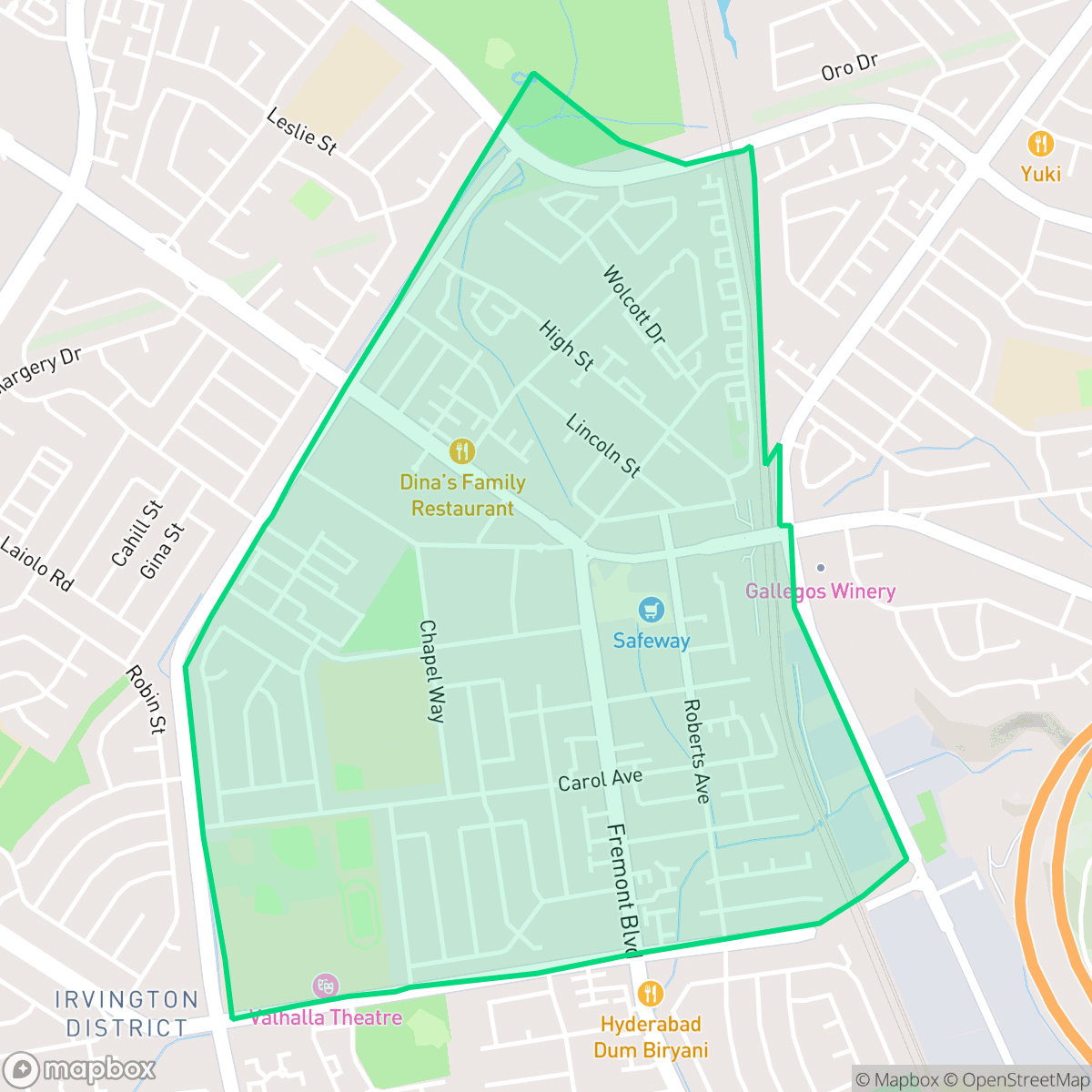
About Irvington
Originally settled as a busy crossroads known as "Washington Corners," the historic Fremont neighborhood of Irvington was renamed in 1884 to honor local Judge Irving. Due to a costly printing error on railroad schedules that the rail company refused to correct, the town officially adopted the misspelled name "Irvington" in 1887. Centered around the iconic "Five Corners" intersection, the district was a thriving 19th-century agricultural and cultural hub. It was home to Washington College, California’s first industrial educational institution, and the Palmdale Winery, once the state's largest winery prior to its destruction in the 1906 earthquake. Irvington’s architectural heritage is anchored by Clark’s Hall; built in 1876, it stands as Fremont’s oldest documented commercial brick building. In 1956, Irvington unified with four other townships to incorporate as the City of Fremont.
This neighborhood offers a blend of residential and institutional spaces, characterized by a mix of single-family homes and multi-story apartment complexes. The area is particularly recognized for its proximity to top-tier educational institutions, including Irvington High and John M. Horner Middle, which consistently draw families to the region. Local life centers around a variety of dining establishments, such as Mirchi Cafe and Bombay Street Food, which contribute to a moderate level of social activity throughout the day.
The area is best suited for those who prioritize school quality and walkability over expansive private outdoor space. While the community provides a reliable infrastructure for pedestrians, prospective residents should be aware of the high density, which results in limited privacy between properties. Additionally, the neighborhood experiences moderate road traffic noise, and individuals should review local disclosures regarding flood and fire safety, as these risks are elevated compared to the broader city averages.
Neighborhood Scores Across 15 Qualities
Housing density is varied, featuring several high-density clusters and shared-wall townhomes alongside standard suburban lots. This level of privacy is slightly lower than the Fremont average due to the presence of closely spaced structures and minimal setbacks in certain pockets of the neighborhood.
Extensive sidewalk networks and clear crosswalks make navigating the area on foot safe and efficient. According to iHuus data, the neighborhood offers a level of walkability that is slightly above the Fremont average.
Residential scenery consists mainly of uniform tract housing and apartment blocks with modest yards. This level of visual variety is slightly below the Fremont city average.
Wide sidewalks and frequent green verges throughout residential blocks make for easy walking routes. While slightly below the Fremont average, the area offers several large parks and sports complexes suitable for pet exercise.
Residential layouts feature a mix of single-family homes and multi-unit apartment complexes. This environment is slightly more developed than the typical semi-rural landscape found elsewhere in Fremont.
A mix of quiet, green residential blocks and pockets of activity provides a more vibrant atmosphere than the Fremont average. Residents can access a variety of diverse dining options and local services within certain walkable clusters, though some areas remain more car-dependent or tranquil.
Steady hum from nearby busy streets is a common feature here, though acoustic comfort levels are notably higher than the Fremont average according to iHuus data.
Air quality remains mostly clean with infrequent instances of elevated readings, performing better than the Fremont city average according to iHuus data.
Residential and institutional uses dominate the area with no detectable warehouses or heavy industrial hazards. This lack of industrial proximity is even more pronounced than the Fremont average, according to iHuus data.
Health insurance access is nearly universal among residents, slightly outpacing the Fremont average according to iHuus data.
Voting patterns and census indicators in Irvington align closely with the broader political landscape of Fremont. According to iHuus data, the area maintains a predominantly liberal ideological lean that is consistent with the city average.
A diverse range of age groups, including young professionals, families, and seniors, characterizes the area. This demographic distribution is largely consistent with the broader Fremont area, according to iHuus data.
Located within a designated 100-year floodplain, this area carries a significantly higher risk of flooding than the Fremont average. Residents should be aware that flood insurance is typically required for properties in this zone according to iHuus data.
Address-Level Insights for Irvington


iHuus Neighborhood Intelligence Insights
Get address-level neighborhood insights for Irvington
- Street-level scores — see how individual blocks compare, not just neighborhood averages
- Micro-zone boundaries — identify quiet pockets, flood boundaries, and walkable clusters before you visit
- 15 dimensions in full — walkability, noise, air quality, school quality, insurance coverage, population age profile, urban/rural index, and more
- Boundary risk alerts — know if your address sits near a block boundary where scores drop, the kind of detail no listing will ever mention
- School insights — individual school ratings and insights, not just district-level data
- Compare before you commit — side-by-side data across neighborhoods, down to block precision
No credit card required
Compare with Any Neighborhood
| Dimension | Irvington | 28 Palms |
|---|---|---|
| 🚶 Walkabilityavg 9.3 | ||
| 🔊 Acoustic Comfortavg 3.38 | ||
| 🤫 Privacy Indexavg 5.09 | ||
| 🎨 Visual Appealavg 6.63 | ||
| 🐕 Dog Friendlinessavg 7.76 | ||
| 🗺️ Urban-Rural Indexavg 6.78 | ||
| ✨ Neighborhood Vibeavg 4.75 | ||
| 🏥 Health Insurance Coverageavg 8.99 | ||
| 🌿 Air Qualityavg 5.76 | ||
| 🏭 Industrial Proximityavg 8.97 | ||
| 🌊 Flood Safetyavg 3.62 | ||
| 🗳️ Ideological Leanavg 9.57 | ||
| 👥 Population Age Profileavg 4.91 | ||
| 🔥 Fire Safetyavg 0.2 | ||
| 🏫 School Quality |
Irvington Rankings
School Districts Serving Irvington
School Insights for Irvington
Below average outcomes; significant attendance and academic challenges.
School Insights
See what's really behind every school rating near Irvington
- Individual school ratings — each school's own score with outcome context, not just a district average
- Enrollment & class size data — student-to-teacher ratio and how it compares to the state average
- Full demographics breakdown — ethnicity and gender composition for every school in the enrollment zone
- Every school in the district — all schools within the enrollment boundary ranked by rating, not just the closest one
- Grade levels & benchmarks — elementary through high school, with below/above state-average flags
No credit card required