Grimmer, Fremont
Updated · 7,947 residents
Grimmer is a highly walkable suburban enclave in Fremont defined by its dense, mid-century residential layout. Residents benefit from a continuous sidewalk network that connects quiet, tree-lined streets to local parks and schools.
Key Highlights
About Grimmer
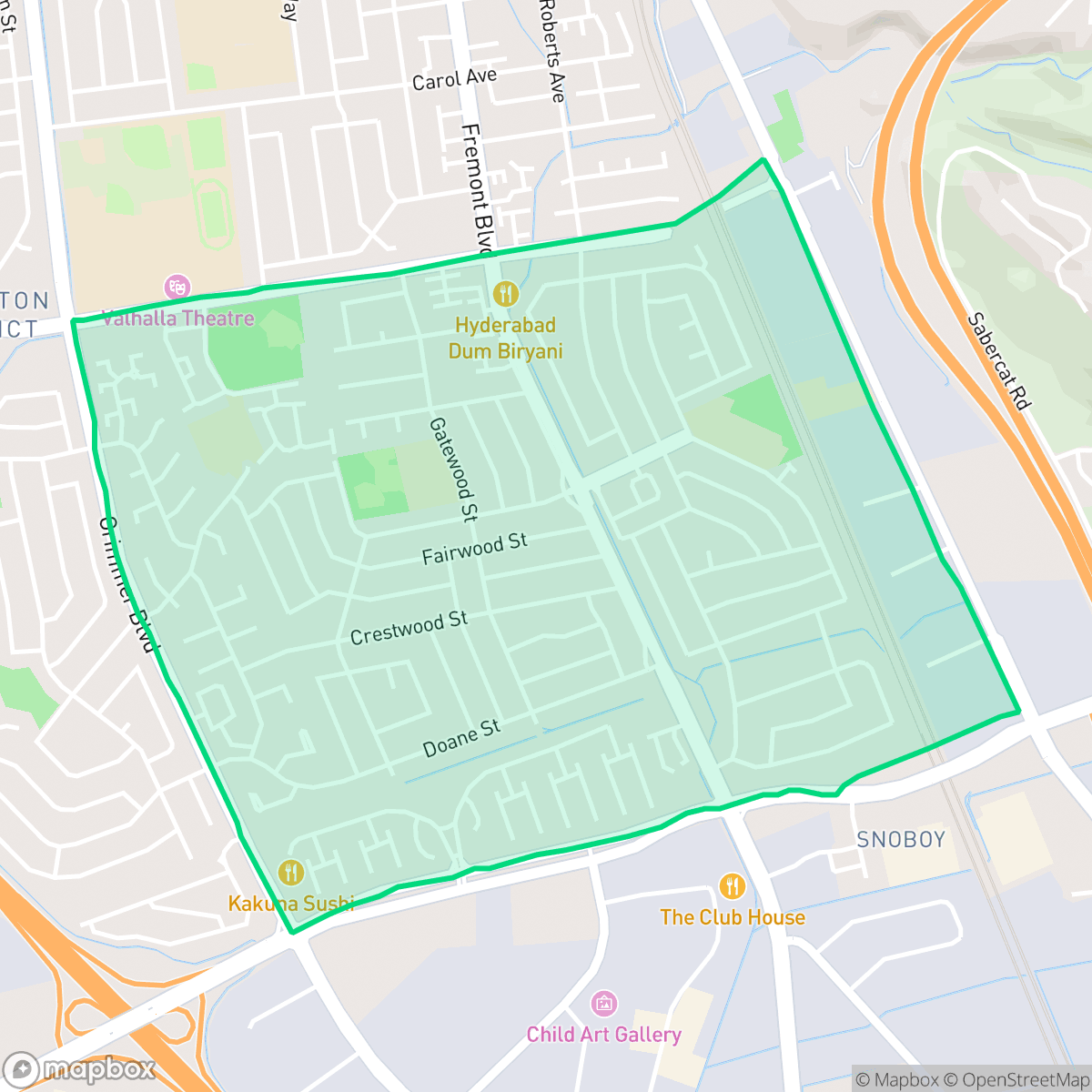
Situated within Fremont’s Irvington district, the Grimmer neighborhood transitioned from a rural, agricultural area in the early 1900s to a suburban enclave during the post-World War II housing boom. Developed primarily in the 1950s and 1960s, the neighborhood is characterized by a high concentration of mid-century ranch-style homes and bungalows. It features local landmarks such as Grimmer Park and E. M. Grimmer Elementary School, which was named after Dr. Elmo "Chuck" Grimmer, a prominent local physician who practiced in the area. On the southwestern edge of the neighborhood, the Pacific Commons shopping center stands on the former 840-acre site of the historic Fremont Dragstrip (later Baylands Raceway Park), which hosted drag racing and local events from 1959 until its closure in 1988.
The area maintains a consistent suburban rhythm characterized by closely spaced single-family homes and a high degree of pedestrian connectivity. According to iHuus data, the neighborhood achieves a perfect walkability score, providing residents with reliable access to nearby schools and green spaces via a well-maintained sidewalk network. The landscape is primarily residential, offering a quiet, stable environment that appeals to families seeking access to the Fremont Unified School District.
While the neighborhood offers excellent pedestrian infrastructure, residents should anticipate a dense living environment where houses are situated in close proximity with minimal side setbacks. The area is notably car-oriented for services outside of immediate walking distance, and noise levels are primarily influenced by regional road traffic. It is best suited for those who value school quality and a walkable, established residential setting over expansive private yards or a high-density commercial nightlife.
Neighborhood Scores Across 15 Qualities
Residential spacing varies from closely packed homes with minimal setbacks to standard suburban layouts. According to iHuus data, privacy levels in this area are slightly lower than the Fremont city average.
Continuous sidewalks and well-marked crosswalks make navigating the area on foot safe and efficient. According to iHuus data, the walkability in this neighborhood is nearly identical to the Fremont average.
Residential scenery ranges from large, upscale homes with private pools to more densely packed, uniform tract housing. This level of visual variety is largely consistent with the broader Fremont area, according to iHuus data.
Wide sidewalks and access to a central public park with sports fields provide reliable walking routes for pets. This level of accessibility for dogs is slightly below the Fremont city average.
Residential layouts feature a blend of single-family homes, apartment complexes, and industrial zones. This environment is slightly less open than the Fremont average, offering a more developed suburban feel compared to more rural parts of the city.
Suburban streets and industrial zones create a calm atmosphere, but the area lacks a high density of amenities. Most daily needs require a vehicle, as the local vibrancy is notably lower than the Fremont average.
Steady traffic sounds from nearby busy streets are present; however, the acoustic environment is more tranquil than the average area found throughout Fremont, according to iHuus data.
Air quality remains consistently good with only rare instances of elevated readings, according to iHuus data. This level of cleanliness is notably higher than the average found across Fremont.
Residents can enjoy a largely residential atmosphere with minimal exposure to heavy industry or large-scale logistics hubs. According to iHuus data, the area lacks the significant industrial activity and heavy freight traffic found more frequently in other parts of Fremont.
Health insurance access is exceptionally high among residents, slightly exceeding the Fremont city average according to iHuus data.
Voting patterns and census indicators show a highly liberal political leaning that is consistent with the broader Fremont area.
Residents live among a diverse range of age groups, including young professionals, families, and seniors. This demographic distribution is closely aligned with the broader Fremont average, according to iHuus data.
Flood risk in this area is notably higher than the Fremont average, though the specific level of vulnerability remains undetermined due to a lack of detailed federal studies. According to iHuus data, residents should remain aware of potential water concerns during extreme weather events.
Address-Level Insights for Grimmer


iHuus Neighborhood Intelligence Insights
Get address-level neighborhood insights for Grimmer
- Street-level scores — see how individual blocks compare, not just neighborhood averages
- Micro-zone boundaries — identify quiet pockets, flood boundaries, and walkable clusters before you visit
- 15 dimensions in full — walkability, noise, air quality, school quality, insurance coverage, population age profile, urban/rural index, and more
- Boundary risk alerts — know if your address sits near a block boundary where scores drop, the kind of detail no listing will ever mention
- School insights — individual school ratings and insights, not just district-level data
- Compare before you commit — side-by-side data across neighborhoods, down to block precision
No credit card required
Compare with Any Neighborhood
| Dimension | Grimmer | 28 Palms |
|---|---|---|
| 🚶 Walkabilityavg 9.3 | ||
| 🔊 Acoustic Comfortavg 3.38 | ||
| 🤫 Privacy Indexavg 5.09 | ||
| 🎨 Visual Appealavg 6.63 | ||
| 🐕 Dog Friendlinessavg 7.76 | ||
| 🗺️ Urban-Rural Indexavg 6.78 | ||
| ✨ Neighborhood Vibeavg 4.75 | ||
| 🏥 Health Insurance Coverageavg 8.99 | ||
| 🌿 Air Qualityavg 5.76 | ||
| 🏭 Industrial Proximityavg 8.97 | ||
| 🌊 Flood Safetyavg 3.62 | ||
| 🗳️ Ideological Leanavg 9.57 | ||
| 👥 Population Age Profileavg 4.91 | ||
| 🔥 Fire Safetyavg 0.2 | ||
| 🏫 School Quality |
Grimmer Rankings
School Districts Serving Grimmer
School Insights for Grimmer
Below average outcomes; significant attendance and academic challenges.
School Insights
See what's really behind every school rating near Grimmer
- Individual school ratings — each school's own score with outcome context, not just a district average
- Enrollment & class size data — student-to-teacher ratio and how it compares to the state average
- Full demographics breakdown — ethnicity and gender composition for every school in the enrollment zone
- Every school in the district — all schools within the enrollment boundary ranked by rating, not just the closest one
- Grade levels & benchmarks — elementary through high school, with below/above state-average flags
No credit card required