Glenmoor, Fremont
Updated · 12,019 residents
Glenmoor is a well-established residential enclave in central Fremont characterized by its grid of mid-century ranch homes and high walkability. Residents benefit from a dense network of sidewalks and proximity to local parks, though the tightly packed housing layout results in limited backyard privacy.
Key Highlights
About Glenmoor
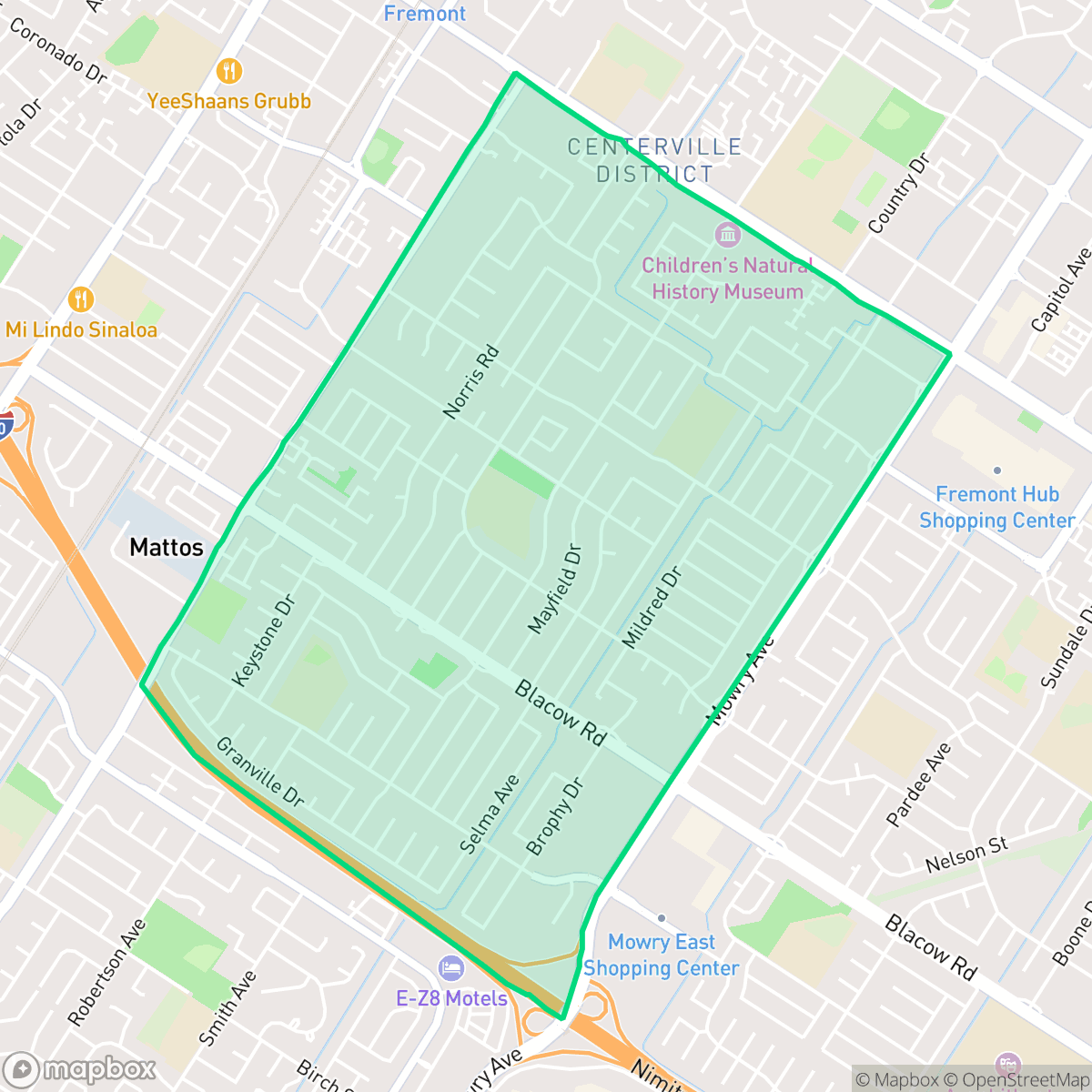
Glenmoor (originally Glenmoor Gardens) in central Fremont, California, is a master-planned neighborhood developed in the 1950s and 1960s by Glenmoor Homes, Inc. on former 19th-century agricultural estates. Originally owned by pioneer settlers like Garrett Norris, Herman Eggers, and Martin Brophy—whose names now grace local streets—the land was later farmed for apricots, cherries, and walnuts. Prominent Portuguese-American civic leader John G. Mattos also owned land here; his historic residence still stands at 38323 Blacow Road. Marketed as a self-contained community "planned for gracious living," Glenmoor is Fremont's largest subdivision, characterized by nearly 1,900 mid-century ranch-style homes on spacious lots. The neighborhood's unique design featured dedicated schools and private, resident-only recreational hubs like Meyer Park and Alta Park, which continue to foster its distinct, close-knit suburban character.
The area maintains a consistent suburban rhythm, defined by its flat, walkable streetscape and reliable access to neighborhood amenities. It is a quiet, purely residential zone that avoids industrial hazards, making it a stable environment for families. The local school landscape is strong, with several well-regarded elementary schools serving the community, supported by the broader Fremont Unified School District.
Prospective residents should note that the neighborhood features closely spaced homes with shared fence lines, which may be a consideration for those prioritizing personal privacy. While the area is exceptionally walkable and pleasant for daily strolls, it experiences moderate noise levels primarily from road traffic. It is an ideal setting for those seeking a predictable, family-oriented environment with established infrastructure and a strong sense of community.
Neighborhood Scores Across 15 Qualities
Residential spacing is typical for a suburb, providing a mix of detached homes and some closely situated units. According to iHuus data, the level of separation between neighbors is roughly aligned with the Fremont average.
Continuous sidewalks and clear pedestrian crossings are available on nearly every street, making this area slightly more pedestrian-friendly than the Fremont average. Residents can easily navigate the neighborhood via a comprehensive network of well-defined paths and low-traffic residential loops.
Large, well-maintained lots featuring private backyard pools and spacious multi-car driveways define the area. This level of visual amenity is consistent with the average found throughout Fremont.
Wide sidewalk verges, central parks, and accessible green spaces provide ample room for exercise. While slightly below the Fremont average, the neighborhood remains a functional area for pet owners due to continuous grassy paths and nearby sports fields.
Dense suburban development defines the area, featuring a mix of single-family homes, schools, and local commercial centers. This landscape is slightly less open than the Fremont average, as much of the neighborhood consists of established residential clusters and retail hubs.
Lively pockets of dining and social hubs provide a noticeable energy that is notably higher than the Fremont average. While many areas feature a diverse mix of local eateries and services, much of the neighborhood remains car-dependent due to the suburban layout.
Steady traffic sounds from nearby busy streets are present, though the acoustic environment remains quieter than the Fremont average according to iHuus data.
Air quality levels are generally acceptable, though residents may experience occasional days with higher pollutant concentrations. According to iHuus data, conditions in Glenmoor are slightly better than the average for Fremont.
Residential and light commercial uses dominate the area with no detectable warehouses or heavy industrial hazards. This lack of industrial activity is consistent with the Fremont city average.
Health insurance enrollment among Glenmoor residents is lower than the average seen across Fremont. According to iHuus data, a significant portion of the local population remains uninsured.
Voting patterns and census indicators reflect a deeply liberal political leaning that is largely consistent with the broader Fremont area.
A balanced mix of young adults, families, and older residents characterizes the community. According to iHuus data, the age distribution is roughly in line with the average seen across Fremont.
Properties in this area are situated within a designated floodplain, which may necessitate flood insurance. According to iHuus data, the risk level in Glenmoor is notably higher than the Fremont city average.
Address-Level Insights for Glenmoor


iHuus Neighborhood Intelligence Insights
Get address-level neighborhood insights for Glenmoor
- Street-level scores — see how individual blocks compare, not just neighborhood averages
- Micro-zone boundaries — identify quiet pockets, flood boundaries, and walkable clusters before you visit
- 15 dimensions in full — walkability, noise, air quality, school quality, insurance coverage, population age profile, urban/rural index, and more
- Boundary risk alerts — know if your address sits near a block boundary where scores drop, the kind of detail no listing will ever mention
- School insights — individual school ratings and insights, not just district-level data
- Compare before you commit — side-by-side data across neighborhoods, down to block precision
No credit card required
Compare with Any Neighborhood
| Dimension | Glenmoor | 28 Palms |
|---|---|---|
| 🚶 Walkabilityavg 9.3 | ||
| 🔊 Acoustic Comfortavg 3.38 | ||
| 🤫 Privacy Indexavg 5.09 | ||
| 🎨 Visual Appealavg 6.63 | ||
| 🐕 Dog Friendlinessavg 7.76 | ||
| 🗺️ Urban-Rural Indexavg 6.78 | ||
| ✨ Neighborhood Vibeavg 4.75 | ||
| 🏥 Health Insurance Coverageavg 8.99 | ||
| 🌿 Air Qualityavg 5.76 | ||
| 🏭 Industrial Proximityavg 8.97 | ||
| 🌊 Flood Safetyavg 3.62 | ||
| 🗳️ Ideological Leanavg 9.57 | ||
| 👥 Population Age Profileavg 4.91 | ||
| 🔥 Fire Safetyavg 0.2 | ||
| 🏫 School Quality |
Glenmoor Rankings
School Districts Serving Glenmoor
School Insights for Glenmoor
Below average outcomes; significant attendance and academic challenges.
School Insights
See what's really behind every school rating near Glenmoor
- Individual school ratings — each school's own score with outcome context, not just a district average
- Enrollment & class size data — student-to-teacher ratio and how it compares to the state average
- Full demographics breakdown — ethnicity and gender composition for every school in the enrollment zone
- Every school in the district — all schools within the enrollment boundary ranked by rating, not just the closest one
- Grade levels & benchmarks — elementary through high school, with below/above state-average flags
No credit card required