Don Edwards National Wildlife Refuge, Fremont
Updated · 429 residents
The Don Edwards National Wildlife Refuge offers a tranquil, nature-focused environment defined by vast wetlands and expansive open spaces. It features highly walkable pedestrian infrastructure and pet-friendly trails, making it an ideal setting for those who prioritize outdoor access over urban convenience.
Key Highlights
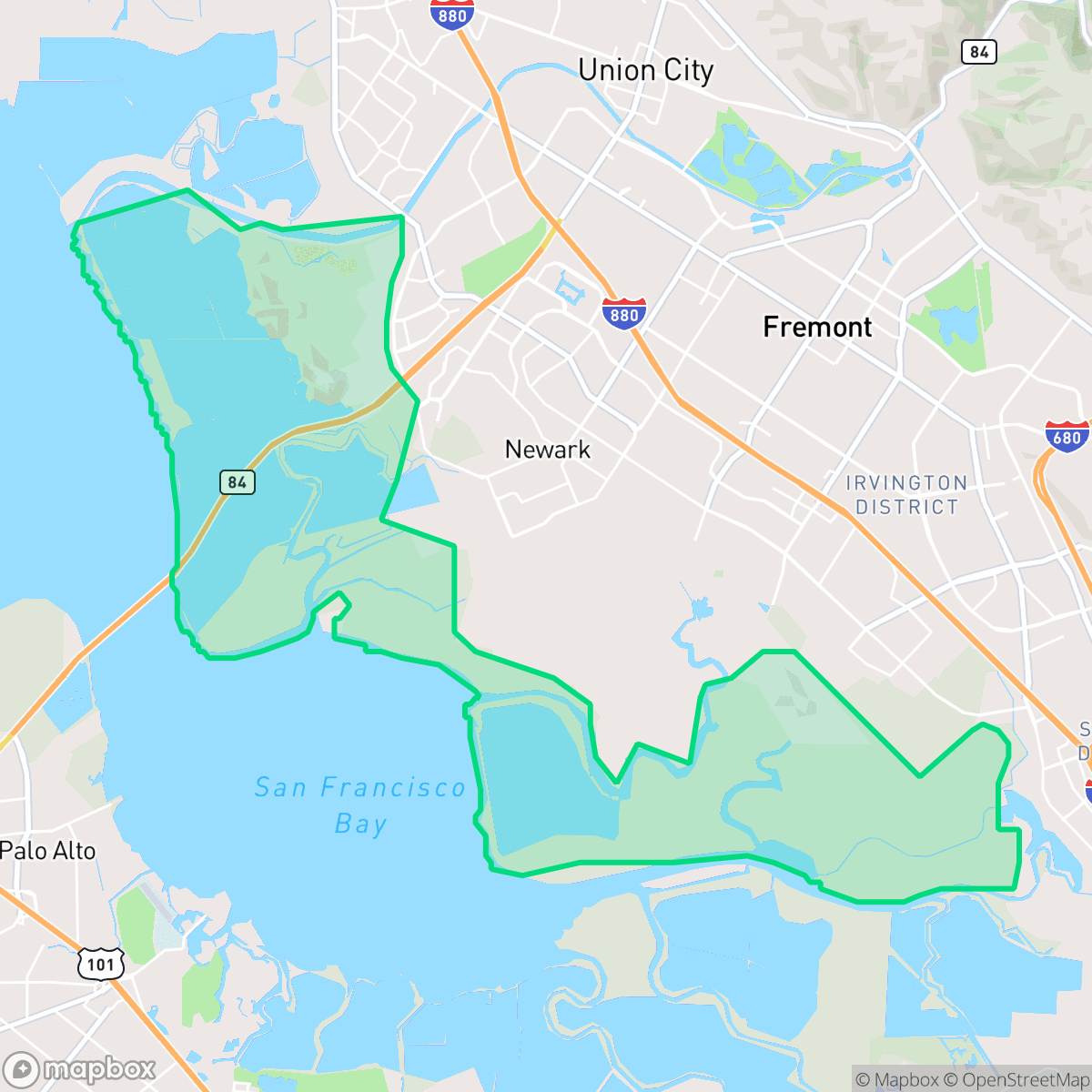
About Don Edwards National Wildlife Refuge
The Don Edwards San Francisco Bay National Wildlife Refuge, established in 1972 as the nation’s first urban wildlife refuge, serves as a vital ecological sanctuary in Fremont. Originally known as the San Francisco Bay National Wildlife Refuge, it was renamed in 1995 to honor Congressman Don Edwards for his pivotal role in its creation. The refuge encompasses over 30,000 acres of land historically shaped by indigenous Ohlone habitation and later transformed by extensive 19th-century salt production. Born from grassroots efforts to curb rapid urban development, the area is currently the site of the South Bay Salt Pond Restoration Project, the West Coast’s largest tidal wetland restoration initiative. The refuge’s Fremont visitor center and its sprawling marshlands remain critical landmarks, symbolizing the region's transition from industrial exploitation to environmental conservation.
The area serves as a quiet retreat from the typical pace of Fremont, characterized by a rural atmosphere and minimal commercial development. While the landscape is dominated by natural beauty and scenic vistas, residents benefit from excellent pedestrian paths that make the outdoors easily accessible. The community is diverse in age and maintains a predominantly liberal outlook, with high levels of health insurance coverage among the population. Because the neighborhood lacks traditional social hubs and business districts, it is best suited for individuals who value solitude and proximity to nature rather than those seeking a vibrant, high-density urban lifestyle.
Living in this region involves specific considerations, particularly regarding environmental factors. The area is situated within a designated floodplain, which necessitates awareness of local flood safety protocols. While the environment is generally clean and free from heavy industrial activity, residents may notice steady traffic sounds from nearby roadways. The neighborhood provides a unique balance of spacious, well-maintained surroundings and high walkability, though the moderate housing density means residents share their environment more closely than in some other parts of the city. Prospective families should note that the area is served by several school districts, each with varying levels of academic performance and operational stability.
Neighborhood Scores Across 15 Qualities
Housing density is moderate with varying distances between neighbors. According to iHuus data, the level of separation between properties is slightly lower than the Fremont average.
Pedestrian infrastructure is excellent, featuring wide sidewalks and frequent crossings that prioritize foot traffic. This area offers slightly better walkability than the Fremont average, according to iHuus data.
Large residential lots and frequent upscale amenities contribute to an aesthetic that is slightly above the Fremont average. According to iHuus data, the area features wide driveways and well-maintained landscapes.
Expansive trails and abundant open spaces provide excellent opportunities for walking dogs. According to iHuus data, this area offers significantly more access to nature and outdoor space than the Fremont average.
Vast wetlands and undeveloped salt ponds dominate the landscape, providing a much more rural and natural environment than the Fremont average. According to iHuus data, the area features minimal building density and is characterized by significant natural acreage with very few residential or commercial structures.
Vast open spaces and minimal development define this area, which lacks the commercial density and social activity found elsewhere in Fremont. According to iHuus data, the landscape is primarily comprised of low-density nature preserves and industrial corridors with very few local businesses or social hubs.
Steady traffic sounds from nearby roads are noticeable, though the acoustic environment is more tranquil than the typical Fremont neighborhood according to iHuus data.
Air quality levels fluctuate between acceptable and unhealthy, presenting occasional concerns for sensitive groups. This area maintains a quality similar to the Fremont average according to iHuus data.
Industrial activity is virtually non-existent in this area, offering a cleaner environment than the Fremont average. While some peripheral salt evaporation ponds and utility infrastructure are visible, there is no heavy manufacturing or hazardous industrial development nearby.
Health insurance access is exceptionally high among local residents, performing slightly above the Fremont average according to iHuus data.
Political leanings in this area are largely liberal, though this is slightly less pronounced than the average found throughout Fremont. According to iHuus data, a modest opposing presence exists within the community.
A balanced mix of young adults, families, and older residents characterizes the area, though the population leans slightly younger than the Fremont average according to iHuus data.
Significant flood risk exists here because the area sits within a designated 100-year floodplain. According to iHuus data, this level of vulnerability is notably higher than the average for Fremont.
Address-Level Insights for Don Edwards National Wildlife Refuge


iHuus Neighborhood Intelligence Insights
Get address-level neighborhood insights for Don Edwards National Wildlife Refuge
- Street-level scores — see how individual blocks compare, not just neighborhood averages
- Micro-zone boundaries — identify quiet pockets, flood boundaries, and walkable clusters before you visit
- 15 dimensions in full — walkability, noise, air quality, school quality, insurance coverage, population age profile, urban/rural index, and more
- Boundary risk alerts — know if your address sits near a block boundary where scores drop, the kind of detail no listing will ever mention
- School insights — individual school ratings and insights, not just district-level data
- Compare before you commit — side-by-side data across neighborhoods, down to block precision
No credit card required
Compare with Any Neighborhood
| Dimension | Don Edwards National Wildlife Refuge | 28 Palms |
|---|---|---|
| 🚶 Walkabilityavg 9.3 | ||
| 🔊 Acoustic Comfortavg 3.38 | ||
| 🤫 Privacy Indexavg 5.09 | ||
| 🎨 Visual Appealavg 6.63 | ||
| 🐕 Dog Friendlinessavg 7.76 | ||
| 🗺️ Urban-Rural Indexavg 6.78 | ||
| ✨ Neighborhood Vibeavg 4.75 | ||
| 🏥 Health Insurance Coverageavg 8.99 | ||
| 🌿 Air Qualityavg 5.76 | ||
| 🏭 Industrial Proximityavg 8.97 | ||
| 🌊 Flood Safetyavg 3.62 | ||
| 🗳️ Ideological Leanavg 9.57 | ||
| 👥 Population Age Profileavg 4.91 | ||
| 🔥 Fire Safetyavg 0.2 | ||
| 🏫 School Quality |
Don Edwards National Wildlife Refuge Rankings
School Districts Serving Don Edwards National Wildlife Refuge
School Insights for Don Edwards National Wildlife Refuge
Below average outcomes; significant attendance and academic challenges.
School Insights
See what's really behind every school rating near Don Edwards National Wildlife Refuge
- Individual school ratings — each school's own score with outcome context, not just a district average
- Enrollment & class size data — student-to-teacher ratio and how it compares to the state average
- Full demographics breakdown — ethnicity and gender composition for every school in the enrollment zone
- Every school in the district — all schools within the enrollment boundary ranked by rating, not just the closest one
- Grade levels & benchmarks — elementary through high school, with below/above state-average flags
No credit card required