Cherry-Guardino, Fremont
Updated · 7,591 residents
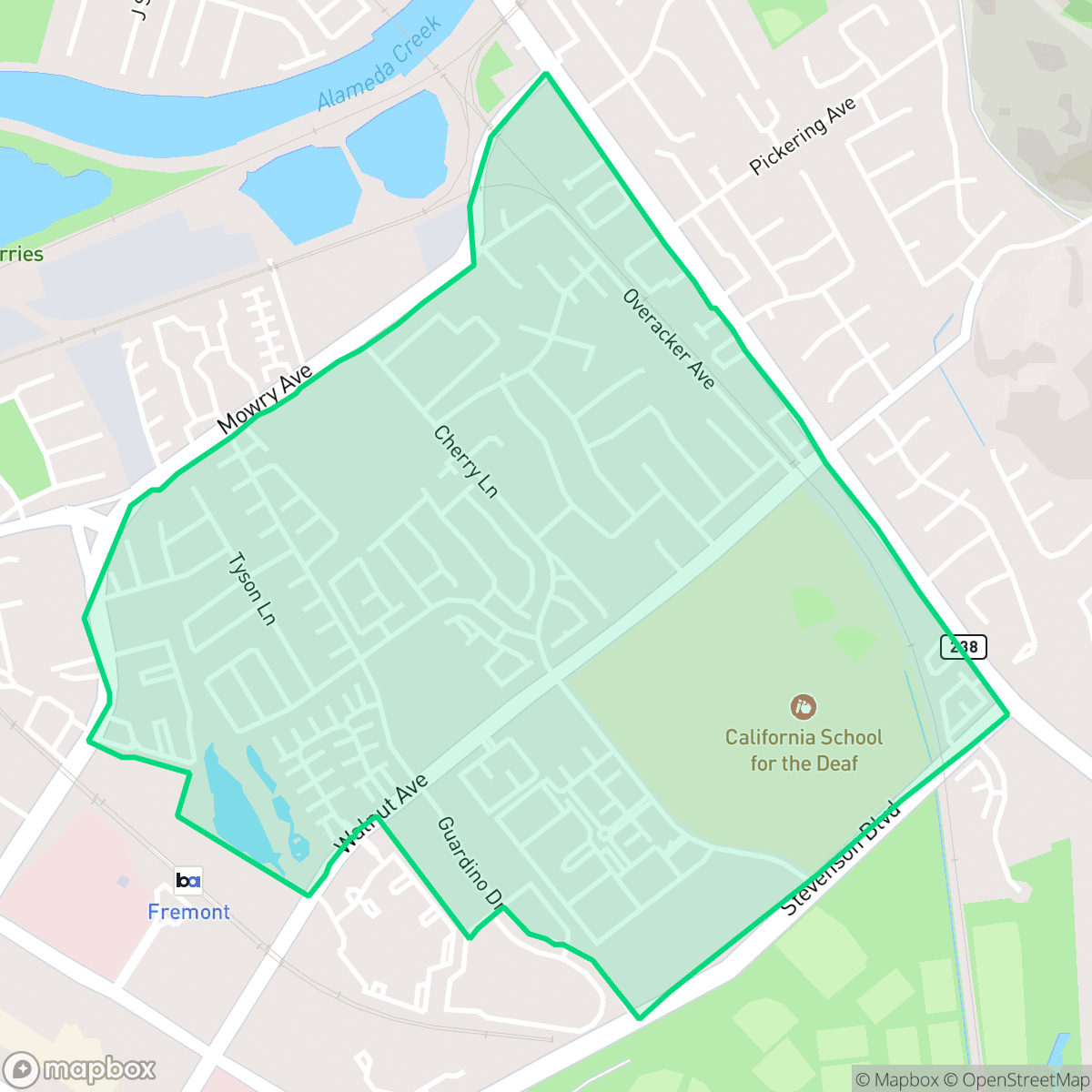
Cherry-Guardino is a centrally located Fremont neighborhood defined by its high walkability and proximity to major regional parks like Lake Elizabeth. The area features a dense residential mix of modern apartments and established housing, offering residents convenient access to transit and local amenities.
Key Highlights
About Cherry-Guardino
The Cherry-Guardino neighborhood in Fremont, California, is a centrally located residential area characterized by a mix of mid-to-late 20th-century single-family homes, modern condominiums, and apartment complexes. A defining cultural and educational anchor of the neighborhood is the campus of the California School for the Deaf, Fremont (CSDF), which sits adjacent to the California School for the Blind. The CSDF campus features a historical marker and statue dedicated to Douglas Tilden, the renowned deaf artist celebrated as the "Father of Sculpture on the Pacific Coast". Geographically, the neighborhood is bordered by natural landmarks such as Tyson Lagoon and Shinn Pond, and lies in close proximity to the historic Shinn Historical Park and Arboretum and Central Park's Lake Elizabeth.
The neighborhood functions as a transit-oriented hub within Fremont, characterized by its dense residential layout and accessibility. Residents benefit from a comprehensive sidewalk network that connects the area to nearby retail centers and public transportation options. The landscape is primarily composed of multi-family housing and townhomes, which contributes to a high-density environment that prioritizes utility over expansive private yards. Living here involves certain trade-offs, particularly regarding acoustic comfort and privacy, as the dense configuration often results in shared walls and proximity to road traffic. While the area provides excellent access to green spaces for pet owners, those seeking a quiet, secluded suburban experience may find the bustling, urban-adjacent atmosphere more suited to commuters and those who value convenience over absolute silence.
Neighborhood Scores Across 15 Qualities
Residential spacing varies throughout the area, ranging from shared-wall apartments to single-family homes with small setbacks. This level of density is roughly in line with the Fremont city average, according to iHuus data.
Extensive sidewalk networks and frequent pedestrian crossings make navigating the area on foot easy. According to iHuus data, this connectivity is slightly above the Fremont average due to the proximity of transit and retail hubs.
Typical tract housing and dense apartment blocks characterize the area. According to iHuus data, the visual landscape is slightly below the Fremont average due to modest yard sizes and prominent surface parking lots.
Access to a central lake park, connected green buffers, and wide sidewalks makes this area more dog friendly than the Fremont average. Residents can utilize various trails and sports fields that are well-separated from heavy traffic.
Residential patterns here mirror the broader city average, consisting of a blend of single-family homes and multi-story apartment complexes. This landscape includes both dense housing tracts and pockets of more open land near commercial hubs.
Low-density residential blocks and light industrial zones create a tranquil atmosphere, though social activity and local businesses are less frequent than in other parts of Fremont. Most residents will find the area primarily composed of serene landscapes and essential services that often require a car for frequent errands.
Frequent noise from nearby freeway and railroad traffic makes this area louder than the Fremont average. Residents can expect consistent acoustic disturbances throughout the day according to iHuus data.
Air quality levels are generally acceptable, though sensitive groups may experience occasional periods of concern. According to iHuus data, conditions in this area are slightly better than the Fremont city average.
Primarily residential streets and green spaces define the area, though some noise may originate from warehouses and the rail corridor near the northern edge. This level of industrial proximity is slightly lower than the Fremont average according to iHuus data.
Nearly all residents are covered by health insurance, a rate that is slightly below the Fremont city average according to iHuus data.
Voting patterns and census indicators reflect a very strong liberal leaning, which is consistent with the broader Fremont area according to iHuus data.
Residents live among a balanced mix of young adults, families, and seniors. This demographic distribution is largely consistent with the broader Fremont area.
Flood risk levels remain undetermined because a detailed federal study has not yet been completed for this area. According to iHuus data, the potential for flooding is notably higher than the Fremont city average.
Extreme fire hazards are present in this area, representing a risk level that is slightly higher than the Fremont city average. Residents should ensure they are prepared with maximum protection and emergency measures according to iHuus data.
Address-Level Insights for Cherry-Guardino


iHuus Neighborhood Intelligence Insights
Get address-level neighborhood insights for Cherry-Guardino
- Street-level scores — see how individual blocks compare, not just neighborhood averages
- Micro-zone boundaries — identify quiet pockets, flood boundaries, and walkable clusters before you visit
- 15 dimensions in full — walkability, noise, air quality, school quality, insurance coverage, population age profile, urban/rural index, and more
- Boundary risk alerts — know if your address sits near a block boundary where scores drop, the kind of detail no listing will ever mention
- School insights — individual school ratings and insights, not just district-level data
- Compare before you commit — side-by-side data across neighborhoods, down to block precision
No credit card required
Compare with Any Neighborhood
| Dimension | Cherry-Guardino | 28 Palms |
|---|---|---|
| 🚶 Walkabilityavg 9.3 | ||
| 🔊 Acoustic Comfortavg 3.38 | ||
| 🤫 Privacy Indexavg 5.09 | ||
| 🎨 Visual Appealavg 6.63 | ||
| 🐕 Dog Friendlinessavg 7.76 | ||
| 🗺️ Urban-Rural Indexavg 6.78 | ||
| ✨ Neighborhood Vibeavg 4.75 | ||
| 🏥 Health Insurance Coverageavg 8.99 | ||
| 🌿 Air Qualityavg 5.76 | ||
| 🏭 Industrial Proximityavg 8.97 | ||
| 🌊 Flood Safetyavg 3.62 | ||
| 🗳️ Ideological Leanavg 9.57 | ||
| 👥 Population Age Profileavg 4.91 | ||
| 🔥 Fire Safetyavg 0.2 | ||
| 🏫 School Quality |
Cherry-Guardino Rankings
School Districts Serving Cherry-Guardino
School Insights for Cherry-Guardino
Below average outcomes; significant attendance and academic challenges.
School Insights
See what's really behind every school rating near Cherry-Guardino
- Individual school ratings — each school's own score with outcome context, not just a district average
- Enrollment & class size data — student-to-teacher ratio and how it compares to the state average
- Full demographics breakdown — ethnicity and gender composition for every school in the enrollment zone
- Every school in the district — all schools within the enrollment boundary ranked by rating, not just the closest one
- Grade levels & benchmarks — elementary through high school, with below/above state-average flags
No credit card required