Cameron Hills, Fremont
Updated · 4,415 residents
Cameron Hills is a quiet, low-density residential hillside community in southern Fremont known for its expansive open spaces and exceptional dog-friendliness. While the area offers a serene, rural-like atmosphere with high visual appeal, it remains car-dependent and features proximity to major roadways that contribute to consistent traffic noise.
Key Highlights
About Cameron Hills
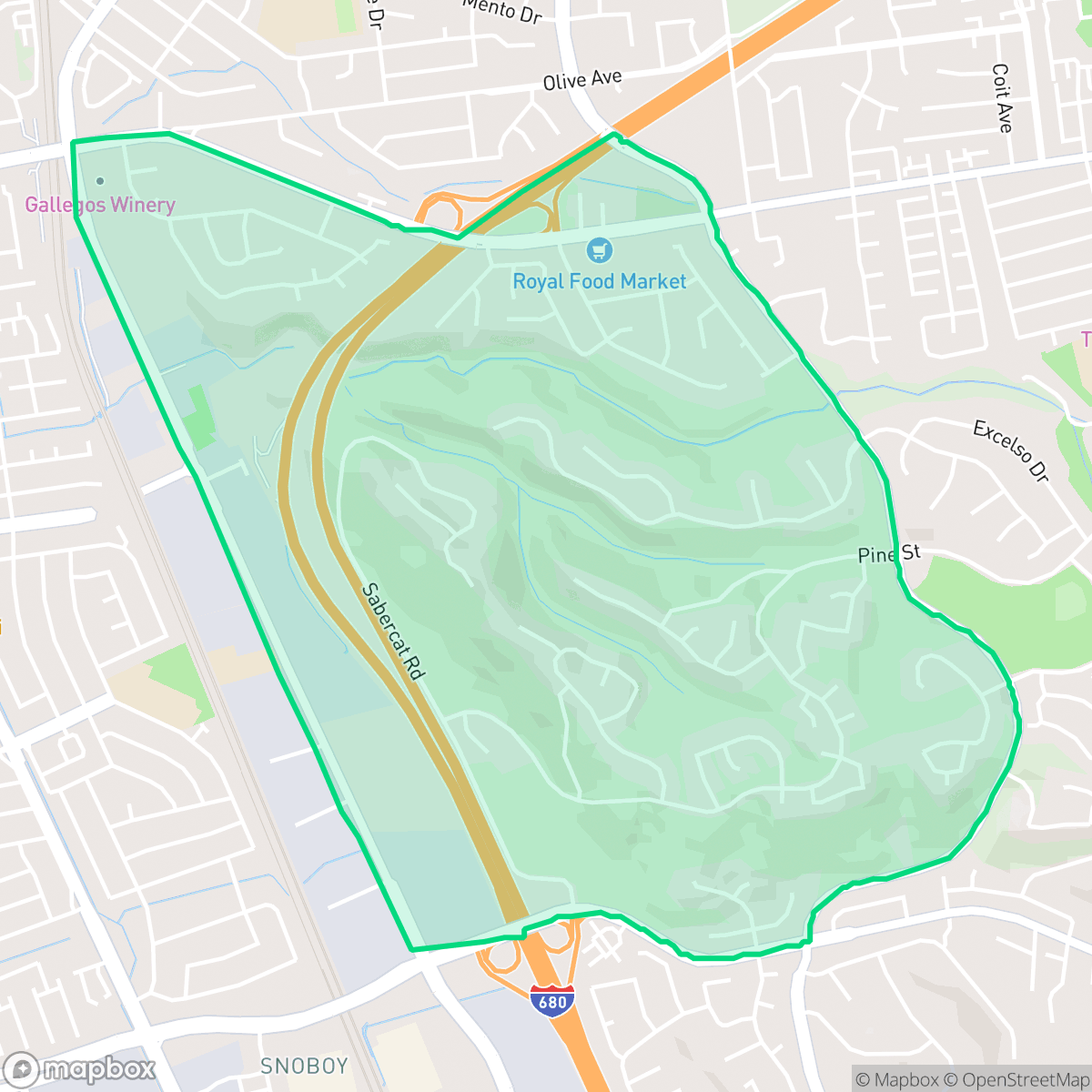
Developed primarily between the 1970s and 1980s, the Cameron Hills neighborhood in southern Fremont is a quiet, residential hillside community characterized by large, multi-level single-family homes and townhomes. The neighborhood is defined by its rich prehistoric and agricultural past, centered around the 98-acre Sabercat Historical Park. This park preserves Sabercat Creek, where local "boy paleontologists" excavated a massive trove of Ice Age fossils—including mammoths and saber-toothed cats—between the 1930s and 1960s. The park also contains the historic ruins of the turn-of-the-century Gallegos (or Dvau) winery storage building, a historic dairy farm, and a massive landmark coast live oak designated by the city in 2012. Additionally, the neighborhood is home to the Washington Township Museum of Local History, housed in a historic 1954 fire station.
The neighborhood is defined by its hillside topography and large, multi-level homes that provide a distinct sense of space compared to the denser parts of Fremont. It is an area characterized by significant natural beauty and open terrain, making it an ideal environment for pet owners who value outdoor access. While the community maintains a peaceful, low-density residential character, it is situated near major transit corridors, which results in a persistent baseline of road traffic noise. Residents here benefit from strong health insurance coverage and access to the high-performing Fremont Unified School District, though the area is best suited for those who prioritize a quiet, suburban lifestyle over walkability or immediate proximity to commercial centers. The neighborhood lacks a dense retail or service core, requiring residents to rely on personal vehicles for daily errands. Furthermore, prospective residents should be aware of the environmental profile, as iHuus data indicates specific challenges regarding flood and fire safety risks that are characteristic of this hillside geography.
Neighborhood Scores Across 15 Qualities
Residential spacing offers a moderate level of separation between neighbors, which is slightly higher than the Fremont city average. Most homes feature typical suburban setbacks and private fenced backyards, though some areas have houses positioned more closely together.
Continuous sidewalks on both sides of the street and clear crosswalks at intersections make navigating the area on foot easy. This level of pedestrian infrastructure is roughly in line with the rest of Fremont.
Expansive homes with well-maintained landscaping and private pools characterize this area, offering a more polished aesthetic than the Fremont average. According to iHuus data, the neighborhood features prominent architectural details and spacious residential lots.
Wide sidewalks, wooded park areas, and connected green corridors provide ample space for pets. According to iHuus data, these features offer a level of dog friendliness that is slightly above the Fremont average.
Open land and scattered greenery provide a more semi-rural atmosphere than the typical Fremont urban layout. According to iHuus data, the area features more frequent sightings of fields and woodland compared to the city average.
Low-density residential blocks and light industrial areas create a subdued atmosphere with limited local services. Most daily errands require a vehicle due to the scarcity of walkable commercial hubs compared to the Fremont average.
Frequent sounds from nearby highways and railroad tracks characterize the area. This level of acoustic disturbance is slightly higher than the average found throughout Fremont, according to iHuus data.
Air quality in this area remains mostly clean with infrequent periods of elevated readings. According to iHuus data, these levels are notably better than the Fremont average.
Industrial presence is minimal in this area, consisting only of occasional light commercial activity. This neighborhood remains very similar to the Fremont average in its lack of large-scale warehouses or heavy freight traffic.
Health insurance access is nearly universal among residents, sitting well above the Fremont average according to iHuus data.
Voting patterns and census indicators reflect a highly liberal political leaning that aligns with the broader Fremont area, according to iHuus data.
Residents live alongside a balanced mix of young professionals, families, and seniors. This age distribution is consistent with the broader Fremont area, according to iHuus data.
Located in a coastal high-hazard zone prone to wave action, this area faces significantly higher flood risks than most of Fremont. Residents should anticipate elevated or potentially prohibitive flood insurance costs according to iHuus data.
Address-Level Insights for Cameron Hills


iHuus Neighborhood Intelligence Insights
Get address-level neighborhood insights for Cameron Hills
- Street-level scores — see how individual blocks compare, not just neighborhood averages
- Micro-zone boundaries — identify quiet pockets, flood boundaries, and walkable clusters before you visit
- 15 dimensions in full — walkability, noise, air quality, school quality, insurance coverage, population age profile, urban/rural index, and more
- Boundary risk alerts — know if your address sits near a block boundary where scores drop, the kind of detail no listing will ever mention
- School insights — individual school ratings and insights, not just district-level data
- Compare before you commit — side-by-side data across neighborhoods, down to block precision
No credit card required
Compare with Any Neighborhood
| Dimension | Cameron Hills | 28 Palms |
|---|---|---|
| 🚶 Walkabilityavg 9.3 | ||
| 🔊 Acoustic Comfortavg 3.38 | ||
| 🤫 Privacy Indexavg 5.09 | ||
| 🎨 Visual Appealavg 6.63 | ||
| 🐕 Dog Friendlinessavg 7.76 | ||
| 🗺️ Urban-Rural Indexavg 6.78 | ||
| ✨ Neighborhood Vibeavg 4.75 | ||
| 🏥 Health Insurance Coverageavg 8.99 | ||
| 🌿 Air Qualityavg 5.76 | ||
| 🏭 Industrial Proximityavg 8.97 | ||
| 🌊 Flood Safetyavg 3.62 | ||
| 🗳️ Ideological Leanavg 9.57 | ||
| 👥 Population Age Profileavg 4.91 | ||
| 🔥 Fire Safetyavg 0.2 | ||
| 🏫 School Quality |
Cameron Hills Rankings
School Districts Serving Cameron Hills
School Insights for Cameron Hills
Below average outcomes; significant attendance and academic challenges.
School Insights
See what's really behind every school rating near Cameron Hills
- Individual school ratings — each school's own score with outcome context, not just a district average
- Enrollment & class size data — student-to-teacher ratio and how it compares to the state average
- Full demographics breakdown — ethnicity and gender composition for every school in the enrollment zone
- Every school in the district — all schools within the enrollment boundary ranked by rating, not just the closest one
- Grade levels & benchmarks — elementary through high school, with below/above state-average flags
No credit card required