Brookvale, Fremont
Updated · 9,999 residents
Brookvale is a highly walkable community in northern Fremont known for its accessible parkland and proximity to regional recreational trails. Residents enjoy a dense suburban environment with a comprehensive network of sidewalks and abundant green spaces, though the area experiences moderate noise levels from local road traffic.
Key Highlights
About Brookvale
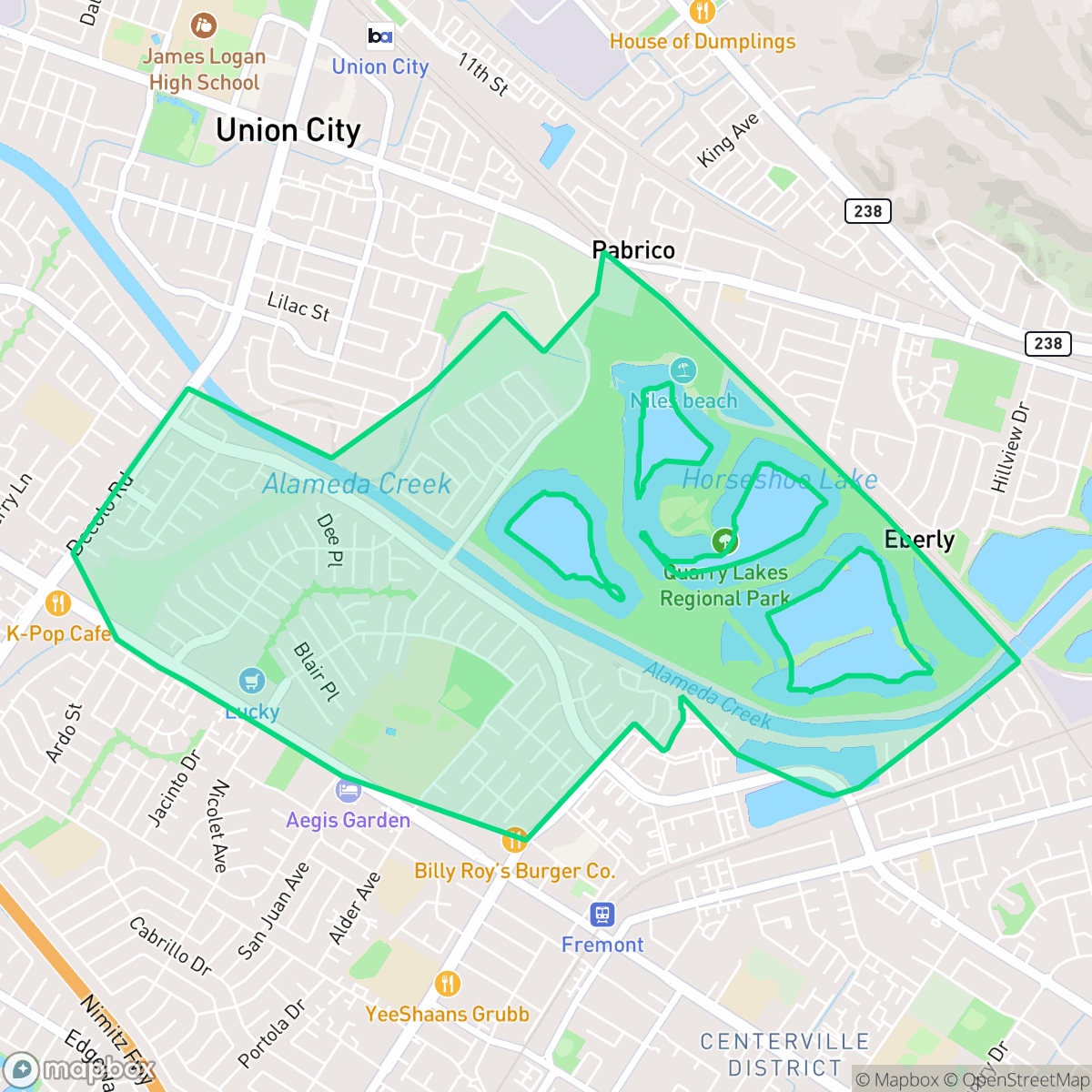
Located in northern Fremont, California, the suburban neighborhood of Brookvale was originally part of a vast 19th-century ranch owned by the prominent Patterson family. Its name derives from a small stream that historically flowed through the area. As part of the post-World War II housing boom in the Centerville district, Brookvale was developed as a residential subdivision primarily between 1971 and 1973. Architecturally, the neighborhood is defined by classic California ranch-style single-family homes characterized by single-story layouts and spacious yards. Centered around Brookvale Park, the neighborhood is bordered by the Alameda Creek Regional Trail and the 471-acre Quarry Lakes Regional Recreation Area, offering residents direct access to extensive greenways and scenic lakeside trails.
The neighborhood functions as a dense suburban enclave that prioritizes pedestrian connectivity and outdoor access. Its layout features a complete sidewalk network that links residential streets to local commercial centers, making it one of the more walkable areas in the city according to iHuus data. The local dining scene provides a diverse range of options, including spots like Gangnam Tofu House, Kyain Kyain, and Suju's Coffee and Tea, which serve as social hubs for the community. Families are well-served by the Fremont Unified School District, with Brookvale Elementary and American High providing high-performing educational options within the vicinity.
Prospective residents should consider a few trade-offs regarding the living environment. While the area is exceptionally dog-friendly and rich in green space, the close proximity of homes results in limited privacy, with many properties sharing fence lines and having small yard buffers. Acoustic comfort is impacted by road traffic, contributing to moderate noise levels throughout the day. Additionally, while the neighborhood is free from industrial hazards, air quality and flood safety metrics suggest that residents should be mindful of broader environmental conditions in this part of the Bay Area.
Neighborhood Scores Across 15 Qualities
Housing structures feature a mix of detached homes and multi-unit buildings with varying setbacks. According to iHuus data, the spacing between neighbors is slightly more concentrated than the typical Fremont average.
Extensive sidewalk networks and clearly marked crosswalks facilitate easy pedestrian movement between residential streets and commercial hubs. This level of connectivity is even higher than the average found throughout Fremont.
Large homes and private backyard pools contribute to a visual landscape that is slightly more upscale than the Fremont average. According to iHuus data, the area features well-maintained properties and spacious driveways typical of affluent suburban residential pockets.
Extensive greenbelts, creek-side trails, and large public parks offer ample space for pets. According to iHuus data, the neighborhood provides more accessible walking areas for dogs than the Fremont average.
Residential patterns consist of established suburban developments featuring single-family homes, apartment complexes, and local commercial centers. This environment is largely consistent with the broader Fremont area's urban-rural balance.
Suburban blocks offer a mix of quiet residential streets and lively pockets of diverse dining and parks, providing a higher level of activity than the Fremont average. While many areas remain calm and low-density, certain sections feature accessible social spots and various local eateries.
Steady traffic hum from nearby busy streets characterizes the area, though acoustic comfort remains higher than the Fremont city average according to iHuus data.
Air quality levels in Brookvale fluctuate between acceptable and unhealthy, presenting occasional concerns for sensitive groups. According to iHuus data, this neighborhood experiences lower air quality than the Fremont average.
Industrial activity and large warehouses are virtually non-existent here, making the area nearly as free of industrial proximity as the rest of Fremont. Residents can expect an environment dominated by residential and light commercial uses without the presence of heavy industrial hazards.
Health insurance enrollment is widespread among Brookvale residents, though it remains slightly below the Fremont city average according to iHuus data.
Voting patterns and census indicators reflect a predominantly liberal political leaning that is consistent with the broader Fremont area, according to iHuus data.
Residents of all ages, from young adults to seniors, live alongside families in this area. According to iHuus data, the age distribution in Brookvale is closely aligned with the broader Fremont average.
Flood risk in this area is higher than the Fremont average, though the specific level of danger remains undetermined due to a lack of detailed federal studies. Residents should remain aware of potential vulnerabilities as official assessments are currently incomplete.
Address-Level Insights for Brookvale


iHuus Neighborhood Intelligence Insights
Get address-level neighborhood insights for Brookvale
- Street-level scores — see how individual blocks compare, not just neighborhood averages
- Micro-zone boundaries — identify quiet pockets, flood boundaries, and walkable clusters before you visit
- 15 dimensions in full — walkability, noise, air quality, school quality, insurance coverage, population age profile, urban/rural index, and more
- Boundary risk alerts — know if your address sits near a block boundary where scores drop, the kind of detail no listing will ever mention
- School insights — individual school ratings and insights, not just district-level data
- Compare before you commit — side-by-side data across neighborhoods, down to block precision
No credit card required
Compare with Any Neighborhood
| Dimension | Brookvale | 28 Palms |
|---|---|---|
| 🚶 Walkabilityavg 9.3 | ||
| 🔊 Acoustic Comfortavg 3.38 | ||
| 🤫 Privacy Indexavg 5.09 | ||
| 🎨 Visual Appealavg 6.63 | ||
| 🐕 Dog Friendlinessavg 7.76 | ||
| 🗺️ Urban-Rural Indexavg 6.78 | ||
| ✨ Neighborhood Vibeavg 4.75 | ||
| 🏥 Health Insurance Coverageavg 8.99 | ||
| 🌿 Air Qualityavg 5.76 | ||
| 🏭 Industrial Proximityavg 8.97 | ||
| 🌊 Flood Safetyavg 3.62 | ||
| 🗳️ Ideological Leanavg 9.57 | ||
| 👥 Population Age Profileavg 4.91 | ||
| 🔥 Fire Safetyavg 0.2 | ||
| 🏫 School Quality |
Brookvale Rankings
School Districts Serving Brookvale
School Insights for Brookvale
Below average outcomes; significant attendance and academic challenges.
School Insights
See what's really behind every school rating near Brookvale
- Individual school ratings — each school's own score with outcome context, not just a district average
- Enrollment & class size data — student-to-teacher ratio and how it compares to the state average
- Full demographics breakdown — ethnicity and gender composition for every school in the enrollment zone
- Every school in the district — all schools within the enrollment boundary ranked by rating, not just the closest one
- Grade levels & benchmarks — elementary through high school, with below/above state-average flags
No credit card required