Fish, Foster City
Updated · 2,644 residents
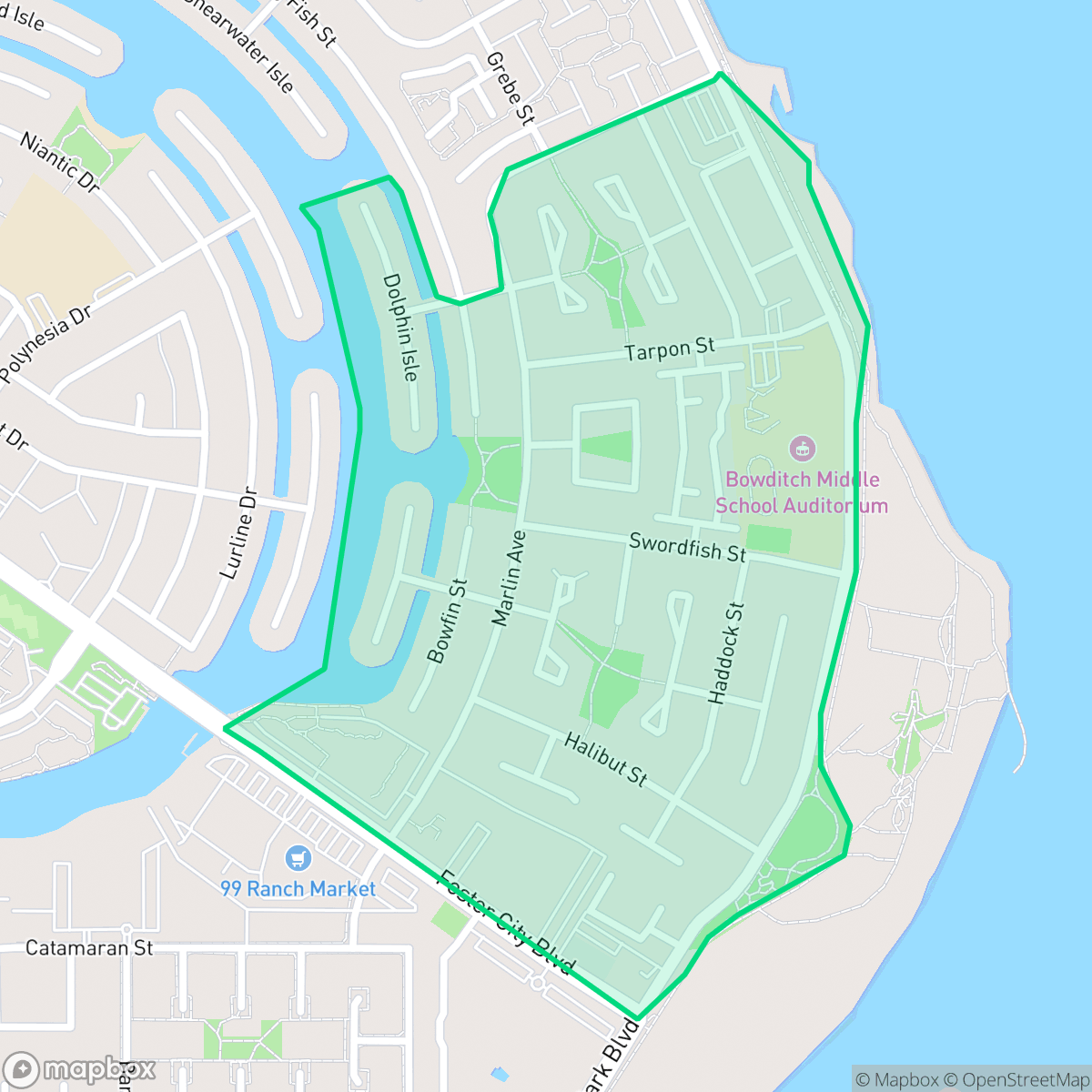
The Fish neighborhood is a highly walkable bayfront community in Foster City, characterized by its extensive network of canals and dedicated pedestrian shoreline paths. Residents benefit from a peaceful, purely residential atmosphere with easy access to local parks and top-tier public schools. According to iHuus data, the area offers a high quality of life with excellent walkability and zero industrial proximity.
Key Highlights
About Fish
The Fish neighborhood, historically designated as Neighborhood 3 (or Carmel Village), is a bayfront enclave in Foster City, California, developed starting in 1965. Built on reclaimed marshland, this master-planned community is defined by its signature streets named after saltwater fish, such as Marlin Avenue, Flying Fish Street, and Bluefish Court. The neighborhood features a mix of mid-1960s single-family homes and later 1970s to 1980s townhomes and condominiums. Distinctive waterfront enclaves, including Sailfish Isle and Dolphin Isle, offer upscale residences equipped with private boat docks along the city's canal network. Carmel Village is also home to Bowditch Middle School—the city’s only public middle school—and local green spaces like Shad Park, Sunfish Park, and the waterfront Marlin Park, alongside the Marlin Cove and Beach Park Plaza shopping centers.
This area is defined by a suburban layout that balances single-family homes with multi-story residential complexes. With a walkability rating that ranks among the highest in the city, the neighborhood provides residents with seamless access to waterfront trails and green spaces such as Shad and Sunfish Parks. The absence of industrial activity ensures a quiet environment for families and professionals, while the presence of Bowditch Middle School anchors the educational landscape for local students. The community maintains a strong sense of place, supported by well-maintained properties and a consistent standard of living. While the neighborhood boasts high visual appeal, prospective residents should note that the residential density results in closely spaced homes and shared fencing. Acoustic comfort is moderate, influenced primarily by road traffic rather than aviation or industrial noise. The community is well-suited for those who prioritize outdoor recreation and a stable, family-oriented environment, supported by strong institutional health and high community engagement. iHuus data confirms that the area maintains a reliable quality of life, making it a stable choice for long-term residents.
Neighborhood Scores Across 15 Qualities
Residential structures are positioned closely together with minimal setbacks, resulting in less privacy than the Foster City average. Many homes in this area feature shared walls or very small gaps between neighboring properties according to iHuus data.
Extensive sidewalk networks and dedicated shoreline paths provide exceptional connectivity for pedestrians. This area offers superior walking infrastructure compared to the rest of Foster City, featuring numerous crossings and low-speed residential streets.
Premium waterfront properties with private docks and large planned homes characterize much of this area, though the overall aesthetic is slightly below the Foster City average. Residential streetscapes feature a mix of high-end estates and standard multi-family complexes with shared amenities.
Abundant shoreline parks and interconnected green belts provide extensive trail networks for pets. This level of accessibility to open space is consistent with the city average.
Dense suburban development defines this area, featuring a variety of single-family homes, townhomes, and apartment complexes alongside water features. This level of development is largely consistent with the rest of Foster City.
Socially vibrant blocks with a notable concentration of dining and parks offer more activity than the Foster City average. Local favorites like Akizu Sushi Bar and Erckenbrack Park contribute to a lively atmosphere, though the layout remains largely car-dependent.
Steady traffic sounds from a nearby busy street are present, though the level of acoustic disturbance is largely consistent with the rest of Foster City according to iHuus data.
Air quality in this area is consistent with the Foster City average, presenting a mix of acceptable and unhealthy days that may occasionally concern sensitive groups according to iHuus data.
No warehouses, industrial facilities, or hazardous sites are present in this area. This layout is consistent with the rest of Foster City, consisting exclusively of residential and recreational spaces.
Nearly all residents possess health insurance, representing a rate that is higher than the Foster City average according to iHuus data.
Voting patterns and census indicators reflect a predominantly liberal political leaning, which is consistent with the broader Foster City area according to iHuus data.
A balanced demographic of young adults, families, and seniors resides here, reflecting a population age profile very similar to the Foster City average according to iHuus data.
Residual flood risks exist within this area as it falls within the 500-year floodplain, though the safety level is comparable to the Foster City average according to iHuus data.
Address-Level Insights for Fish


iHuus Neighborhood Intelligence Insights
Get address-level neighborhood insights for Fish
- Street-level scores — see how individual blocks compare, not just neighborhood averages
- Micro-zone boundaries — identify quiet pockets, flood boundaries, and walkable clusters before you visit
- 15 dimensions in full — walkability, noise, air quality, school quality, insurance coverage, population age profile, urban/rural index, and more
- Boundary risk alerts — know if your address sits near a block boundary where scores drop, the kind of detail no listing will ever mention
- School insights — individual school ratings and insights, not just district-level data
- Compare before you commit — side-by-side data across neighborhoods, down to block precision
No credit card required
Compare with Any Neighborhood
| Dimension | Fish | Admirals |
|---|---|---|
| 🚶 Walkabilityavg 9.66 | ||
| 🔊 Acoustic Comfortavg 5.36 | ||
| 🤫 Privacy Indexavg 4.79 | ||
| 🎨 Visual Appealavg 7.56 | ||
| 🐕 Dog Friendlinessavg 8.13 | ||
| 🗺️ Urban-Rural Indexavg 6.57 | ||
| ✨ Neighborhood Vibeavg 5.89 | ||
| 🏥 Health Insurance Coverageavg 9.32 | ||
| 🌿 Air Qualityavg 6 | ||
| 🏭 Industrial Proximityavg 9.99 | ||
| 🌊 Flood Safetyavg 7.51 | ||
| 🗳️ Ideological Leanavg 9.61 | ||
| 👥 Population Age Profileavg 4.98 | ||
| 🔥 Fire Safety | ||
| 🏫 School Quality |
Fish Rankings
School Districts Serving Fish
School Insights for Fish
Below average outcomes; significant attendance and academic challenges.
School Insights
See what's really behind every school rating near Fish
- Individual school ratings — each school's own score with outcome context, not just a district average
- Enrollment & class size data — student-to-teacher ratio and how it compares to the state average
- Full demographics breakdown — ethnicity and gender composition for every school in the enrollment zone
- Every school in the district — all schools within the enrollment boundary ranked by rating, not just the closest one
- Grade levels & benchmarks — elementary through high school, with below/above state-average flags
No credit card required