Explorers, Foster City
Updated · 2,052 residents
The Explorers neighborhood in Foster City is a dense, master-planned residential area defined by its 1970s townhome architecture and waterfront access. Residents benefit from high visual appeal and excellent dog-friendly amenities, though the tightly packed housing layout results in limited privacy for homeowners.
Key Highlights
About Explorers
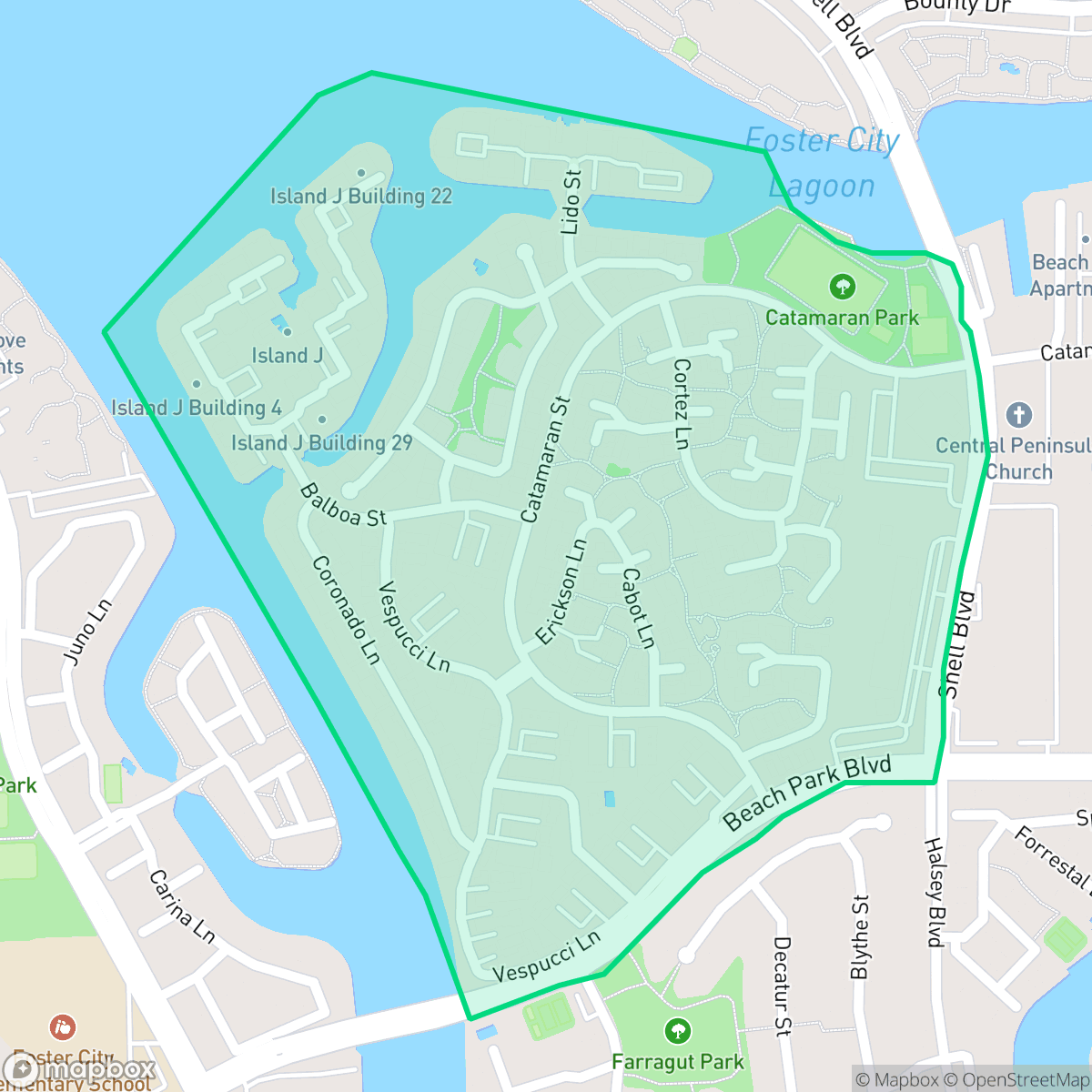
The Explorers neighborhood in Foster City, historically designated as Neighborhood 5, was developed during the 1970s as the city's first neighborhood built out of chronological order. Characterized by its explorer-themed street names—such as Vasco Da Gama, Balboa, and Vespucci—the area consists entirely of multifamily condominiums and townhomes rather than detached single-family residences. It serves as a showcase of 1970s architectural design and master planning, featuring the low-rise townhomes of Winston Square and the waterfront condominiums of Lido Isle. Notably, the neighborhood's prominent development, "The Islands," won the 1976 Award of Excellence from Architectural Record. The area was also historically home to the Charter Square shopping center, which was later demolished to construct Beach Park Elementary School.
The neighborhood offers a distinct suburban atmosphere characterized by its consistent architectural style and well-maintained green belts. With a strong commitment to residential and recreational use, it remains free of industrial activity, fostering a quiet environment suited for families and professionals. According to iHuus data, the area maintains a high level of visual appeal, largely due to its waterfront settings and shared luxury facilities like tennis courts and pools.
Prospective residents should consider that the high-density nature of the townhome and condominium design creates a trade-off regarding privacy, as homes are situated in close proximity. While the area is highly walkable with safe, low-traffic residential loops, those seeking expansive detached lots may find the layout restrictive. The neighborhood is well-served by local schools, including Beach Park Elementary, and remains an attractive option for those prioritizing community-focused living and proximity to outdoor recreational trails.
Neighborhood Scores Across 15 Qualities
Residential spacing varies from shared-wall townhomes to detached houses with moderate yard buffers. According to iHuus data, privacy levels in this area are slightly lower than the Foster City average due to more frequent close-proximity structures.
Extensive sidewalk networks and pedestrian bridges provide safe, connected routes for walking throughout the community. This area offers a pedestrian experience that is very similar to the high standard found across Foster City.
Manicured landscapes, private pools, and waterfront properties define the area, though the overall visual quality is slightly below the Foster City average. Many lots feature complex architectural designs and premium amenities according to iHuus data.
Abundant waterfront trails, wide green belts, and connected park spaces provide excellent opportunities for pet exercise. This level of accessibility to open space is roughly in line with the rest of Foster City.
Primarily composed of dense suburban developments, this area features a mix of townhomes, apartments, and planned communities. The landscape is largely built up with significant grey cover, mirroring the typical suburban character found across Foster City.
Active blocks featuring a noticeable concentration of dining and leisure spots provide a more vibrant atmosphere than the Foster City average. According to iHuus data, these areas offer diverse social hubs such as parks and local eateries interspersed with quiet suburban streets.
Steady sounds from nearby busy streets are present. According to iHuus data, acoustic comfort in this area is slightly higher than the Foster City average.
Air quality in this area typically fluctuates between acceptable and unhealthy levels. According to iHuus data, these conditions are consistent with the city average, though sensitive groups may experience occasional concern on certain days.
Land use in this area is strictly residential and recreational, with no detectable warehouses, industrial facilities, or hazardous sites. This lack of industrial proximity is consistent with the rest of Foster City.
Nearly all residents in this area maintain health insurance coverage, which is slightly below the Foster City average.
Voting patterns and census indicators show a predominantly liberal political leaning, which is consistent with the city average according to iHuus data.
A diverse mix of young adults, families, and older residents defines this area. This demographic distribution is nearly in line with the Foster City average, according to iHuus data.
Residual flood risk exists within this area because it falls within a 500-year floodplain, though safety levels are slightly higher than the Foster City average according to iHuus data.
Address-Level Insights for Explorers


iHuus Neighborhood Intelligence Insights
Get address-level neighborhood insights for Explorers
- Street-level scores — see how individual blocks compare, not just neighborhood averages
- Micro-zone boundaries — identify quiet pockets, flood boundaries, and walkable clusters before you visit
- 15 dimensions in full — walkability, noise, air quality, school quality, insurance coverage, population age profile, urban/rural index, and more
- Boundary risk alerts — know if your address sits near a block boundary where scores drop, the kind of detail no listing will ever mention
- School insights — individual school ratings and insights, not just district-level data
- Compare before you commit — side-by-side data across neighborhoods, down to block precision
No credit card required
Compare with Any Neighborhood
| Dimension | Explorers | Admirals |
|---|---|---|
| 🚶 Walkabilityavg 9.66 | ||
| 🔊 Acoustic Comfortavg 5.36 | ||
| 🤫 Privacy Indexavg 4.79 | ||
| 🎨 Visual Appealavg 7.56 | ||
| 🐕 Dog Friendlinessavg 8.13 | ||
| 🗺️ Urban-Rural Indexavg 6.57 | ||
| ✨ Neighborhood Vibeavg 5.89 | ||
| 🏥 Health Insurance Coverageavg 9.32 | ||
| 🌿 Air Qualityavg 6 | ||
| 🏭 Industrial Proximityavg 9.99 | ||
| 🌊 Flood Safetyavg 7.51 | ||
| 🗳️ Ideological Leanavg 9.61 | ||
| 👥 Population Age Profileavg 4.98 | ||
| 🔥 Fire Safety | ||
| 🏫 School Quality |
Explorers Rankings
School Districts Serving Explorers
School Insights for Explorers
Below average outcomes; significant attendance and academic challenges.
School Insights
See what's really behind every school rating near Explorers
- Individual school ratings — each school's own score with outcome context, not just a district average
- Enrollment & class size data — student-to-teacher ratio and how it compares to the state average
- Full demographics breakdown — ethnicity and gender composition for every school in the enrollment zone
- Every school in the district — all schools within the enrollment boundary ranked by rating, not just the closest one
- Grade levels & benchmarks — elementary through high school, with below/above state-average flags
No credit card required