Birds, Foster City
Updated · 2,349 residents
The Birds neighborhood is an exceptionally walkable residential area characterized by its mid-century modern aesthetic and direct access to the San Francisco Bay. While it offers residents convenient proximity to local parks and community amenities, the area experiences notable noise from road traffic and features limited privacy between homes.
Key Highlights
About Birds
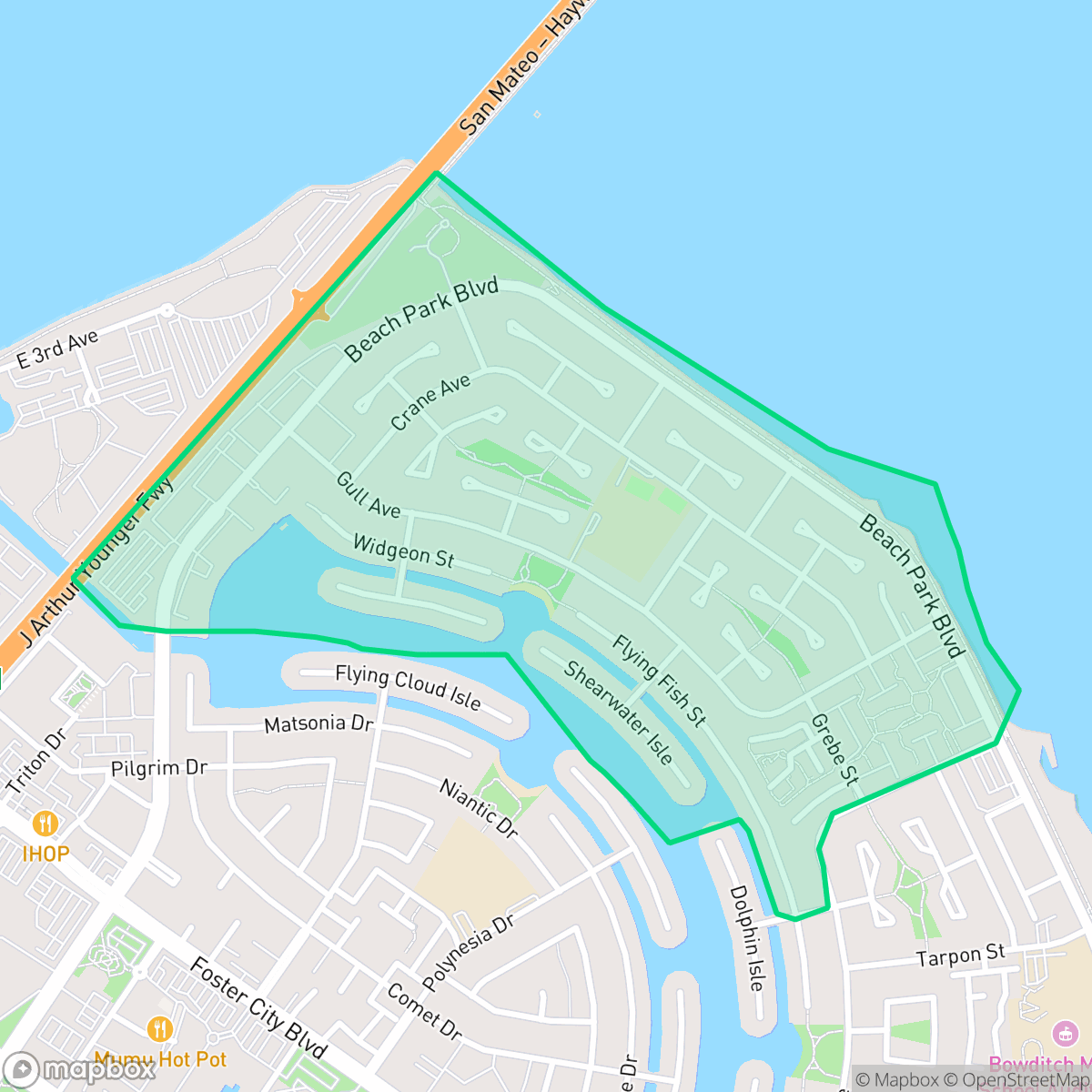
Established in 1965, the Birds neighborhood (originally Neighborhood Two and later known as Bay Vista) was Foster City’s second master-planned subdivision. Developed under the vision of T. Jack Foster, the neighborhood’s initial residential construction spanned from 1965 to 1969 and featured mid-century modern designs by prominent builders, including Joseph Eichler, Kay, and Duc & Elliot. True to its name, the neighborhood’s streets—such as Dove Lane, Duck Court, and Loon Court—are named after bird species. Bordered to the west by the San Francisco Bay along Beach Park Boulevard, the neighborhood provides direct access to the scenic Bay Trail. Local landmarks include Audubon Elementary School, completed in 1968 to serve the growing community, and several bird-themed public spaces, including Gull Park, Turnstone Park, and Kildeer Park.
The area functions as a highly accessible suburban enclave, where residents benefit from a perfect walkability score. The layout integrates residential streets with community green spaces like Gull Park, fostering a social atmosphere that slightly exceeds the city average for liveliness. Local establishments such as Sandwich Monkey and Penelope's Coffee and Tea serve as primary social hubs, providing residents with immediate access to dining and services. According to iHuus data, the community maintains high health insurance coverage and a stable population profile, reflecting a demographic that values long-term residency in a well-connected environment.
Prospective residents should account for specific trade-offs, particularly regarding acoustic comfort. The neighborhood experiences significant noise from road traffic, which impacts the overall tranquility of the residential blocks. Additionally, the architectural density results in lower privacy levels compared to other parts of Foster City. The area is best suited for individuals who prioritize walkability and proximity to the waterfront over absolute quiet, and who appreciate the established, master-planned character of this coastal community.
Neighborhood Scores Across 15 Qualities
Residential spacing is varied with some areas featuring closely positioned houses and shared walls in certain complexes. This level of density is slightly higher than the Foster City average, according to iHuus data.
Continuous sidewalks and extensive lagoon paths provide excellent opportunities for walking. This level of accessibility is consistent with the high walkability found throughout Foster City.
Waterfront properties featuring private docks and upscale amenities provide a high level of visual interest, though the overall aesthetic sits slightly below the Foster City average. According to iHuus data, the area is characterized by complex architectural geometries and frequent access to community pools.
Wide green verges and abundant public parks provide ample space for pets. This neighborhood offers slightly less dog-friendly infrastructure than the Foster City average according to iHuus data.
Dense suburban layouts of single-family and multi-family homes are interspersed with various water features, matching the city average for urban-rural character.
Local dining options and parks create a more active atmosphere than the Foster City average. While certain blocks offer quiet suburban scenery, several areas feature a noticeable concentration of social hubs and leisure businesses.
Steady traffic sounds from nearby busy streets are noticeable, making this area slightly noisier than the Foster City average according to iHuus data.
Air quality in this area fluctuates between acceptable and unhealthy levels, consistent with the average for Foster City. According to iHuus data, sensitive groups should remain aware of occasional days with poorer air quality.
No warehouses, industrial facilities, or hazardous sites are present in this area. This neighborhood matches the city average for being exclusively residential and recreational.
Nearly all residents are covered by health insurance, representing a rate slightly higher than the Foster City average according to iHuus data.
Voting patterns and census indicators show a predominantly liberal political leaning, which is consistent with the overall city average according to iHuus data.
Residents live alongside a balanced distribution of young adults, families, and older individuals. This demographic spread is consistent with the broader Foster City area according to iHuus data.
Residual flood risk exists due to the area's location within a 500-year floodplain, though safety levels remain comparable to the Foster City average according to iHuus data.
Address-Level Insights for Birds


iHuus Neighborhood Intelligence Insights
Get address-level neighborhood insights for Birds
- Street-level scores — see how individual blocks compare, not just neighborhood averages
- Micro-zone boundaries — identify quiet pockets, flood boundaries, and walkable clusters before you visit
- 15 dimensions in full — walkability, noise, air quality, school quality, insurance coverage, population age profile, urban/rural index, and more
- Boundary risk alerts — know if your address sits near a block boundary where scores drop, the kind of detail no listing will ever mention
- School insights — individual school ratings and insights, not just district-level data
- Compare before you commit — side-by-side data across neighborhoods, down to block precision
No credit card required
Compare with Any Neighborhood
| Dimension | Birds | Admirals |
|---|---|---|
| 🚶 Walkabilityavg 9.66 | ||
| 🔊 Acoustic Comfortavg 5.36 | ||
| 🤫 Privacy Indexavg 4.79 | ||
| 🎨 Visual Appealavg 7.56 | ||
| 🐕 Dog Friendlinessavg 8.13 | ||
| 🗺️ Urban-Rural Indexavg 6.57 | ||
| ✨ Neighborhood Vibeavg 5.89 | ||
| 🏥 Health Insurance Coverageavg 9.32 | ||
| 🌿 Air Qualityavg 6 | ||
| 🏭 Industrial Proximityavg 9.99 | ||
| 🌊 Flood Safetyavg 7.51 | ||
| 🗳️ Ideological Leanavg 9.61 | ||
| 👥 Population Age Profileavg 4.98 | ||
| 🔥 Fire Safety | ||
| 🏫 School Quality |
Birds Rankings
School Districts Serving Birds
School Insights for Birds
Below average outcomes; significant attendance and academic challenges.
School Insights
See what's really behind every school rating near Birds
- Individual school ratings — each school's own score with outcome context, not just a district average
- Enrollment & class size data — student-to-teacher ratio and how it compares to the state average
- Full demographics breakdown — ethnicity and gender composition for every school in the enrollment zone
- Every school in the district — all schools within the enrollment boundary ranked by rating, not just the closest one
- Grade levels & benchmarks — elementary through high school, with below/above state-average flags
No credit card required