Walnut Village, Fontana
Updated · 3,750 residents
Walnut Village is a dense suburban community in northeast Fontana characterized by its grid of single-family homes and proximity to major regional logistics hubs. While the area offers a consistent sidewalk network for pedestrians, residents experience notable noise from road traffic and limited private green space.
Key Highlights
About Walnut Village
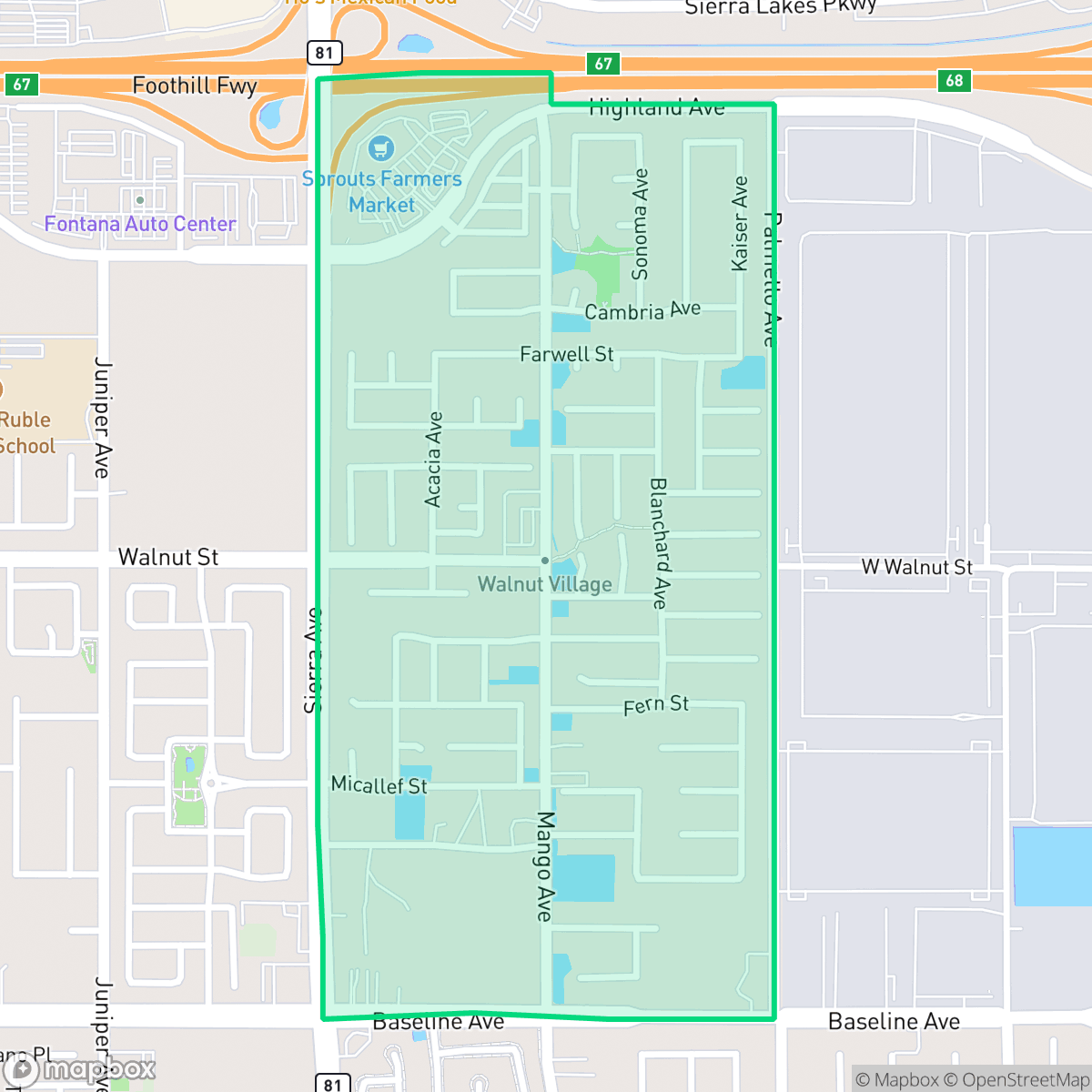
Located in the northeast portion of Fontana, California, Walnut Village is a master-planned suburban community bounded by the 210 Freeway, Palmetto Avenue, Baseline Avenue, and Sierra Avenue. The neighborhood's modern development took shape following the adoption of the original Walnut Village Specific Plan in 1983. A major milestone in its growth occurred in February 1985 with the opening of the Walnut Village patio homes, a 269-unit master-planned community designed by architect Len Nobel and developed by Berry Development and Centennial Group. Characterized primarily by single-family homes built between the 1970s and late 1990s, the neighborhood has transitioned over the decades. In 2024, the city approved the New Walnut Village Specific Plan to introduce mixed-use zoning, up-zoning, and increased residential density across its 342-acre footprint.
The area is defined by its compact residential layout where homes are situated in close proximity, often sharing side yards. The streetscape features standard middle-class tract housing, interspersed with the occasional private pool. According to iHuus data, the neighborhood benefits from a high rate of health insurance coverage among its residents, reflecting a stable professional demographic. Its location near major freight corridors provides convenient transit access, though this proximity to industrial warehouses introduces consistent road traffic noise and impacts the overall acoustic comfort of the area.
Prospective residents should note the trade-offs inherent in this dense suburban environment. While the area maintains a high degree of walkability for a community of its type, the lack of expansive public parks and narrow sidewalk verges can be challenging for pet owners. The neighborhood is best suited for those who prioritize proximity to major transit arteries and regional employment centers over quiet, secluded living. With the recent shift toward mixed-use zoning, the area is currently transitioning to accommodate higher residential density and a more diverse range of amenities.
Neighborhood Scores Across 15 Qualities
Residential plots feature closely packed housing with shared side yards and minimal buffering between neighbors. This layout provides less privacy than the typical Fontana neighborhood, according to iHuus data.
Sidewalks are common along residential streets and include safe crossings, though connectivity is limited by large industrial blocks and high-traffic roads. According to iHuus data, walking ease in this area is lower than the Fontana city average.
Standard tract housing characterizes this area, featuring uniform rooflines and small yards. According to iHuus data, the visual landscape is slightly less varied than the city average.
Limited public parks and narrow sidewalk verges make off-leash exercise difficult. According to iHuus data, the availability of accessible green space in this area is below the Fontana average.
Residential tracts sit alongside large-scale logistics warehouses and industrial earthworks. This landscape is slightly more urbanized than the surrounding Fontana area according to iHuus data.
A steady flow of activity exists near major transit corridors, though much of the area remains a quiet suburban setting. According to iHuus data, the level of local liveliness is slightly higher than the Fontana average, driven by a mix of essential services and dining options near highway-adjacent blocks.
Steady traffic sounds from a nearby busy street are common in this area. This level of acoustic activity is slightly higher than the average for Fontana, according to iHuus data.
Air quality in this area fluctuates between acceptable and unhealthy levels on certain days. According to iHuus data, the air quality tends to be slightly lower than the Fontana city average, which may cause occasional concern for sensitive groups.
Residential pockets exist alongside distribution centers and logistics hubs, resulting in more heavy truck traffic and loading dock activity than the typical Fontana neighborhood. According to iHuus data, some areas are also located near a Superfund site with potential groundwater concerns.
Health insurance accessibility is notably higher here than the Fontana average, according to iHuus data. Most residents in this area possess comprehensive medical coverage.
Political leanings in Walnut Village align closely with the broader Fontana area, characterized by a liberal majority and a modest opposing presence according to iHuus data.
A diverse mix of young adults, families, and older residents defines the community. This demographic spread is roughly in line with the broader Fontana area, according to iHuus data.
Flood risk in this area is significant and matches the level found across the rest of the city. Residents should prepare for potentially high or prohibitive insurance costs due to these hazards.
Address-Level Insights for Walnut Village


iHuus Neighborhood Intelligence Insights
Get address-level neighborhood insights for Walnut Village
- Street-level scores — see how individual blocks compare, not just neighborhood averages
- Micro-zone boundaries — identify quiet pockets, flood boundaries, and walkable clusters before you visit
- 15 dimensions in full — walkability, noise, air quality, school quality, insurance coverage, population age profile, urban/rural index, and more
- Boundary risk alerts — know if your address sits near a block boundary where scores drop, the kind of detail no listing will ever mention
- School insights — individual school ratings and insights, not just district-level data
- Compare before you commit — side-by-side data across neighborhoods, down to block precision
No credit card required
Compare with Any Neighborhood
| Dimension | Walnut Village | Citrus Heights |
|---|---|---|
| 🚶 Walkabilityavg 7.84 | ||
| 🔊 Acoustic Comfortavg 4.52 | ||
| 🤫 Privacy Indexavg 4.77 | ||
| 🎨 Visual Appealavg 6.2 | ||
| 🐕 Dog Friendlinessavg 5.44 | ||
| 🗺️ Urban-Rural Indexavg 6.65 | ||
| ✨ Neighborhood Vibeavg 4.01 | ||
| 🏥 Health Insurance Coverageavg 6.25 | ||
| 🌿 Air Qualityavg 6.56 | ||
| 🏭 Industrial Proximityavg 6.85 | ||
| 🌊 Flood Safetyavg 1.02 | ||
| 🗳️ Ideological Leanavg 8.61 | ||
| 👥 Population Age Profileavg 4.4 | ||
| 🔥 Fire Safetyavg 0.29 | ||
| 🏫 School Quality |
Walnut Village Rankings
School Districts Serving Walnut Village
School Insights for Walnut Village
Below average outcomes; significant attendance and academic challenges.
School Insights
See what's really behind every school rating near Walnut Village
- Individual school ratings — each school's own score with outcome context, not just a district average
- Enrollment & class size data — student-to-teacher ratio and how it compares to the state average
- Full demographics breakdown — ethnicity and gender composition for every school in the enrollment zone
- Every school in the district — all schools within the enrollment boundary ranked by rating, not just the closest one
- Grade levels & benchmarks — elementary through high school, with below/above state-average flags
No credit card required