Southridge Village, Fontana
Updated · 25,549 residents
Southridge Village is a master-planned community in southern Fontana characterized by a highly walkable residential layout and extensive access to local parks. While the neighborhood offers a dense suburban environment with uniform tract housing, it maintains a strong connection to outdoor recreation through greenbelts and the expansive Martin Tudor Jurupa Hills Regional Park.
Key Highlights
About Southridge Village
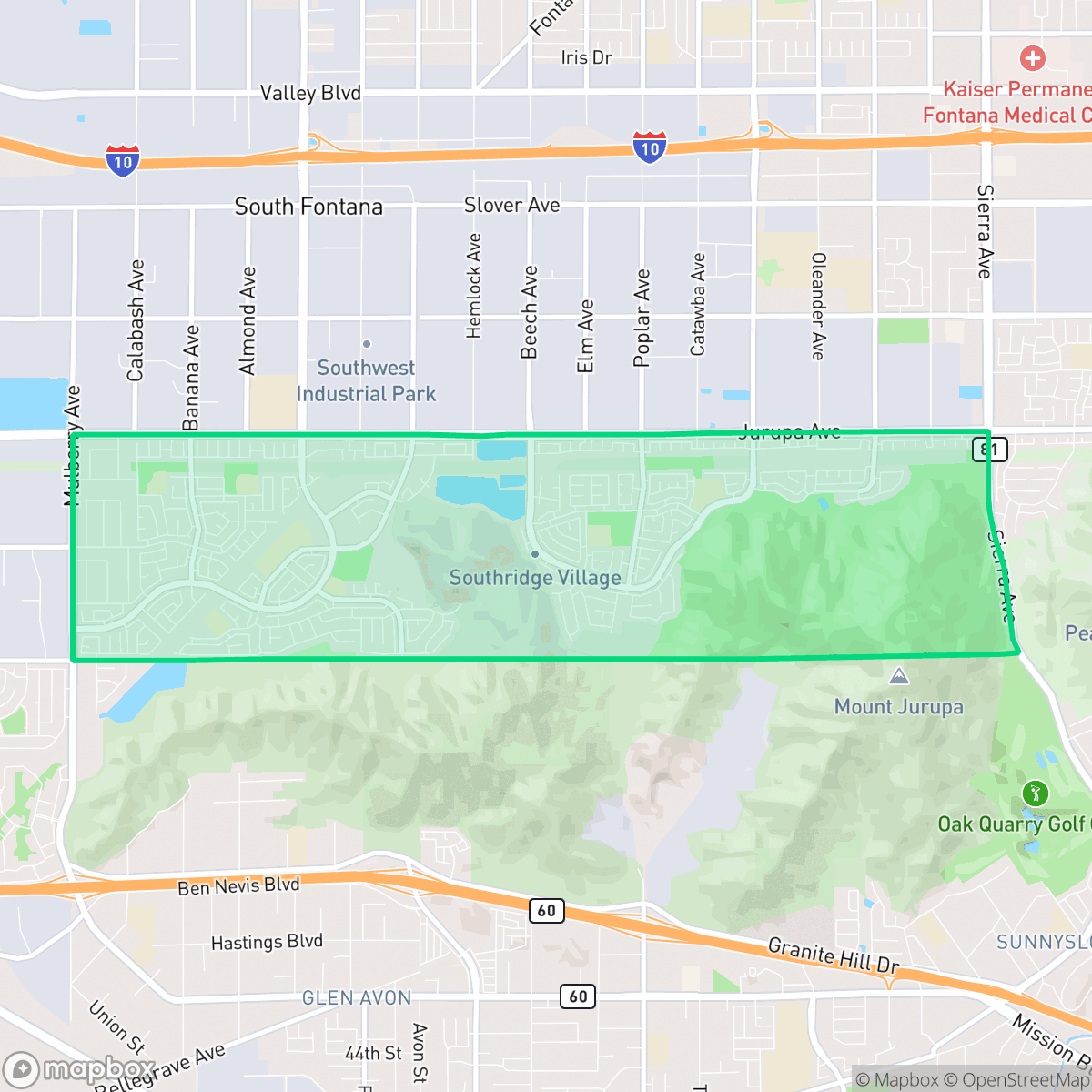
Established under a specific plan adopted in 1981, Southridge Village is a 2,640-acre master-planned community in southern Fontana, California. Bounded by Jurupa Avenue to the north and the Riverside County line to the south, the neighborhood was designed to transition Fontana away from its industrial, steel-mill-dominated past into a modern residential hub. Developed in phases starting in the 1980s, the community features thousands of suburban homes, local schools, and the prominent Martin Tudor Jurupa Hills Regional Park, which provides hiking trails and open space. Historically, Southridge Village represented a major cultural shift; in its early years, some new residents famously attempted to use the neighborhood's name as their official mailing address to distance themselves from the city's blue-collar reputation.
The area functions as a dense, suburban residential hub that prioritizes pedestrian connectivity. Residents benefit from a comprehensive network of sidewalks that span both residential streets and major thoroughfares, making it one of the more walkable districts in the city. The landscape is defined by uniform tract housing and shared green spaces, including utility corridors that provide pet-friendly walking paths. According to iHuus data, the neighborhood maintains high air quality scores, which contributes to the appeal of its numerous outdoor recreational areas and neighborhood parks.
Prospective residents should consider the trade-offs inherent in this high-density setting, where homes are often closely spaced with minimal yard buffers. The proximity to large-scale industrial warehouses and freight corridors means that while the streets are generally quiet, the area is subject to the logistical activity characteristic of the broader Fontana region. The neighborhood is well-suited for those seeking a structured, suburban lifestyle with immediate access to schools and community amenities, though it may be less appealing to those prioritizing maximum privacy or complete isolation from industrial operations.
Neighborhood Scores Across 15 Qualities
Residential spacing in Southridge Village is somewhat compressed, with several clusters of homes featuring minimal setbacks and closely packed rooftops. According to iHuus data, this level of density is slightly higher than the average for Fontana.
Extensive sidewalk networks and marked crosswalks make navigating the area on foot easy; according to iHuus data, this level of pedestrian infrastructure is notably higher than the Fontana average.
Residential views range from large homes with private pools and expansive driveways to more uniform, densely packed tract housing. Overall visual quality is slightly above the Fontana average due to the presence of upscale amenities and larger lots in certain sections.
Abundant greenbelts, large parks, and wide sidewalk verges provide ample space for walking dogs. According to iHuus data, these connected green spaces and utility corridors offer significantly better pet walking opportunities than the Fontana average.
Residential tracts here sit adjacent to large-scale industrial warehouses and expansive open terrain. According to iHuus data, this area offers a slightly more semi-rural feel than the typical Fontana landscape.
A tranquil, low-density atmosphere prevails here, characterized by a balance of green spaces and industrial warehouses. While the area is largely residential and quiet, it offers a similar level of activity to the rest of Fontana.
A persistent hum from nearby busy streets characterizes the area, which is slightly more audible than the average for Fontana. According to iHuus data, this level of acoustic activity remains moderate throughout the day.
Air quality remains mostly clean with infrequent periods of elevated readings. According to iHuus data, the air quality in Southridge Village is notably better than the Fontana average.
Industrial presence is minimal within the neighborhood, as the area consists mainly of residential zones and light commercial spaces. This level of industrial proximity is consistent with the average found throughout Fontana.
Health insurance enrollment among residents is notably higher than the Fontana average, according to iHuus data. This indicates a greater proportion of the local population has access to medical coverage.
Voting patterns and census indicators show a strong liberal leaning that is even more pronounced than the city average, according to iHuus data.
Residents live alongside a balanced mix of young adults, families, and older individuals. This demographic distribution is consistent with the broader Fontana area according to iHuus data.
Located within a 100-year floodplain, this area faces significant flood risks that are notably higher than the Fontana average. According to iHuus data, residents should prepare for the potential necessity of flood insurance.
High levels of fire risk are present in this area, which is notably higher than the typical levels found throughout Fontana. Residents should be aware of extreme fire hazards and ensure that all necessary protection measures are in place according to iHuus data.
Address-Level Insights for Southridge Village


iHuus Neighborhood Intelligence Insights
Get address-level neighborhood insights for Southridge Village
- Street-level scores — see how individual blocks compare, not just neighborhood averages
- Micro-zone boundaries — identify quiet pockets, flood boundaries, and walkable clusters before you visit
- 15 dimensions in full — walkability, noise, air quality, school quality, insurance coverage, population age profile, urban/rural index, and more
- Boundary risk alerts — know if your address sits near a block boundary where scores drop, the kind of detail no listing will ever mention
- School insights — individual school ratings and insights, not just district-level data
- Compare before you commit — side-by-side data across neighborhoods, down to block precision
No credit card required
Compare with Any Neighborhood
| Dimension | Southridge Village | Citrus Heights |
|---|---|---|
| 🚶 Walkabilityavg 7.84 | ||
| 🔊 Acoustic Comfortavg 4.52 | ||
| 🤫 Privacy Indexavg 4.77 | ||
| 🎨 Visual Appealavg 6.2 | ||
| 🐕 Dog Friendlinessavg 5.44 | ||
| 🗺️ Urban-Rural Indexavg 6.65 | ||
| ✨ Neighborhood Vibeavg 4.01 | ||
| 🏥 Health Insurance Coverageavg 6.25 | ||
| 🌿 Air Qualityavg 6.56 | ||
| 🏭 Industrial Proximityavg 6.85 | ||
| 🌊 Flood Safetyavg 1.02 | ||
| 🗳️ Ideological Leanavg 8.61 | ||
| 👥 Population Age Profileavg 4.4 | ||
| 🔥 Fire Safetyavg 0.29 | ||
| 🏫 School Quality |
Southridge Village Rankings
School Districts Serving Southridge Village
School Insights for Southridge Village
Below average outcomes; significant attendance and academic challenges.
School Insights
See what's really behind every school rating near Southridge Village
- Individual school ratings — each school's own score with outcome context, not just a district average
- Enrollment & class size data — student-to-teacher ratio and how it compares to the state average
- Full demographics breakdown — ethnicity and gender composition for every school in the enrollment zone
- Every school in the district — all schools within the enrollment boundary ranked by rating, not just the closest one
- Grade levels & benchmarks — elementary through high school, with below/above state-average flags
No credit card required