Downtown Fontana, Fontana
Updated · 7,824 residents
Downtown Fontana serves as the city's cultural and historical core, currently evolving into a pedestrian-friendly entertainment hub known as the Forge District. The area features a dense, lively suburban environment with diverse local dining options, though residents should expect tight living quarters and significant road noise.
Key Highlights
About Downtown Fontana
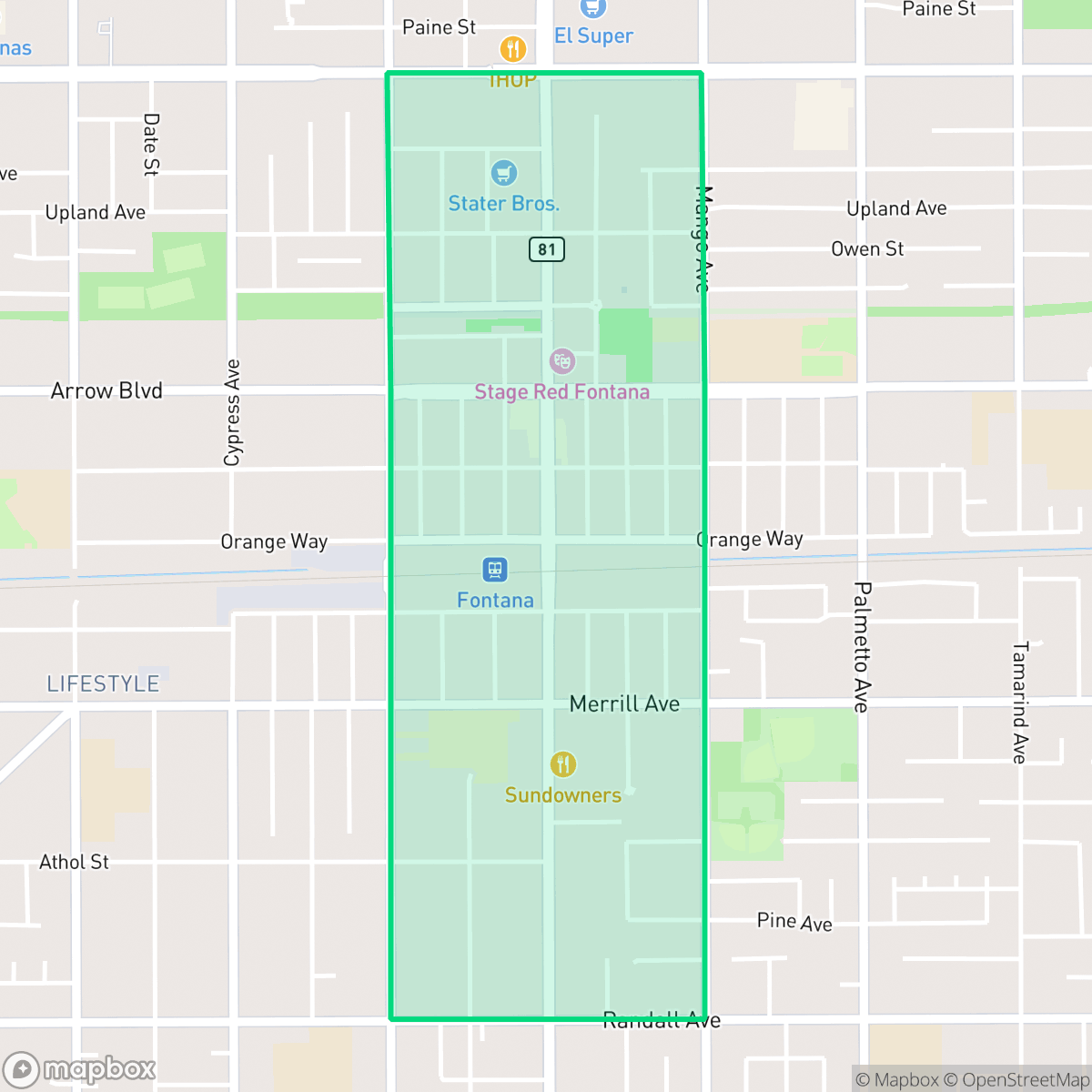
Downtown Fontana, centered along Sierra Avenue just south of historic Route 66, serves as the city's historical and cultural heart. Originally a bustling blue-collar hub during the mid-20th-century boom of the nearby Kaiser Steel mill, the neighborhood retains several key architectural landmarks. Notable among these is the 1937 Art Deco Fontana Theater, designed by the Boller Brothers, which was recently restored and renamed Stage Red Theater to honor local musician Sammy Hagar. Nearby, the Helen Putnam Historical Plaza hosts the Art Depot—a former 1915 Pacific Electric Railway freight station now operating as a cultural arts center—and the 1925 Pagliuso Family Chapel. Today, the neighborhood is undergoing a modern renaissance, with the city actively transforming the historic core into a pedestrian-friendly entertainment hub known as the Forge District.
This neighborhood functions as a vibrant social center, characterized by its grid-based street layout and a high density of residential and commercial properties. The ongoing development of the Forge District aims to revitalize the historic core, fostering a lively atmosphere supported by local eateries and cultural venues. Residents benefit from a consistent sidewalk network that facilitates local transit, contributing to a more active street life than found in surrounding areas.
Prospective residents should weigh the benefits of this central location against specific livability trade-offs. The high-density layout results in limited privacy, as many homes share walls or sit in close proximity to neighbors. Additionally, the area experiences elevated noise levels primarily from road traffic, and the proximity to industrial zones suggests a more urbanized experience. While the neighborhood offers a strong sense of community and accessibility, those seeking quiet, spacious lots or top-tier school districts may find the environment challenging.
Neighborhood Scores Across 15 Qualities
Residential structures and multi-unit buildings feature minimal gaps between neighbors, resulting in a density slightly higher than the Fontana average according to iHuus data.
Sidewalks and marked crosswalks are widely available throughout the area, though large parking lots and certain major roads create a car-centric feel that is slightly lower than the Fontana average. Residential streets offer a consistent grid for walking, according to iHuus data.
Standard tract housing and apartment complexes dominate the landscape, featuring consistent rooflines and modest yards. According to iHuus data, the visual variety in this area is slightly lower than the Fontana city average.
Access to public green space for dogs is inconsistent throughout the area, though some parts of the neighborhood benefit from proximity to large sports parks and walking paths. According to iHuus data, the availability of dog-friendly infrastructure is roughly in line with the rest of Fontana.
Low-density residential layouts and commercial blocks characterize this area, which feels slightly more urban than the typical Fontana landscape. According to iHuus data, the neighborhood features a dense mix of single-family homes and multi-story apartments integrated with commercial strips.
Frequent activity from a dense mix of local eateries, coffee shops, and community spaces makes this area significantly more vibrant than the Fontana average. Residents can find a concentrated variety of dining and social spots, though most destinations require a vehicle to reach.
Local traffic from nearby busy streets creates a consistent hum. This level of acoustic activity is slightly higher than the average found throughout Fontana.
Air quality in this area fluctuates between acceptable and unhealthy levels, presenting occasional concerns for sensitive groups. According to iHuus data, these conditions are slightly lower than the average seen throughout Fontana.
Residential and light commercial uses dominate the area, making it significantly clearer of heavy industry than the Fontana average. While some large warehouse structures exist on the periphery, residents will find very few industrial hazards or large-scale manufacturing plants within the neighborhood core.
Health insurance access is lower than the city average for this area, according to iHuus data.
Voting patterns and census indicators show a strong liberal leaning that is more pronounced than the city average, according to iHuus data.
Residents of all ages, from young professionals to seniors, live alongside one another here. This demographic spread is largely in line with the broader Fontana area.
Property located within a known floodplain face increased vulnerability to flooding; according to iHuus data, this area carries a higher risk of flood events compared to the rest of Fontana.
Address-Level Insights for Downtown Fontana


iHuus Neighborhood Intelligence Insights
Get address-level neighborhood insights for Downtown Fontana
- Street-level scores — see how individual blocks compare, not just neighborhood averages
- Micro-zone boundaries — identify quiet pockets, flood boundaries, and walkable clusters before you visit
- 15 dimensions in full — walkability, noise, air quality, school quality, insurance coverage, population age profile, urban/rural index, and more
- Boundary risk alerts — know if your address sits near a block boundary where scores drop, the kind of detail no listing will ever mention
- School insights — individual school ratings and insights, not just district-level data
- Compare before you commit — side-by-side data across neighborhoods, down to block precision
No credit card required
Compare with Any Neighborhood
| Dimension | Downtown Fontana | Citrus Heights |
|---|---|---|
| 🚶 Walkabilityavg 7.84 | ||
| 🔊 Acoustic Comfortavg 4.52 | ||
| 🤫 Privacy Indexavg 4.77 | ||
| 🎨 Visual Appealavg 6.2 | ||
| 🐕 Dog Friendlinessavg 5.44 | ||
| 🗺️ Urban-Rural Indexavg 6.65 | ||
| ✨ Neighborhood Vibeavg 4.01 | ||
| 🏥 Health Insurance Coverageavg 6.25 | ||
| 🌿 Air Qualityavg 6.56 | ||
| 🏭 Industrial Proximityavg 6.85 | ||
| 🌊 Flood Safetyavg 1.02 | ||
| 🗳️ Ideological Leanavg 8.61 | ||
| 👥 Population Age Profileavg 4.4 | ||
| 🔥 Fire Safetyavg 0.29 | ||
| 🏫 School Quality |
Downtown Fontana Rankings
School Districts Serving Downtown Fontana
School Insights for Downtown Fontana
Below average outcomes; significant attendance and academic challenges.
School Insights
See what's really behind every school rating near Downtown Fontana
- Individual school ratings — each school's own score with outcome context, not just a district average
- Enrollment & class size data — student-to-teacher ratio and how it compares to the state average
- Full demographics breakdown — ethnicity and gender composition for every school in the enrollment zone
- Every school in the district — all schools within the enrollment boundary ranked by rating, not just the closest one
- Grade levels & benchmarks — elementary through high school, with below/above state-average flags
No credit card required