The Parkway, Folsom
Updated · 3,060 residents
The Parkway is a quiet, master-planned community in Folsom defined by its extensive trail network and commitment to preserved natural space. Residents benefit from exceptional walkability and dog-friendly surroundings, though the area remains a serene, suburban environment with limited commercial activity.
Key Highlights
About The Parkway
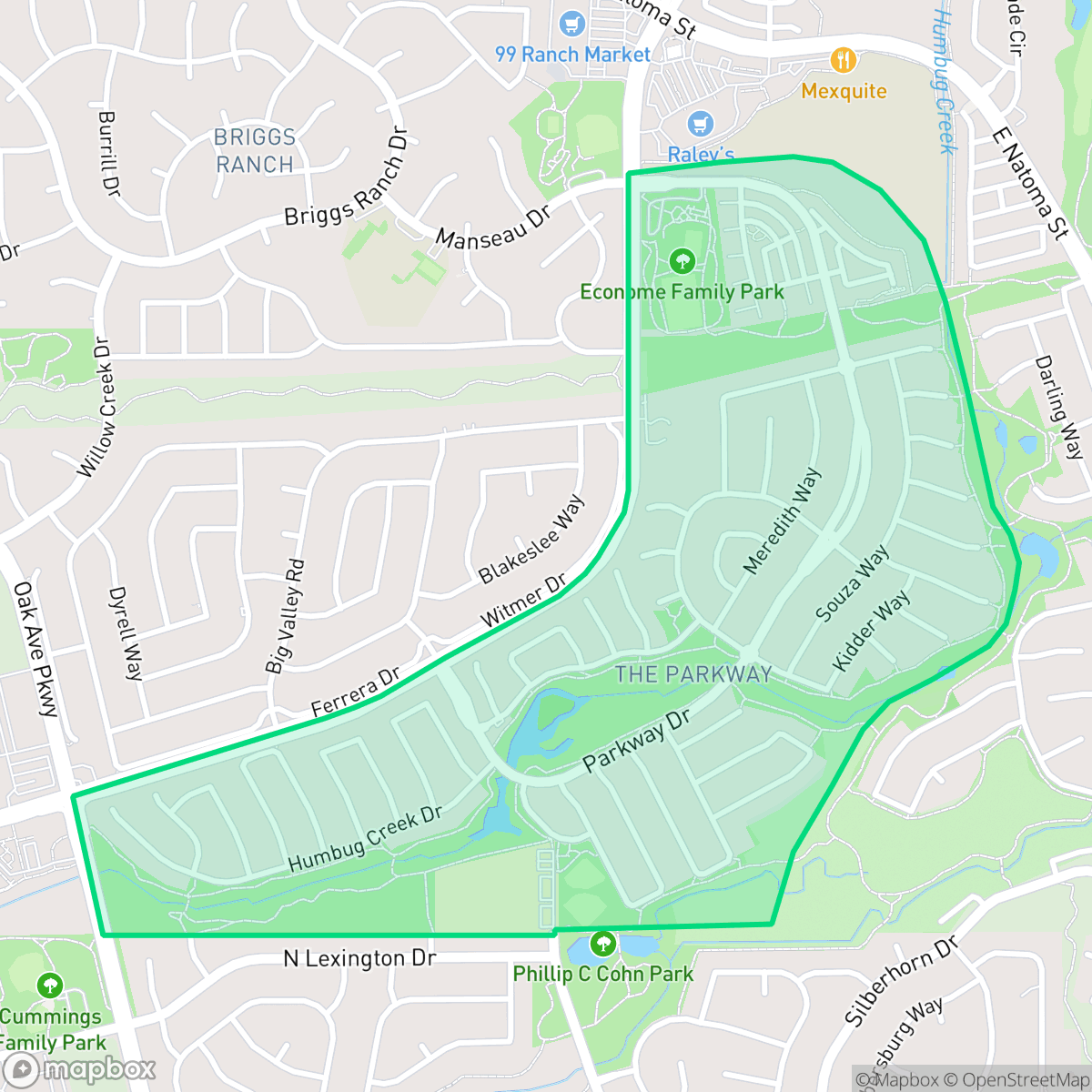
The Parkway is a 612-acre master-planned community in Folsom, California, established in 1995 by Parker Development Company. The neighborhood’s site was historically subject to intensive surface mining by the Natomas Company along Humbug-Willow Creek from the early 1900s through the 1930s. In designing the community, developers undertook a major environmental reclamation project, restoring the damaged riparian stream corridor, wetlands, and woodlands. Today, more than a third of the neighborhood is preserved as natural habitat. A signature feature of the community is its five-mile trail system, which integrates into the larger Humbug-Willow Creek Parkway and features interpretive signs highlighting the area’s ecological and gold-mining history, alongside preserved vernal pools and fishing ponds.
The neighborhood functions as a tranquil residential enclave, characterized by its integration of suburban housing with significant green belts and local parks like Philip C. Cohn Park. While the area lacks a dense commercial core, its layout prioritizes pedestrian access, making it highly suitable for those seeking a quiet lifestyle with immediate proximity to outdoor recreation. According to iHuus data, the area maintains a high degree of acoustic comfort, though noise from road traffic is the primary contributor to local sound levels.
Prospective residents should note that the community is primarily residential, requiring short drives to access major retail or professional services. While the area offers high levels of health insurance coverage and a peaceful atmosphere, it is important to consider regional environmental factors, including a higher risk profile for wildfires common to the surrounding foothill landscape. The neighborhood is best suited for individuals or families who prioritize a quiet, pedestrian-friendly environment over proximity to urban nightlife or commercial hubs.
Neighborhood Scores Across 15 Qualities
Residential spacing offers a balanced degree of separation between neighbors. According to iHuus data, this level of privacy is slightly higher than the average found across Folsom.
Pedestrian infrastructure is exceptional here, featuring wide sidewalks and ample crossings that are significantly more accessible than the Folsom average. Residents can navigate the area easily via well-maintained, pedestrian-priority pathways according to iHuus data.
Large homes and frequent upscale amenities provide a highly polished streetscape that is more visually pleasing than the Folsom average. According to iHuus data, the area is characterized by spacious driveways and well-maintained properties.
Extensive parklands and trail networks provide significant opportunities for outdoor exercise with pets. According to iHuus data, the availability of open space and recreational areas here is notably higher than the Folsom average.
Open land and scattered homes amidst woodland characterize this area. The landscape feels slightly more developed than the typical rural surroundings found elsewhere in Folsom.
Low-density residential streets and green spaces offer a serene environment, but limited local business density makes most errands dependent on a vehicle. This area is less active than the Folsom average, as most dining and services require driving rather than walking.
Steady traffic sounds from a nearby busy street are present. This level of acoustic activity is consistent with the average experienced throughout Folsom.
Air quality levels in this area are consistent with the Folsom average, presenting a mix of acceptable and unhealthy days that may cause occasional concern for sensitive groups according to iHuus data.
No warehouses, industrial facilities, or hazard sites are present within the neighborhood. According to iHuus data, this area is exclusively residential and offers more separation from industrial activity than the Folsom average.
Health insurance access is exceptionally high among residents, slightly surpassing the average for Folsom. According to iHuus data, nearly all inhabitants are covered by a health plan.
Political views in this area are split nearly evenly between conservative and liberal leanings, representing a more balanced ideological landscape than the Folsom average according to iHuus data.
Residents live alongside a balanced range of young professionals, families, and seniors. This demographic spread is largely consistent with the broader Folsom area according to iHuus data.
Residual flood risk exists within this area due to its location in a 500-year floodplain, though safety levels remain higher than the Folsom average according to iHuus data.
High fire hazards exist within this area, matching the elevated risk levels seen across the rest of Folsom. Residents should be prepared to implement maximum protection measures due to the extreme nature of the local fire danger.
Address-Level Insights for The Parkway


iHuus Neighborhood Intelligence Insights
Get address-level neighborhood insights for The Parkway
- Street-level scores — see how individual blocks compare, not just neighborhood averages
- Micro-zone boundaries — identify quiet pockets, flood boundaries, and walkable clusters before you visit
- 15 dimensions in full — walkability, noise, air quality, school quality, insurance coverage, population age profile, urban/rural index, and more
- Boundary risk alerts — know if your address sits near a block boundary where scores drop, the kind of detail no listing will ever mention
- School insights — individual school ratings and insights, not just district-level data
- Compare before you commit — side-by-side data across neighborhoods, down to block precision
No credit card required
Compare with Any Neighborhood
| Dimension | The Parkway | American River Canyon |
|---|---|---|
| 🚶 Walkabilityavg 8.43 | ||
| 🔊 Acoustic Comfortavg 4.27 | ||
| 🤫 Privacy Indexavg 5.81 | ||
| 🎨 Visual Appealavg 7.54 | ||
| 🐕 Dog Friendlinessavg 8.27 | ||
| 🗺️ Urban-Rural Indexavg 6.98 | ||
| ✨ Neighborhood Vibeavg 4.02 | ||
| 🏥 Health Insurance Coverageavg 9.11 | ||
| 🌿 Air Qualityavg 6 | ||
| 🏭 Industrial Proximityavg 8.52 | ||
| 🌊 Flood Safetyavg 5.33 | ||
| 🗳️ Ideological Leanavg 4.81 | ||
| 👥 Population Age Profileavg 4.97 | ||
| 🔥 Fire Safetyavg 0.56 | ||
| 🏫 School Quality |
The Parkway Rankings
School Districts Serving The Parkway
School Insights for The Parkway
Below average outcomes; significant attendance and academic challenges.
School Insights
See what's really behind every school rating near The Parkway
- Individual school ratings — each school's own score with outcome context, not just a district average
- Enrollment & class size data — student-to-teacher ratio and how it compares to the state average
- Full demographics breakdown — ethnicity and gender composition for every school in the enrollment zone
- Every school in the district — all schools within the enrollment boundary ranked by rating, not just the closest one
- Grade levels & benchmarks — elementary through high school, with below/above state-average flags
No credit card required