Prairie Oaks, Folsom
Updated · 6,112 residents
Prairie Oaks is a quiet, suburban community in Folsom characterized by high walkability and dog-friendly green spaces. Residents enjoy convenient access to local parks and dining, though the area experiences notable noise from nearby road traffic.
Key Highlights
About Prairie Oaks
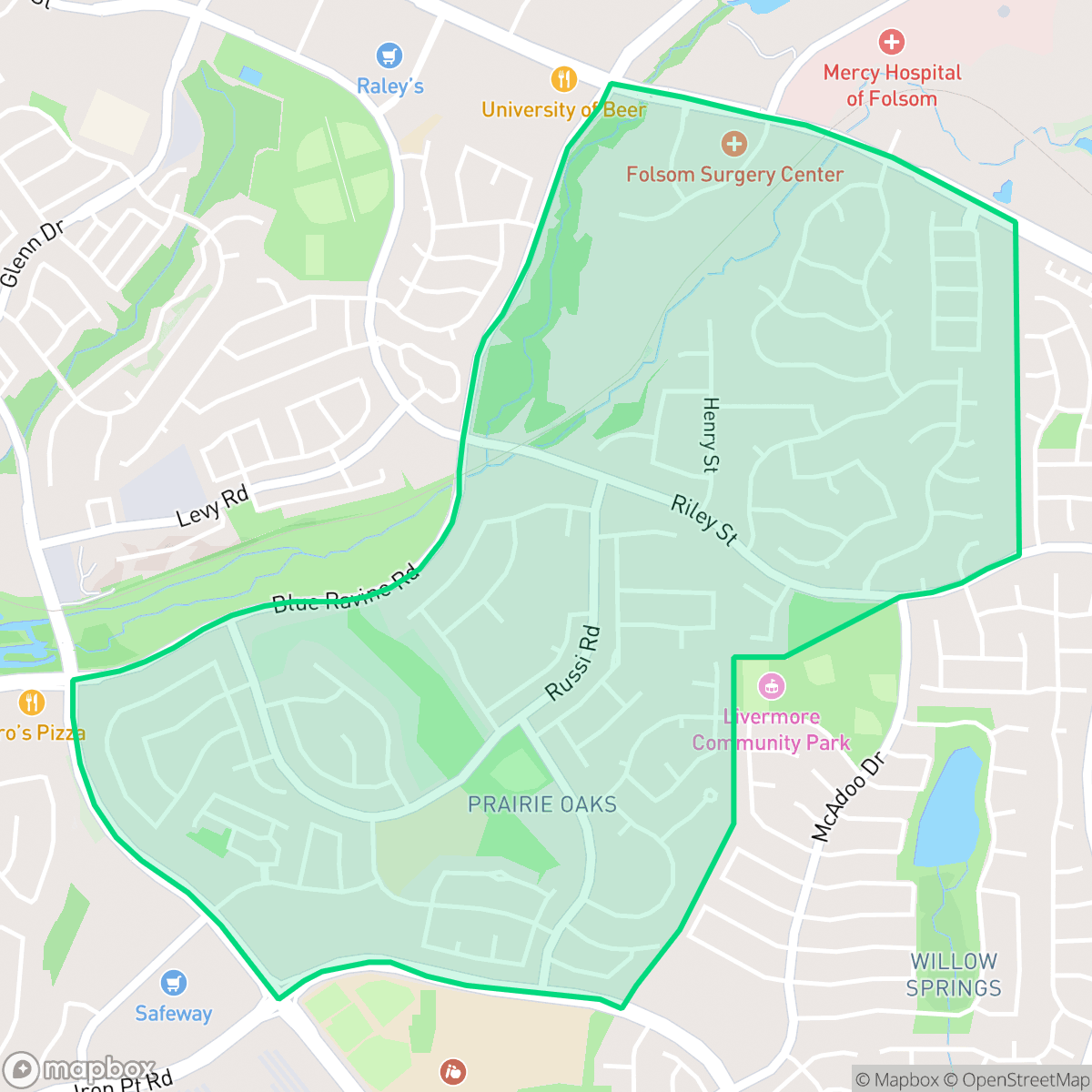
The Prairie Oaks neighborhood in Folsom, California, is a suburban residential community developed primarily between 1994 and 2001. Despite its modern character, the neighborhood occupies land of significant Gold Rush-era historical importance. It was named after Prairie City, a prosperous 1850s gold-mining town of up to 2,000 residents that once stood in this general vicinity before vanishing by the 1860s. The site of Prairie City is recognized as California Historical Landmark #464, commemorated by a marker on nearby Prairie City Road. The area's historical legacy was physically unearthed in 1997 during construction of the nearby highway off-ramp, when workers discovered the skeletal remains of 12 early residents. These remains were subsequently relocated to the Mormon Island relocation cemetery, preserving a tangible link between the modern subdivision and its 19th-century mining predecessor.
This residential enclave offers a serene environment defined by its suburban layout and integration with local nature. The neighborhood features a high density of walkable paths that connect residents to community amenities, including neighborhood parks and a selection of dining options such as Peet's Coffee and local eateries. The landscape is predominantly residential, punctuated by ample green space, which contributes to a high level of dog friendliness and visual appeal for those seeking a quiet pace of life.
While the area provides excellent access to healthcare and a strong sense of community, potential residents should consider the trade-offs associated with its location. The neighborhood experiences higher than average noise levels due to road traffic and presents significant challenges regarding fire safety. It is well-suited for families and individuals who prioritize walkability and access to neighborhood services over a high-energy urban nightlife, provided they are comfortable with the specific environmental risks inherent to this part of Folsom.
Neighborhood Scores Across 15 Qualities
Residential spacing is consistent with the Folsom average, featuring a mix of detached homes and denser clusters where some units sit closely together. According to iHuus data, while many properties maintain small yard buffers, certain areas contain attached housing with less separation between neighbors.
Continuous sidewalks and dedicated trails through green belts make walking easy and safe. This neighborhood offers a more connected pedestrian network than the average Folsom area, according to iHuus data.
Large homes with private pools and expansive driveways create a highly polished streetscape that sits slightly above the Folsom average. According to iHuus data, the area is characterized by well-maintained properties and substantial residential lots.
Extensive greenbelts, riparian corridors, and wide sidewalk verges provide ample space for walking pets. According to iHuus data, the connectivity of these paths and trails is slightly above the Folsom average.
Open land and scattered greenery provide a semi-rural atmosphere, though the area is slightly less developed than the Folsom city average. Residents will find a mix of single-family homes integrated with natural buffers and green spaces.
Local amenities and dining options provide a consistent level of activity that sits slightly above the Folsom average. While various social hubs and green spaces are accessible, the area remains primarily car-oriented with limited business density within walking distance.
Steady hum from a nearby busy street defines the acoustic environment. This level of noise is slightly more noticeable than in other parts of Folsom, according to iHuus data.
Air quality in this area fluctuates between acceptable and unhealthy levels, matching the typical conditions found across Folsom. Sensitive groups should remain aware of occasional periods of concern according to iHuus data.
Residential and natural parklands define this area with no warehouses or industrial facilities present. This lack of heavy industry makes the neighborhood even more secluded from industrial activity than the Folsom average.
Health insurance access is nearly universal among residents, slightly exceeding the Folsom average according to iHuus data.
Political viewpoints in this area are distributed fairly evenly between conservative and liberal leanings, representing a more moderate landscape than the Folsom city average according to iHuus data.
Residents live alongside a balanced mix of young adults, families, and older individuals. This demographic spread is largely consistent with the broader Folsom area, according to iHuus data.
Flood risk levels in this area are comparable to the Folsom average, though a lack of detailed FEMA studies means the specific risk level remains undetermined. Residents should exercise caution as official flood studies for this part of Prairie Oaks are not yet complete.
Address-Level Insights for Prairie Oaks


iHuus Neighborhood Intelligence Insights
Get address-level neighborhood insights for Prairie Oaks
- Street-level scores — see how individual blocks compare, not just neighborhood averages
- Micro-zone boundaries — identify quiet pockets, flood boundaries, and walkable clusters before you visit
- 15 dimensions in full — walkability, noise, air quality, school quality, insurance coverage, population age profile, urban/rural index, and more
- Boundary risk alerts — know if your address sits near a block boundary where scores drop, the kind of detail no listing will ever mention
- School insights — individual school ratings and insights, not just district-level data
- Compare before you commit — side-by-side data across neighborhoods, down to block precision
No credit card required
Compare with Any Neighborhood
| Dimension | Prairie Oaks | American River Canyon |
|---|---|---|
| 🚶 Walkabilityavg 8.43 | ||
| 🔊 Acoustic Comfortavg 4.27 | ||
| 🤫 Privacy Indexavg 5.81 | ||
| 🎨 Visual Appealavg 7.54 | ||
| 🐕 Dog Friendlinessavg 8.27 | ||
| 🗺️ Urban-Rural Indexavg 6.98 | ||
| ✨ Neighborhood Vibeavg 4.02 | ||
| 🏥 Health Insurance Coverageavg 9.11 | ||
| 🌿 Air Qualityavg 6 | ||
| 🏭 Industrial Proximityavg 8.52 | ||
| 🌊 Flood Safetyavg 5.33 | ||
| 🗳️ Ideological Leanavg 4.81 | ||
| 👥 Population Age Profileavg 4.97 | ||
| 🔥 Fire Safetyavg 0.56 | ||
| 🏫 School Quality |
Prairie Oaks Rankings
School Districts Serving Prairie Oaks
School Insights for Prairie Oaks
Below average outcomes; significant attendance and academic challenges.
School Insights
See what's really behind every school rating near Prairie Oaks
- Individual school ratings — each school's own score with outcome context, not just a district average
- Enrollment & class size data — student-to-teacher ratio and how it compares to the state average
- Full demographics breakdown — ethnicity and gender composition for every school in the enrollment zone
- Every school in the district — all schools within the enrollment boundary ranked by rating, not just the closest one
- Grade levels & benchmarks — elementary through high school, with below/above state-average flags
No credit card required