Lexington Hills, Folsom
Updated · 4,445 residents
Lexington Hills offers exceptional walkability and a strong connection to nature through its extensive trail network and greenbelts. While residents enjoy a highly accessible suburban environment, the area experiences elevated noise levels, particularly from aviation activity.
Key Highlights
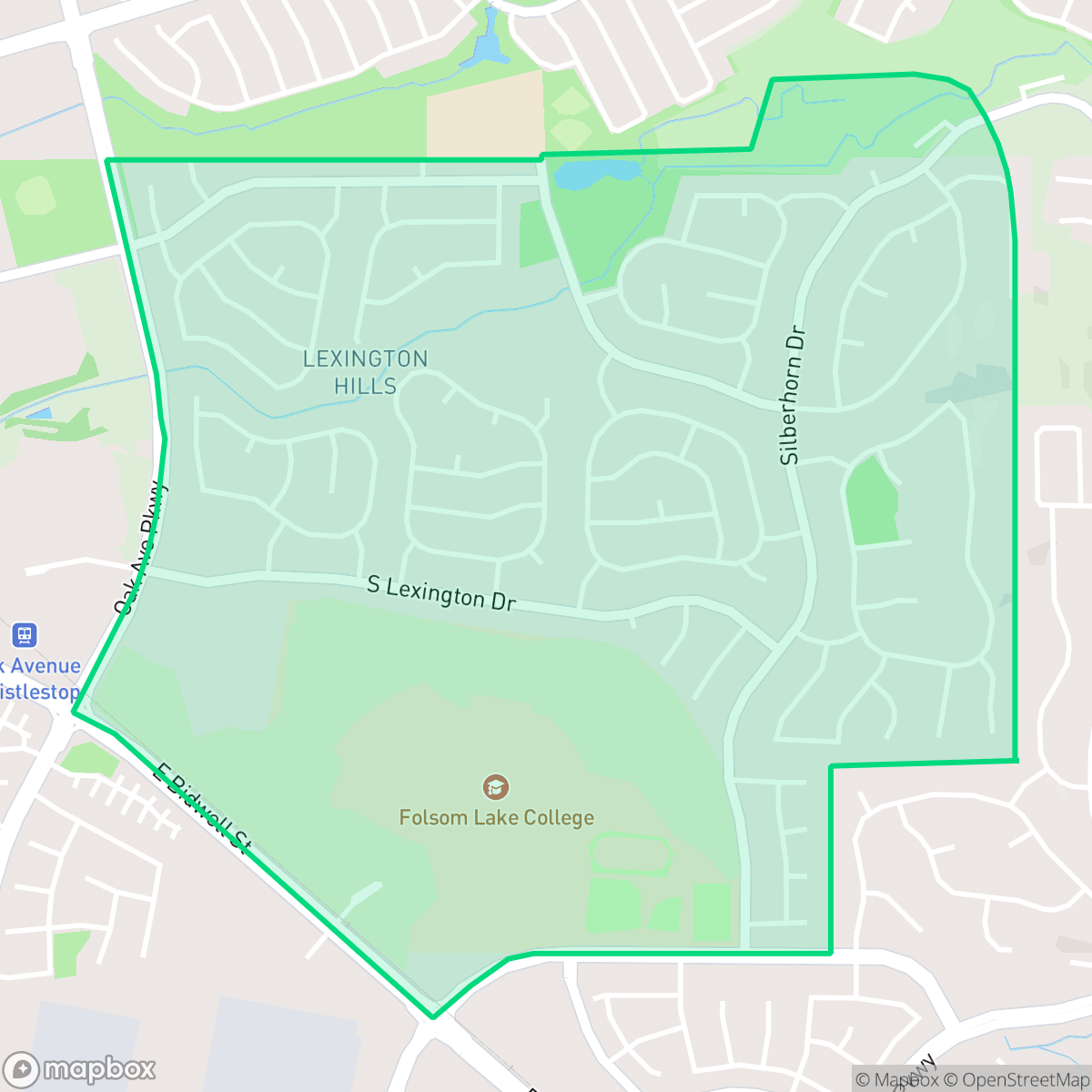
About Lexington Hills
Developed primarily during the late 1980s and early 1990s, Lexington Hills is an established residential neighborhood in central Folsom, California. Characterized by its master-planned layout, the neighborhood features a mix of spacious production and semi-custom homes situated on generous lots with mature, tree-lined streets. Lexington Hills is highly regarded for its integration of natural spaces, boasting an extensive network of greenbelts, wetlands, and recreational trails. Notable local landmarks and public spaces include Cobble Hills Ridge Park, the Folsom Kids Play Park (locally known as Castle Park), and Oak Chan Elementary School, which sits near the center of the community. The neighborhood's western edge is bordered by the Cummings Family Skate, Scooter, and Bike Park, reflecting the area's strong emphasis on outdoor recreation.
The neighborhood functions as a highly accessible hub within Folsom, characterized by its seamless integration of residential streets and recreational access. According to iHuus data, the area achieves a perfect walkability score, allowing residents to navigate between local parks and social amenities with ease. The streetscape maintains a consistent suburban aesthetic, blending quiet residential pockets with areas that see higher daytime commercial activity.
Prospective residents should note that the area presents specific trade-offs regarding acoustic comfort and environmental safety. Higher noise levels, largely attributed to aviation, contrast with the neighborhood's otherwise serene green spaces. Furthermore, while the Folsom-Cordova Unified School District provides significant educational infrastructure, the community faces challenges related to fire safety and fiscal management. The area is well-suited for those who prioritize pedestrian accessibility and an active outdoor lifestyle over total acoustic isolation.
Neighborhood Scores Across 15 Qualities
Residential spacing varies across the area, with some clusters featuring attached units and closer neighbor proximity. This level of density is roughly comparable to the average found throughout Folsom.
Pedestrian access is excellent throughout the area due to a comprehensive sidewalk network and safe, separated paths. This level of walkability is notably higher than the Folsom average.
Uniform tract housing and apartment complexes with shared recreational pools characterize the area. The visual landscape aligns with the typical appearance of Folsom.
Extensive central greenbelts, riparian corridors, and wooded paths with visible trails provide ample space for outdoor exercise. According to iHuus data, the availability of these open spaces and parks is notably higher than the Folsom average.
Residential layouts feature a blend of single-family homes and integrated green buffers. This area is slightly less rural than the Folsom average, characterized more by dense suburban development and multi-family complexes.
A balanced mix of residential streets and occasional social hubs provides a more active atmosphere than the Folsom average. While certain pockets near the railway and waterfront offer dining and leisure, most areas remain quiet and primarily car-dependent.
Moderate levels of ambient noise are present due to steady traffic from a nearby busy street. This level of acoustic activity is consistent with the average found throughout Folsom.
Air quality in this area fluctuates between acceptable and unhealthy levels, matching the typical conditions found across Folsom. Residents with respiratory sensitivities should monitor local reports for days when air quality may become a concern.
Industrial facilities and warehouses are absent from the area, providing a much cleaner environment than the Folsom average. Residents can expect a landscape composed strictly of residential, commercial, and natural spaces without the presence of heavy industrial hazards.
Health insurance enrollment is nearly universal among residents, remaining slightly above the Folsom average according to iHuus data.
Political perspectives in this area are relatively evenly split between conservative and liberal leanings. This reflects a more balanced ideological landscape than the broader Folsom area, according to iHuus data.
Residents live among a diverse range of age groups, including young adults, families, and seniors. This demographic spread is largely in line with the broader Folsom area according to iHuus data.
Flood risk in this area is higher than the Folsom average, though a detailed FEMA study has not yet been completed for this specific location. According to iHuus data, the neighborhood sits in an area of undetermined risk.
Address-Level Insights for Lexington Hills


iHuus Neighborhood Intelligence Insights
Get address-level neighborhood insights for Lexington Hills
- Street-level scores — see how individual blocks compare, not just neighborhood averages
- Micro-zone boundaries — identify quiet pockets, flood boundaries, and walkable clusters before you visit
- 15 dimensions in full — walkability, noise, air quality, school quality, insurance coverage, population age profile, urban/rural index, and more
- Boundary risk alerts — know if your address sits near a block boundary where scores drop, the kind of detail no listing will ever mention
- School insights — individual school ratings and insights, not just district-level data
- Compare before you commit — side-by-side data across neighborhoods, down to block precision
No credit card required
Compare with Any Neighborhood
| Dimension | Lexington Hills | American River Canyon |
|---|---|---|
| 🚶 Walkabilityavg 8.43 | ||
| 🔊 Acoustic Comfortavg 4.27 | ||
| 🤫 Privacy Indexavg 5.81 | ||
| 🎨 Visual Appealavg 7.54 | ||
| 🐕 Dog Friendlinessavg 8.27 | ||
| 🗺️ Urban-Rural Indexavg 6.98 | ||
| ✨ Neighborhood Vibeavg 4.02 | ||
| 🏥 Health Insurance Coverageavg 9.11 | ||
| 🌿 Air Qualityavg 6 | ||
| 🏭 Industrial Proximityavg 8.52 | ||
| 🌊 Flood Safetyavg 5.33 | ||
| 🗳️ Ideological Leanavg 4.81 | ||
| 👥 Population Age Profileavg 4.97 | ||
| 🔥 Fire Safetyavg 0.56 | ||
| 🏫 School Quality |
Lexington Hills Rankings
School Districts Serving Lexington Hills
School Insights for Lexington Hills
Below average outcomes; significant attendance and academic challenges.
School Insights
See what's really behind every school rating near Lexington Hills
- Individual school ratings — each school's own score with outcome context, not just a district average
- Enrollment & class size data — student-to-teacher ratio and how it compares to the state average
- Full demographics breakdown — ethnicity and gender composition for every school in the enrollment zone
- Every school in the district — all schools within the enrollment boundary ranked by rating, not just the closest one
- Grade levels & benchmarks — elementary through high school, with below/above state-average flags
No credit card required