Historic Folsom, Folsom
Updated · 2,193 residents
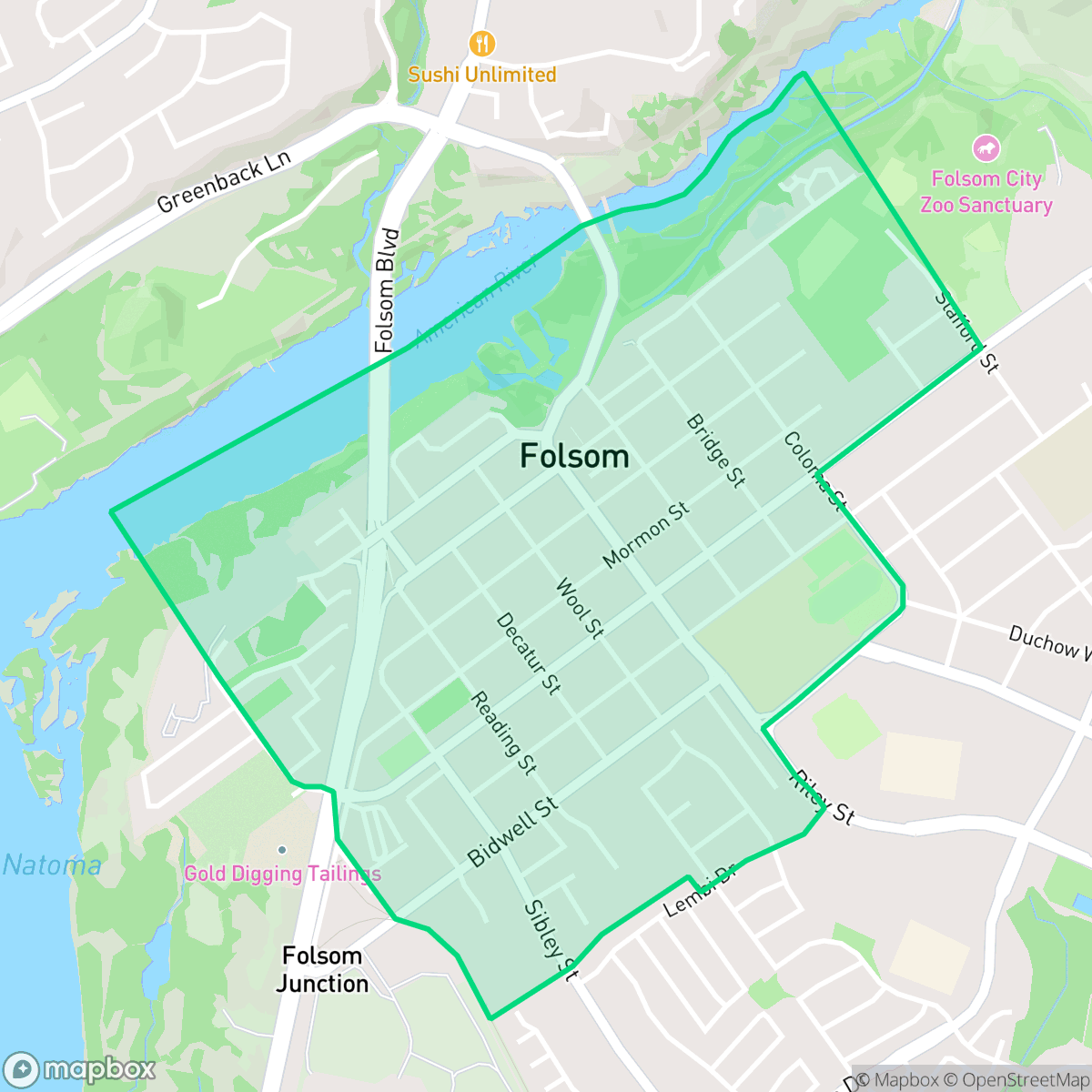
Historic Folsom is a vibrant, pedestrian-friendly district centered on Sutter Street that offers a unique blend of Gold Rush heritage and modern community life. While the area provides high walkability and excellent access to local dining and entertainment, residents should note higher noise levels from road traffic and significant environmental risks regarding fire and flood safety.
Key Highlights
About Historic Folsom
Laid out in 1855 by railroad engineer Theodore Judah for founder Joseph Folsom, the Historic Folsom neighborhood served as a vital Gold Rush-era terminal. Its historic heart, Sutter Street, retains its 19th-century character with a mix of Gold Rush-era structures and late Victorian brick buildings, which replaced original wooden storefronts destroyed by fires in the 1860s and 1880s. The neighborhood is rich in landmark infrastructure, notably hosting the terminus of the Sacramento Valley Railroad—California’s first passenger line (1856)—complete with a historic turntable and depot. Other prominent landmarks include the 1895 Folsom Powerhouse, the Truss Bridge over the American River, and the historic Folsom Hotel. Today, the district blends its Old West heritage with modern vitality, anchored by local businesses, the Zittel Family Amphitheater, and a preserved pedestrian-friendly streetscape.
The neighborhood serves as a lively hub for residents and visitors, characterized by a high level of social activity that stands out within the city. Local destinations such as Sociology Coffee Bar and various neighborhood eateries contribute to a walkable environment where daily errands and social outings are easily accomplished on foot. The presence of green spaces and proximity to the American River adds to the appeal for those who prioritize an active, community-focused lifestyle.
The area experiences moderate noise levels primarily driven by road traffic, which is a factor for those sensitive to acoustic disturbances. While the district benefits from strong health insurance coverage and proximity to schools like Sutter Middle, prospective residents should be aware of the localized environmental risks, specifically concerning fire and flood safety. This area is well-suited for those who value a historic, high-energy atmosphere over the quiet seclusion of typical suburban developments.
Neighborhood Scores Across 15 Qualities
Residential spacing provides a moderate level of separation between homes, which is roughly in line with the Folsom average. Most properties feature fenced backyards and standard suburban distances between neighbors.
Pedestrian access is excellent due to continuous sidewalks on both sides of most streets and ample crossings. According to iHuus data, the area offers superior walkability compared to the Folsom average.
Large homes with manicured landscaping and private pools characterize this area, though the overall visual appeal sits slightly below the Folsom average.
Access to large public parks and school fields provides ample green space for exercise. This area offers a level of dog friendliness that is very similar to the rest of Folsom.
Dense suburban development with single-family homes and commercial centers characterizes this area. The landscape matches the typical urban-rural balance found throughout Folsom.
Diverse dining, coffee shops, and local destinations create a much more active atmosphere than the Folsom average. While many blocks offer a vibrant mix of social spots and green space, some areas remain car-dependent due to the suburban layout.
A steady hum of local traffic persists due to the proximity of a busy street. This level of acoustic activity is slightly higher than the average found throughout Folsom.
Air quality fluctuates between acceptable and unhealthy levels, presenting occasional concerns for sensitive groups. This condition is consistent with the broader Folsom area according to iHuus data.
Industrial presence is virtually non-existent here, offering a cleaner environment than the Folsom average. This neighborhood consists of purely residential and light commercial spaces without any detectable warehouses or heavy industrial hazards.
Health insurance access among residents is notable but remains lower than the average found across the rest of Folsom. According to iHuus data, a significant portion of the community maintains coverage, though it does not reach the citywide norm.
Political leanings in this area are evenly split between conservative and liberal perspectives, representing a slightly more balanced ideological landscape than the Folsom city average.
Residents live alongside a balanced mix of young adults, families, and older generations. This demographic spread is largely consistent with the broader Folsom area.
Properties within this area are situated inside a designated floodplain, which presents a significantly higher risk of flooding than the rest of Folsom. Residents should be aware that flood insurance is typically required for homes in this zone according to iHuus data.
Fire risk in this area is exceptionally high and significantly exceeds the average for Folsom. Residents should be aware that the neighborhood faces a severe threat of fire, necessitating rigorous-safety precautions.
Address-Level Insights for Historic Folsom


iHuus Neighborhood Intelligence Insights
Get address-level neighborhood insights for Historic Folsom
- Street-level scores — see how individual blocks compare, not just neighborhood averages
- Micro-zone boundaries — identify quiet pockets, flood boundaries, and walkable clusters before you visit
- 15 dimensions in full — walkability, noise, air quality, school quality, insurance coverage, population age profile, urban/rural index, and more
- Boundary risk alerts — know if your address sits near a block boundary where scores drop, the kind of detail no listing will ever mention
- School insights — individual school ratings and insights, not just district-level data
- Compare before you commit — side-by-side data across neighborhoods, down to block precision
No credit card required
Compare with Any Neighborhood
| Dimension | Historic Folsom | American River Canyon |
|---|---|---|
| 🚶 Walkabilityavg 8.43 | ||
| 🔊 Acoustic Comfortavg 4.27 | ||
| 🤫 Privacy Indexavg 5.81 | ||
| 🎨 Visual Appealavg 7.54 | ||
| 🐕 Dog Friendlinessavg 8.27 | ||
| 🗺️ Urban-Rural Indexavg 6.98 | ||
| ✨ Neighborhood Vibeavg 4.02 | ||
| 🏥 Health Insurance Coverageavg 9.11 | ||
| 🌿 Air Qualityavg 6 | ||
| 🏭 Industrial Proximityavg 8.52 | ||
| 🌊 Flood Safetyavg 5.33 | ||
| 🗳️ Ideological Leanavg 4.81 | ||
| 👥 Population Age Profileavg 4.97 | ||
| 🔥 Fire Safetyavg 0.56 | ||
| 🏫 School Quality |
Historic Folsom Rankings
School Districts Serving Historic Folsom
School Insights for Historic Folsom
Below average outcomes; significant attendance and academic challenges.
School Insights
See what's really behind every school rating near Historic Folsom
- Individual school ratings — each school's own score with outcome context, not just a district average
- Enrollment & class size data — student-to-teacher ratio and how it compares to the state average
- Full demographics breakdown — ethnicity and gender composition for every school in the enrollment zone
- Every school in the district — all schools within the enrollment boundary ranked by rating, not just the closest one
- Grade levels & benchmarks — elementary through high school, with below/above state-average flags
No credit card required