Briggs Ranch, Folsom
Updated · 6,924 residents
Briggs Ranch is a serene, suburban enclave in Folsom defined by its rolling hills and protected heritage oak trees. The neighborhood offers an exceptionally walkable environment with high dog friendliness, though residents should expect a quiet atmosphere with limited local commercial activity.
Key Highlights
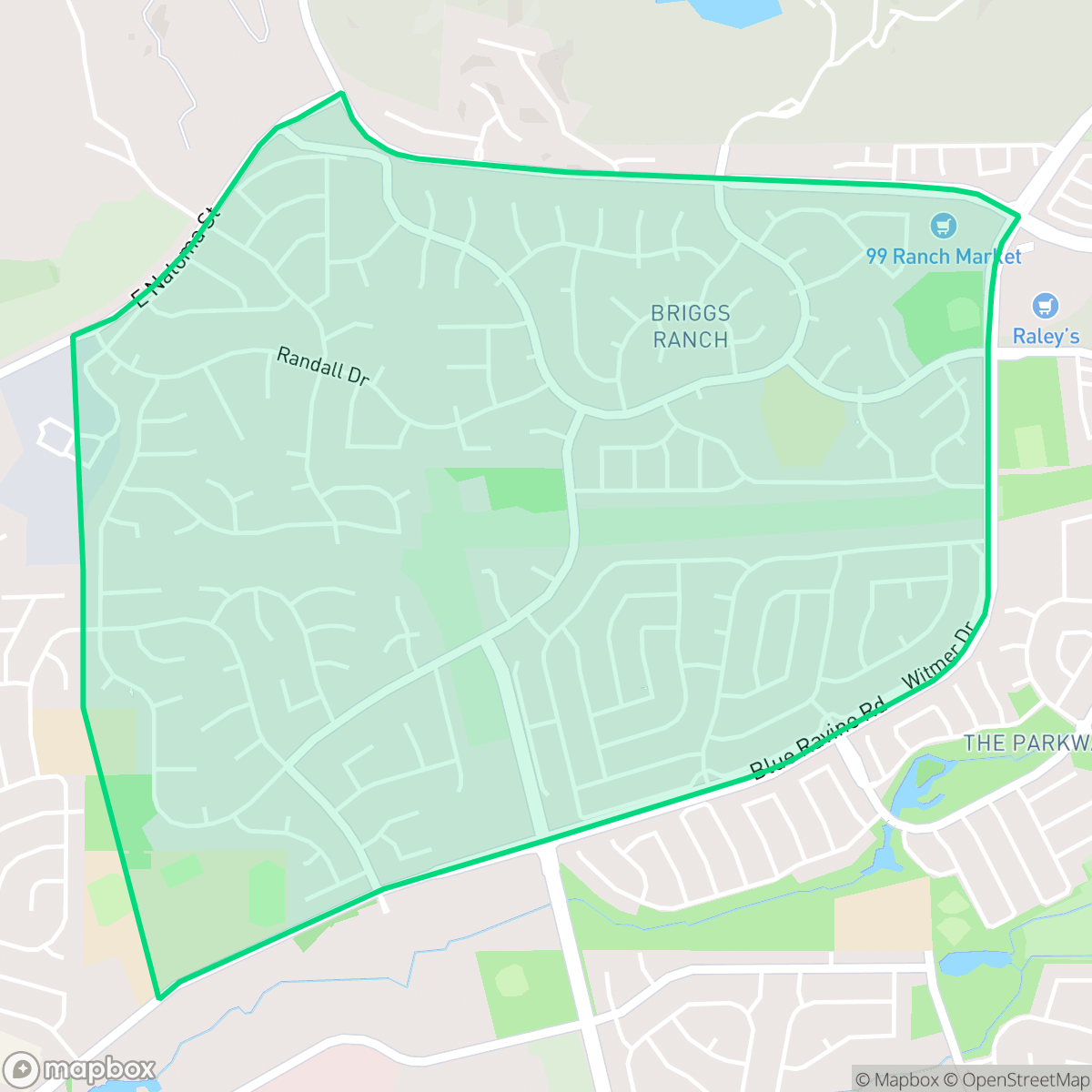
About Briggs Ranch
Briggs Ranch was established on land originally owned by the Briggs family. Following the death of the family patriarch, Elvie Perazzo Briggs deeded a portion of the property to the City of Folsom. In 1987, the city zoned the site for residential development and selected Winncrest Homes to build the master-planned neighborhood. Constructed in three phases between 1990 and 1995, Briggs Ranch features a mix of tract homes, such as the initial "Classic" series, and upscale custom homes. The neighborhood is characterized by its rolling hills, spacious lots, and protected heritage oak trees. Its central community landmark is the Elvie Perazzo Briggs Park, which offers sports fields, play structures, and preserved oak woodlands, reflecting the area's transition from private ranchland to a family-oriented suburban enclave.
Briggs Ranch maintains a peaceful residential character, characterized by quiet streets and significant green space. With a high walkability score, residents can easily navigate the neighborhood on foot, making it a popular choice for dog owners and those seeking an active outdoor lifestyle. The environment is largely free from industrial activity, ensuring a clean and consistent aesthetic that aligns with the established suburban appeal of Folsom.
While the area excels in accessibility for pedestrians, it lacks a dense concentration of local businesses, often requiring residents to travel for daily retail and dining needs. The acoustic environment is generally comfortable, though road traffic remains the primary source of noise. Families may find the proximity to highly rated institutions like Folsom Middle School attractive, though they should be mindful of the broader district's administrative and fiscal challenges. It is best suited for those prioritizing a tranquil, pedestrian-friendly home environment over urban convenience.
Neighborhood Scores Across 15 Qualities
Large lots with significant separation between homes provide more privacy than the typical Folsom neighborhood. According to iHuus data, this area offers greater seclusion due to the wider spacing of residential properties.
Pedestrian access is excellent due to wide sidewalks on both sides of the street and many designated crossings. This area offers superior walkability compared to the Folsom average, according to iHuus data.
Large homes and frequent upscale amenities contribute to a landscape that is more visually appealing than the Folsom average. According to iHuus data, the area features spacious driveways and well-maintained property aesthetics.
Extensive trail networks and large open parks provide ample space for pets. This level of accessibility to outdoor recreation is notably higher than the Folsom average, according to iHuus data.
Expansive open spaces and oak savannas characterize much of the area, providing a landscape that is slightly more rural than the Folsom average. Residential pockets range from dense suburban layouts to scattered homes nestled among woodlands and large open fields.
Serene suburban streets and green spaces characterize this area, though a lack of nearby businesses makes most daily errands dependent on a vehicle. This low level of activity is slightly below the Folsom average, resulting in a peaceful but less walkable environment.
Steady noise from nearby busy streets is a common feature here; however, acoustic levels remain more tranquil than the average for Folsom.
Air quality in this area is consistent with the Folsom average. Residents may experience a mix of acceptable and unhealthy days, which could pose occasional concerns for sensitive groups according to iHuus data.
Heavy industrial activity is absent from the area, though residents live near municipal water storage and a wastewater treatment facility. This level of industrial proximity is slightly higher than the Folsom average according to iHuus data.
Health insurance coverage is nearly universal among residents, sitting slightly above the Folsom average according to iHuus data.
Political leanings in this area are distributed relatively evenly between conservative and liberal perspectives. This ideological diversity is slightly more balanced than the broader Folsom average, according to iHuus data.
Residents live alongside a varied mix of young adults, families, and seniors. This demographic distribution is roughly in line with the overall Folsom average according to iHuus data.
Flood risk in this area is slightly above the Folsom average, though official FEMA studies for the neighborhood have not yet been completed.
Significant fire hazards are present in this area, representing a higher risk level than the Folsom average. According to iHuus data, residents may need to prioritize enhanced wildfire mitigation measures.
Address-Level Insights for Briggs Ranch


iHuus Neighborhood Intelligence Insights
Get address-level neighborhood insights for Briggs Ranch
- Street-level scores — see how individual blocks compare, not just neighborhood averages
- Micro-zone boundaries — identify quiet pockets, flood boundaries, and walkable clusters before you visit
- 15 dimensions in full — walkability, noise, air quality, school quality, insurance coverage, population age profile, urban/rural index, and more
- Boundary risk alerts — know if your address sits near a block boundary where scores drop, the kind of detail no listing will ever mention
- School insights — individual school ratings and insights, not just district-level data
- Compare before you commit — side-by-side data across neighborhoods, down to block precision
No credit card required
Compare with Any Neighborhood
| Dimension | Briggs Ranch | American River Canyon |
|---|---|---|
| 🚶 Walkabilityavg 8.43 | ||
| 🔊 Acoustic Comfortavg 4.27 | ||
| 🤫 Privacy Indexavg 5.81 | ||
| 🎨 Visual Appealavg 7.54 | ||
| 🐕 Dog Friendlinessavg 8.27 | ||
| 🗺️ Urban-Rural Indexavg 6.98 | ||
| ✨ Neighborhood Vibeavg 4.02 | ||
| 🏥 Health Insurance Coverageavg 9.11 | ||
| 🌿 Air Qualityavg 6 | ||
| 🏭 Industrial Proximityavg 8.52 | ||
| 🌊 Flood Safetyavg 5.33 | ||
| 🗳️ Ideological Leanavg 4.81 | ||
| 👥 Population Age Profileavg 4.97 | ||
| 🔥 Fire Safetyavg 0.56 | ||
| 🏫 School Quality |
Briggs Ranch Rankings
School Districts Serving Briggs Ranch
School Insights for Briggs Ranch
Below average outcomes; significant attendance and academic challenges.
School Insights
See what's really behind every school rating near Briggs Ranch
- Individual school ratings — each school's own score with outcome context, not just a district average
- Enrollment & class size data — student-to-teacher ratio and how it compares to the state average
- Full demographics breakdown — ethnicity and gender composition for every school in the enrollment zone
- Every school in the district — all schools within the enrollment boundary ranked by rating, not just the closest one
- Grade levels & benchmarks — elementary through high school, with below/above state-average flags
No credit card required