American River Canyon, Folsom
Updated · 3,480 residents
American River Canyon is a tranquil, residential enclave in Folsom defined by its scenic green spaces and custom architecture. While it offers a quiet atmosphere with high visual appeal, residents should expect limited local nightlife and moderate noise levels from nearby road traffic.
Key Highlights
About American River Canyon
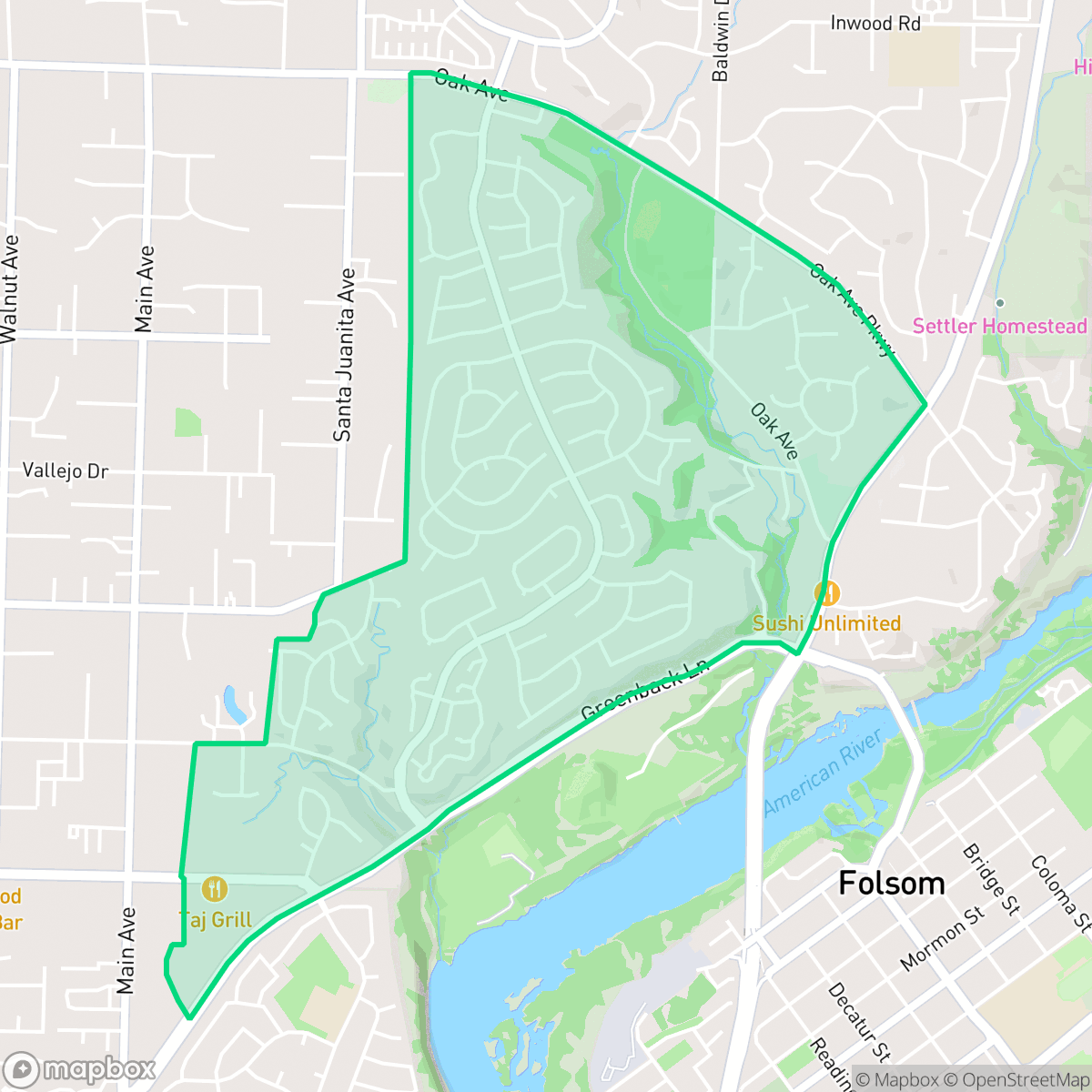
Located north of the American River in Folsom, California, the American River Canyon neighborhood is an upscale residential community developed in two primary phases. The original southern section, below Oak Avenue Parkway, was built by various custom home builders during the 1980s and 1990s. To the north, Elliott Homes developed American River Canyon North starting in the late 1980s, establishing an 11-village master-planned community of 762 custom home lots. The neighborhood is widely recognized for its iconic waterfall entrance along the American River Canyon Drive loop, which features a prominent 5,200-square-foot private residence constructed directly atop the waterfall structure in 2006. Residents enjoy immediate access to the American River Parkway trail network, connected via the Historic Truss Bridge, as well as the nearby Lew Howard Park.
The area maintains a low-density, suburban character that prioritizes residential privacy and access to nature. With a high visual appeal score according to iHuus data, the neighborhood features a balanced mix of green spaces and well-maintained streets, providing a serene environment for homeowners. It is primarily a commuter-oriented community, as the limited density results in a quieter, less active social scene compared to the city center. Prospective residents should note the trade-offs between the peaceful surroundings and the limited walkability to commercial amenities. While the area is suitable for those seeking a quiet retreat, it is situated near major roadways, contributing to a moderate noise level of 58 decibels. According to iHuus, the neighborhood is well-suited for families and individuals who value proximity to outdoor recreation, such as the American River Parkway, over the convenience of a high-energy urban lifestyle.
Neighborhood Scores Across 15 Qualities
Residential spacing is mixed with some buffers between neighbors, providing a level of privacy slightly higher than the Folsom average according to iHuus data.
Pedestrian access is supported by sidewalks on one side of the street and safe crossings. This level of connectivity is slightly lower than the average for Folsom.
Spacious properties and premium amenities create an environment that is more visually polished than the Folsom average, according to iHuus data.
Expansive green spaces and wide, traffic-free paths offer good opportunities for pet owners; however, access to pet-friendly amenities is lower than the Folsom city average.
Wooded areas and scattered homes characterize this area, providing a slightly more open and rural feel than the Folsom average according to iHuus data.
Low-density residential streets and scattered businesses create a peaceful atmosphere that is notably quieter than the Folsom average. While some essential services and dining options are available, the area is largely car-oriented with limited social hubs within walking distance.
A steady hum of local traffic from a nearby busy street is present; however, acoustic comfort remains slightly higher than the Folsom average according to iHuus data.
Air quality levels in this area are consistent with the Folsom average, though residents may encounter days with occasional concerns for sensitive groups. According to iHuus data, the atmosphere fluctuates between acceptable and unhealthy conditions.
Industrial facilities and warehouses are absent from this area, providing a landscape that is even more residential than the Folsom average. According to iHuus data, the neighborhood consists of quiet streets and open green spaces without proximity to hazard sites.
Health insurance access is widespread among residents, though slightly lower than the average found across Folsom according to iHuus data.
Political leanings in this area skew significantly more conservative than the Folsom average. According to iHuus data, the neighborhood contains a conservative majority with a modest presence of opposing viewpoints.
A balanced demographic of young adults, families, and older residents characterizes this area, representing a slightly more varied age distribution than the Folsom average according to iHuus data.
Some areas within the neighborhood fall inside the 500-year floodplain, indicating a presence of residual flood risk that is higher than the Folsom city average. According to iHuus data, residents should account for these specific environmental vulnerabilities when evaluating property locations.
Address-Level Insights for American River Canyon


iHuus Neighborhood Intelligence Insights
Get address-level neighborhood insights for American River Canyon
- Street-level scores — see how individual blocks compare, not just neighborhood averages
- Micro-zone boundaries — identify quiet pockets, flood boundaries, and walkable clusters before you visit
- 15 dimensions in full — walkability, noise, air quality, school quality, insurance coverage, population age profile, urban/rural index, and more
- Boundary risk alerts — know if your address sits near a block boundary where scores drop, the kind of detail no listing will ever mention
- School insights — individual school ratings and insights, not just district-level data
- Compare before you commit — side-by-side data across neighborhoods, down to block precision
No credit card required
Compare with Any Neighborhood
| Dimension | American River Canyon | American River Canyon North |
|---|---|---|
| 🚶 Walkabilityavg 8.43 | ||
| 🔊 Acoustic Comfortavg 4.27 | ||
| 🤫 Privacy Indexavg 5.81 | ||
| 🎨 Visual Appealavg 7.54 | ||
| 🐕 Dog Friendlinessavg 8.27 | ||
| 🗺️ Urban-Rural Indexavg 6.98 | ||
| ✨ Neighborhood Vibeavg 4.02 | ||
| 🏥 Health Insurance Coverageavg 9.11 | ||
| 🌿 Air Qualityavg 6 | ||
| 🏭 Industrial Proximityavg 8.52 | ||
| 🌊 Flood Safetyavg 5.33 | ||
| 🗳️ Ideological Leanavg 4.81 | ||
| 👥 Population Age Profileavg 4.97 | ||
| 🔥 Fire Safetyavg 0.56 | ||
| 🏫 School Quality |
American River Canyon Rankings
School Districts Serving American River Canyon
School Insights for American River Canyon
Below average outcomes; significant attendance and academic challenges.
School Insights
See what's really behind every school rating near American River Canyon
- Individual school ratings — each school's own score with outcome context, not just a district average
- Enrollment & class size data — student-to-teacher ratio and how it compares to the state average
- Full demographics breakdown — ethnicity and gender composition for every school in the enrollment zone
- Every school in the district — all schools within the enrollment boundary ranked by rating, not just the closest one
- Grade levels & benchmarks — elementary through high school, with below/above state-average flags
No credit card required