American River Canyon North, Folsom
Updated · 5,012 residents
American River Canyon North is an upscale residential community defined by its custom-built homes and scenic, elevated terrain overlooking the canyon. While the area offers a quiet, suburban atmosphere with significant green space, residents primarily rely on vehicles for daily errands due to the neighborhood's car-oriented layout.
Key Highlights
About American River Canyon North
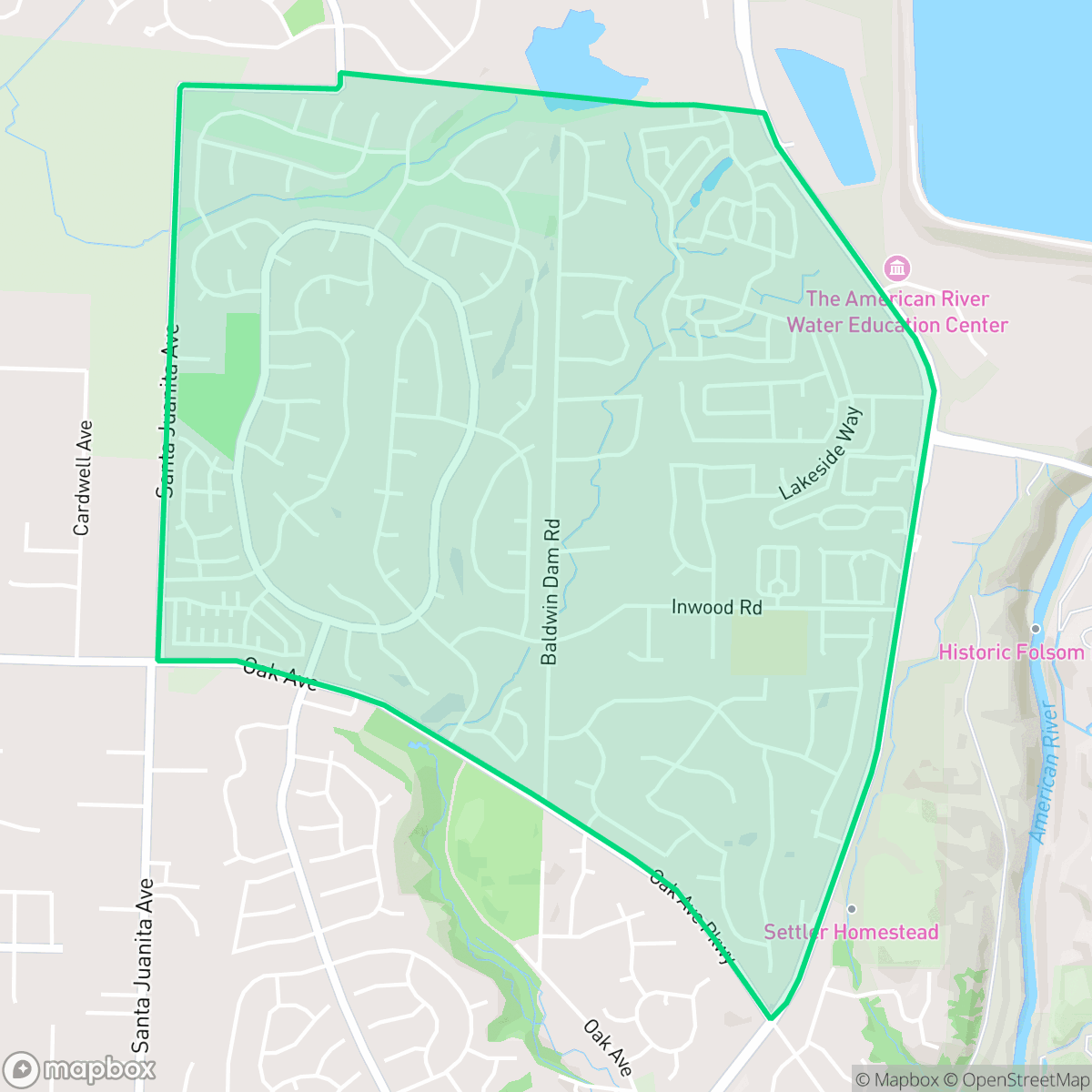
Developed primarily by Elliott Homes beginning in the late 1980s, American River Canyon North is an upscale residential community in Folsom, California. Built in phases through the late 2000s, the master-planned neighborhood consists of 11 distinct villages featuring custom-built homes. It is widely recognized for its iconic waterfall entrance at American River Canyon Drive and Oak Avenue Parkway, which originally featured a sales pavilion atop the falls that was later converted into a private residence. The neighborhood's layout includes the American River Canyon Drive loop, the gated Cascades development built in 1990 adjacent to Davie Park, and the semi-attached Canyon Falls Village completed in 2001. Situated on elevated terrain north of the American River, the area blends custom architectural designs with preserved open spaces and scenic canyon views.
The area functions as a tranquil, suburban enclave characterized by its established housing blocks and integration with natural surroundings. Residents enjoy access to several quiet, tree-lined streets and proximity to local green spaces, which contribute to a peaceful environment. While the neighborhood lacks a dense commercial core, it provides essential services within a short drive, maintaining a clear separation between residential life and the surrounding industrial and commercial zones.
Prospective residents should note that the neighborhood is primarily car-dependent, with limited walkability for daily needs. Acoustic comfort is influenced by moderate road traffic, and the area faces specific environmental considerations, including a low fire safety rating. It is best suited for those seeking a quiet, stable environment who prioritize access to spacious, custom-designed housing over proximity to high-density retail or urban nightlife.
Neighborhood Scores Across 15 Qualities
Residential spacing provides a moderate level of separation between neighbors, which is slightly higher than the average for Folsom. According to iHuus data, the area features mixed housing densities that offer a balance of community connection and personal buffer.
Sidewalks are available on one side of the street with safe crossings provided. This level of pedestrian accessibility is slightly lower than the average for Folsom.
Large residential lots and premium amenities create a highly aesthetic environment that is more visually appealing than the Folsom average. According to iHuus data, the area features prominent architecture and well-maintained properties.
Connected green spaces and wide, traffic-free paths provide ample room for exercise. This area is slightly below the Folsom average for pet-friendly amenities.
Spacious landscapes and dense woodland define this area, providing a more rural feel than the typical Folsom suburb. Residents can expect a mix of low-density residential estates and significant undeveloped canyon land according to iHuus data.
Low density housing and significant open space create a quiet, rural atmosphere with very little commercial activity. This area is notably less lively than the Folsom average, as most daily needs require a car due to the lack of local business hubs.
Frequent noise from nearby railroad tracks and major freeways creates a less tranquil environment than the Folsom average. According to iHuus data, residents may experience more consistent auditory disturbances compared to other parts of the city.
Air quality levels are consistent with the Folsom average, though residents may encounter periods of moderate concern for sensitive groups. According to iHuus data, the area experiences a mix of acceptable and unhealthy days.
Residential life remains largely undisturbed by heavy industry, though the presence of a wastewater treatment plant and a large institutional complex introduces some visual and traffic-related blight. This area has slightly more industrial presence than the Folsom average due to these utility and correctional facilities.
Health insurance access is nearly universal for residents in this area. According to iHuus data, coverage rates in American River Canyon North are notably higher than the Folsom city average.
Political leanings in this area lean conservative, representing a more right-leaning community than the Folsom average according to iHuus data.
Residents live alongside a balanced mix of young adults, families, and older populations. This demographic spread is more varied than the average found across Folsom, according to iHuus data.
Residual flood risk exists within this area due to its location in a 500-year floodplain, though safety levels remain higher than the Folsom city average according to iHuus data.
High levels of wildfire hazard exist in this area, which represents a significantly higher risk than the Folsom average. Residents must prioritize extreme fire protection measures due to the intense vulnerability identified by iHuus data.
Address-Level Insights for American River Canyon North


iHuus Neighborhood Intelligence Insights
Get address-level neighborhood insights for American River Canyon North
- Street-level scores — see how individual blocks compare, not just neighborhood averages
- Micro-zone boundaries — identify quiet pockets, flood boundaries, and walkable clusters before you visit
- 15 dimensions in full — walkability, noise, air quality, school quality, insurance coverage, population age profile, urban/rural index, and more
- Boundary risk alerts — know if your address sits near a block boundary where scores drop, the kind of detail no listing will ever mention
- School insights — individual school ratings and insights, not just district-level data
- Compare before you commit — side-by-side data across neighborhoods, down to block precision
No credit card required
Compare with Any Neighborhood
| Dimension | American River Canyon North | American River Canyon |
|---|---|---|
| 🚶 Walkabilityavg 8.43 | ||
| 🔊 Acoustic Comfortavg 4.27 | ||
| 🤫 Privacy Indexavg 5.81 | ||
| 🎨 Visual Appealavg 7.54 | ||
| 🐕 Dog Friendlinessavg 8.27 | ||
| 🗺️ Urban-Rural Indexavg 6.98 | ||
| ✨ Neighborhood Vibeavg 4.02 | ||
| 🏥 Health Insurance Coverageavg 9.11 | ||
| 🌿 Air Qualityavg 6 | ||
| 🏭 Industrial Proximityavg 8.52 | ||
| 🌊 Flood Safetyavg 5.33 | ||
| 🗳️ Ideological Leanavg 4.81 | ||
| 👥 Population Age Profileavg 4.97 | ||
| 🔥 Fire Safetyavg 0.56 | ||
| 🏫 School Quality |
American River Canyon North Rankings
School Districts Serving American River Canyon North
School Insights for American River Canyon North
Below average outcomes; significant attendance and academic challenges.
School Insights
See what's really behind every school rating near American River Canyon North
- Individual school ratings — each school's own score with outcome context, not just a district average
- Enrollment & class size data — student-to-teacher ratio and how it compares to the state average
- Full demographics breakdown — ethnicity and gender composition for every school in the enrollment zone
- Every school in the district — all schools within the enrollment boundary ranked by rating, not just the closest one
- Grade levels & benchmarks — elementary through high school, with below/above state-average flags
No credit card required