Downtown, El Monte
Updated · 6,077 residents
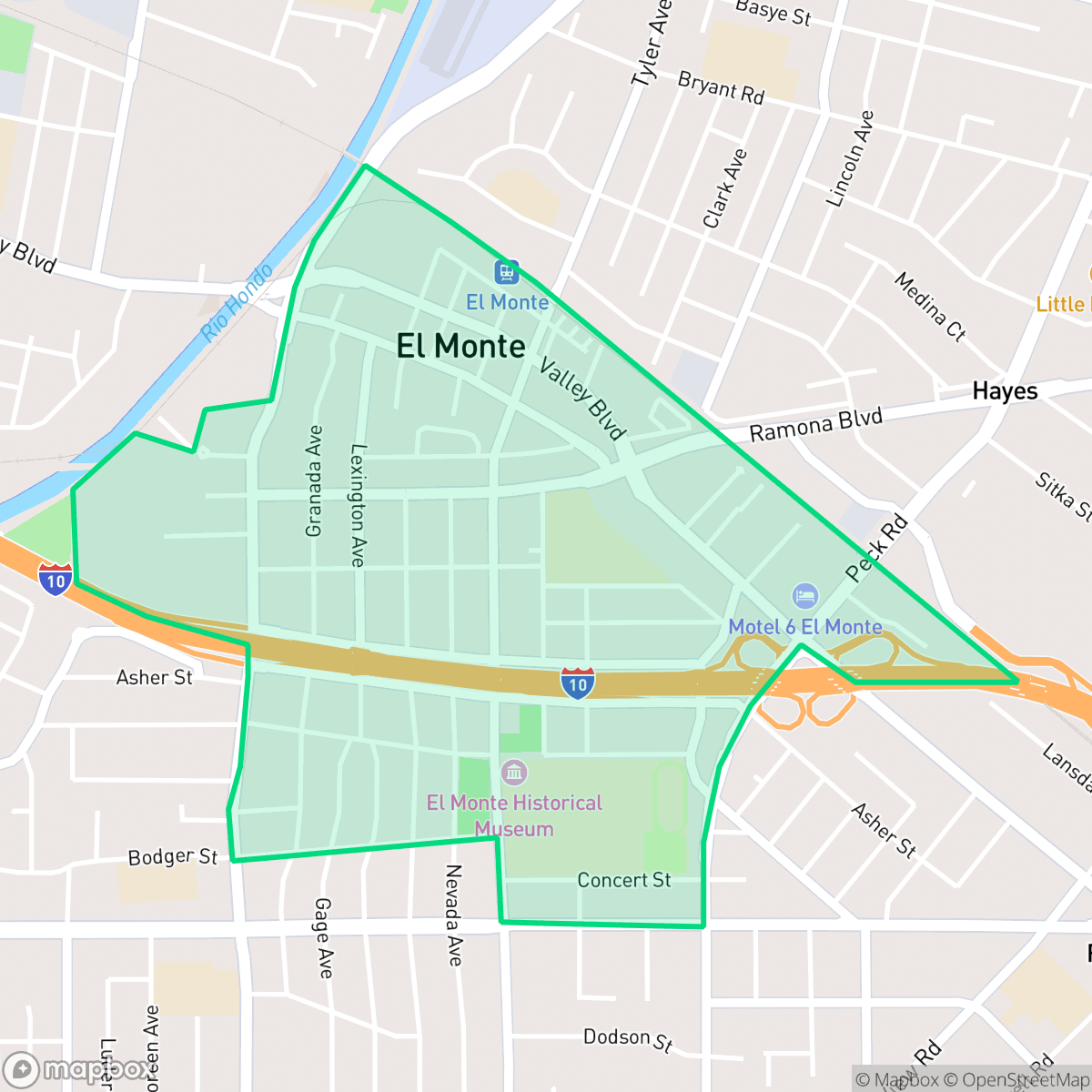
Downtown El Monte serves as a central transit and commercial hub, offering a blend of local markets and diverse dining options. While the area provides moderate walkability, residents should expect notable noise levels from nearby freeways and railroad tracks. The neighborhood features a dense suburban landscape with a mix of residential and commercial spaces.
Key Highlights
About Downtown
Downtown El Monte serves as the historic heart of a community once known as the 'End of the Santa Fe Trail.' Originally settled in the 1850s by pioneers drawn to the fertile alluvial soil between the San Gabriel and Rio Hondo rivers, the area evolved from a frontier agricultural outpost into a bustling transit and commercial hub. The neighborhood’s character is anchored by the El Monte Historical Museum, which preserves the city's legacy from its rancho-era roots to its 20th-century development. Historically, the area was defined by its proximity to the Southern Pacific Railroad depot and later became a focal point for the city's civic life. Today, it maintains a distinct cultural identity through its blend of historic landmarks, local markets, and its role as a central gathering place for the diverse San Gabriel Valley community.
This neighborhood functions as a dense urban core where residential blocks meet active commercial zones. The area maintains a consistent rhythm of activity, supported by a variety of local businesses and dining establishments that serve the diverse San Gabriel Valley population. While the layout is relatively compact, the physical environment is defined by a mix of tract housing and apartment complexes, resulting in close proximity between neighbors.
Prospective residents should note that the area is characterized by significant noise from transit corridors and heavy traffic, which may impact acoustic comfort. Although sidewalks are widely available, the neighborhood remains largely car-dependent due to the influence of nearby industrial logistics hubs and major highways. The local school landscape is varied, with districts currently navigating significant administrative and academic transitions. This location is best suited for individuals who prioritize central access to services and an urban-adjacent lifestyle over quiet, secluded living.
Neighborhood Scores Across 15 Qualities
Residential structures and apartment complexes are closely packed with minimal separation between buildings. This high-density layout features narrow gaps between houses and shared walls, which is consistent with the city average for El Monte.
Sidewalks and crosswalks are widely available on most streets, though connectivity is periodically interrupted by major highways and heavy traffic on bordering arterials. This level of pedestrian accessibility is roughly in line with the El Monte city average.
Uniform tract housing and high-density apartment complexes define the landscape. This area features a slightly higher level of visual density than the rest of the city, characterized by small yards and standard roof geometries.
Public park access and wide, grassy sidewalk verges are scarce in this area. According to iHuus data, the availability of outdoor pet spaces is slightly below the El Monte city average.
A blend of single-family homes, apartment blocks, and commercial corridors creates a suburban landscape that is slightly more developed than the El Monte average. According to iHuus data, the area features a consistent mix of residential pockets and large-scale retail centers with very little undeveloped land.
Diverse dining options and local social hubs provide more activity than the rest of the city, though much of the area relies on vehicle travel due to the proximity of warehouses and highways. According to iHuus data, the neighborhood offers a steady rhythm of services and greenery interspersed with industrial zones.
Frequent traffic and transit-related noise from nearby freeways and railroad tracks characterize this area. According to iHuus data, acoustic comfort is notably lower than the El Monte city average.
Air quality remains consistently good with infrequent periods of elevated readings. This level of cleanliness is roughly in line with the average seen across El Monte.
Active commercial warehouses and logistics hubs create a landscape of mixed-use development, which is slightly higher than the El Monte average. Residents may encounter increased truck traffic and noise from large-scale industrial lots near the highway, according to iHuus data.
Health insurance accessibility is lower than the El Monte average, according to iHuus data. Residents may find fewer local options for coverage compared to other parts of the city.
Voting patterns and census indicators show a predominantly liberal political leaning, which is slightly more pronounced than the El Monte city average according to iHuus data.
Residents live alongside a balanced variety of young adults, families, and older individuals. This demographic distribution is largely consistent with the rest of El Monte, according to iHuus data.
Address-Level Insights for Downtown


iHuus Neighborhood Intelligence Insights
Get address-level neighborhood insights for Downtown
- Street-level scores — see how individual blocks compare, not just neighborhood averages
- Micro-zone boundaries — identify quiet pockets, flood boundaries, and walkable clusters before you visit
- 15 dimensions in full — walkability, noise, air quality, school quality, insurance coverage, population age profile, urban/rural index, and more
- Boundary risk alerts — know if your address sits near a block boundary where scores drop, the kind of detail no listing will ever mention
- School insights — individual school ratings and insights, not just district-level data
- Compare before you commit — side-by-side data across neighborhoods, down to block precision
No credit card required
Compare with Any Neighborhood
| Dimension | Downtown | Mountain View |
|---|---|---|
| 🚶 Walkabilityavg 7.89 | ||
| 🔊 Acoustic Comfortavg 3.54 | ||
| 🤫 Privacy Indexavg 3.89 | ||
| 🎨 Visual Appealavg 5.51 | ||
| 🐕 Dog Friendlinessavg 4.38 | ||
| 🗺️ Urban-Rural Indexavg 6.21 | ||
| ✨ Neighborhood Vibeavg 4.71 | ||
| 🏥 Health Insurance Coverageavg 5.11 | ||
| 🌿 Air Qualityavg 8.12 | ||
| 🏭 Industrial Proximityavg 6.02 | ||
| 🌊 Flood Safetyavg 0.16 | ||
| 🗳️ Ideological Leanavg 9.4 | ||
| 👥 Population Age Profileavg 4.84 | ||
| 🔥 Fire Safetyavg 0 | ||
| 🏫 School Quality |
Downtown Rankings
School Districts Serving Downtown
School Insights for Downtown
Below average outcomes; significant attendance and academic challenges.
School Insights
See what's really behind every school rating near Downtown
- Individual school ratings — each school's own score with outcome context, not just a district average
- Enrollment & class size data — student-to-teacher ratio and how it compares to the state average
- Full demographics breakdown — ethnicity and gender composition for every school in the enrollment zone
- Every school in the district — all schools within the enrollment boundary ranked by rating, not just the closest one
- Grade levels & benchmarks — elementary through high school, with below/above state-average flags
No credit card required