Sunkist Park, Culver City
Updated · 2,662 residents
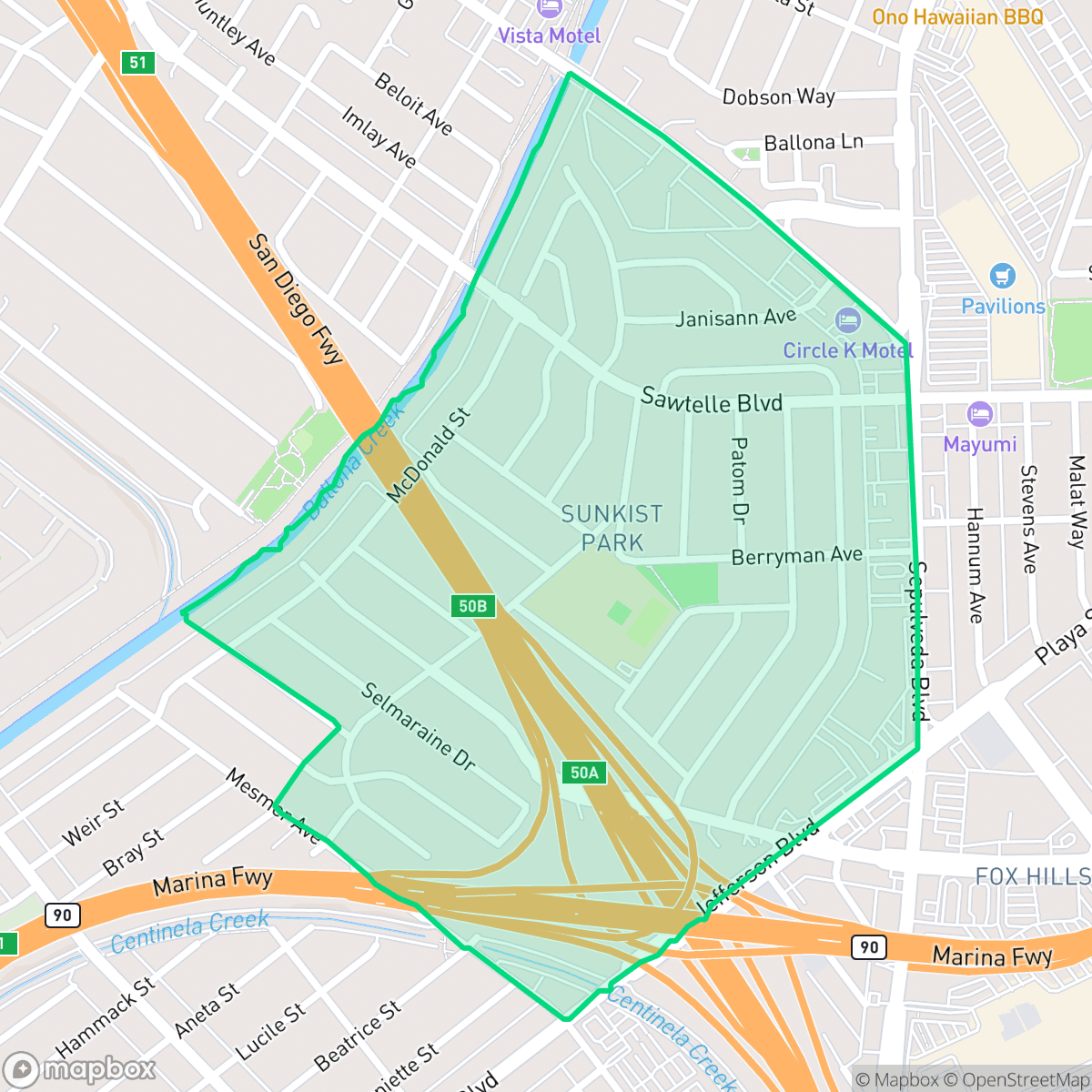
Sunkist Park is a suburban neighborhood in southwestern Culver City known for its proximity to El Marino Park and its highly regarded language immersion magnet school. While the area offers high health insurance coverage and good air quality, residents should be aware of significant road noise levels and a lack of natural fire safety infrastructure.
Key Highlights
About Sunkist Park
Sunkist Park, situated in southwestern Culver City, was annexed in 1949 as part of the 384-acre Overland-Mesmer Annexation. Developed shortly thereafter, the neighborhood consists of approximately 850 households. Its streets honor local figures, such as Segrell Way, named after former Culver City Mayor A. H. Segrell. At the heart of the community is El Marino Park, established in 1954 on land purchased from developer Camillo Cereghino. The adjacent El Marino Elementary School opened in 1953, closed in the 1980s due to declining enrollment, and reopened in 1994 as a highly regarded Spanish and Japanese language immersion magnet school. Historically, the neighborhood faced mid-century challenges, including discriminatory housing practices that restricted minority and Japanese-American homebuyers.
The neighborhood features a mix of suburban residential blocks and light industrial units, creating a distinct daytime atmosphere shaped by its location near major highway corridors. Residents benefit from the presence of El Marino Park, which serves as a central recreational hub, and access to a well-regarded language immersion program at the local elementary school. According to iHuus data, the area maintains strong health insurance coverage and favorable air quality, contributing to a stable environment for its approximately 850 households.
Prospective residents should consider the trade-offs associated with the area, particularly the elevated noise levels from nearby road traffic that can impact acoustic comfort. While the neighborhood is moderately walkable, the proximity to industrial zones and specific infrastructure challenges, such as low fire safety scores, are notable factors for long-term planning. The area is well-suited for families prioritizing access to specialized educational programs and those who value the established community character over absolute quiet or seclusion.
Neighborhood Scores Across 15 Qualities
Housing density is consistent with the Culver City average, featuring a mix of property spacing and some neighbors situated close together. According to iHuus data, certain residential pockets feature houses located with very minimal buffer between property lines.
Sidewalks and frequent crosswalks are available throughout the residential blocks, though the neighborhood is less walkable than the Culver City average due to the freeway bisecting the area. According to iHuus data, many streets feature clear paths on both sides of the roadway.
Uniform tract housing and closely packed lots define the area, offering slightly less visual variety than the Culver City average. Some properties include private pools, but most yards are relatively small.
Narrow street verges and a lack of nearby public parks make walking dogs more difficult here compared to the Culver City average. While some areas feature sidewalk greenery, many parts of the neighborhood consist of densely packed private yards with minimal accessible outdoor space.
Residential pockets feature a mix of single-family homes and larger-scale transportation infrastructure. This area maintains a slightly more open, semi-rural character than the typical Culver City landscape, according to iHuus data.
Low-density residential streets and light industrial areas create a calm atmosphere that is less active than the Culver City average. While some local dining options exist near green spaces, most commercial services are not within easy walking distance.
Persistent noise from the nearby airport runway and heavy rail lines creates significant acoustic disruption. This level of noise is considerably higher than the average found throughout Culver City, according to iHuus data.
Air quality remains mostly clean with only rare instances of elevated readings. According to iHuus data, the air quality levels here are consistent with the Culver City average.
Residential and light commercial uses dominate the area, with no significant heavy industrial activity or hazardous facilities present. This level of industrial proximity is consistent with the city average, according to iHuus data.
Health insurance access is widespread among residents, sitting slightly above the Culver City average according to iHuus data.
Voting patterns and census indicators reflect a very high level of liberal leaning, which is consistent with the broader Culver City area according to iHuus data.
Residents live alongside a balanced distribution of young adults, families, and older populations. This demographic spread is very similar to the broader Culver City area according to iHuus data.
Flood risk in this area is notably lower than the Culver City average, though some residual risk remains within the 500-year floodplain according to iHuus data.
Address-Level Insights for Sunkist Park


iHuus Neighborhood Intelligence Insights
Get address-level neighborhood insights for Sunkist Park
- Street-level scores — see how individual blocks compare, not just neighborhood averages
- Micro-zone boundaries — identify quiet pockets, flood boundaries, and walkable clusters before you visit
- 15 dimensions in full — walkability, noise, air quality, school quality, insurance coverage, population age profile, urban/rural index, and more
- Boundary risk alerts — know if your address sits near a block boundary where scores drop, the kind of detail no listing will ever mention
- School insights — individual school ratings and insights, not just district-level data
- Compare before you commit — side-by-side data across neighborhoods, down to block precision
No credit card required
Compare with Any Neighborhood
| Dimension | Sunkist Park | Blair Hills |
|---|---|---|
| 🚶 Walkabilityavg 9.25 | ||
| 🔊 Acoustic Comfortavg 1.98 | ||
| 🤫 Privacy Indexavg 4.22 | ||
| 🎨 Visual Appealavg 6.37 | ||
| 🐕 Dog Friendlinessavg 5.1 | ||
| 🗺️ Urban-Rural Indexavg 6.22 | ||
| ✨ Neighborhood Vibeavg 5.3 | ||
| 🏥 Health Insurance Coverageavg 8.25 | ||
| 🌿 Air Qualityavg 8 | ||
| 🏭 Industrial Proximityavg 8.28 | ||
| 🌊 Flood Safetyavg 5.25 | ||
| 🗳️ Ideological Leanavg 9.89 | ||
| 👥 Population Age Profileavg 5.05 | ||
| 🔥 Fire Safetyavg 0.02 | ||
| 🏫 School Quality |
Sunkist Park Rankings
School Districts Serving Sunkist Park
School Insights for Sunkist Park
Below average outcomes; significant attendance and academic challenges.
School Insights
See what's really behind every school rating near Sunkist Park
- Individual school ratings — each school's own score with outcome context, not just a district average
- Enrollment & class size data — student-to-teacher ratio and how it compares to the state average
- Full demographics breakdown — ethnicity and gender composition for every school in the enrollment zone
- Every school in the district — all schools within the enrollment boundary ranked by rating, not just the closest one
- Grade levels & benchmarks — elementary through high school, with below/above state-average flags
No credit card required