Studio Village, Culver City
Updated · 1,742 residents
Studio Village is a quiet, residential enclave in Culver City defined by its dense suburban grid and proximity to community parks. While the area offers a stable environment with excellent air quality, residents should anticipate notable noise levels from nearby road traffic.
Key Highlights
About Studio Village
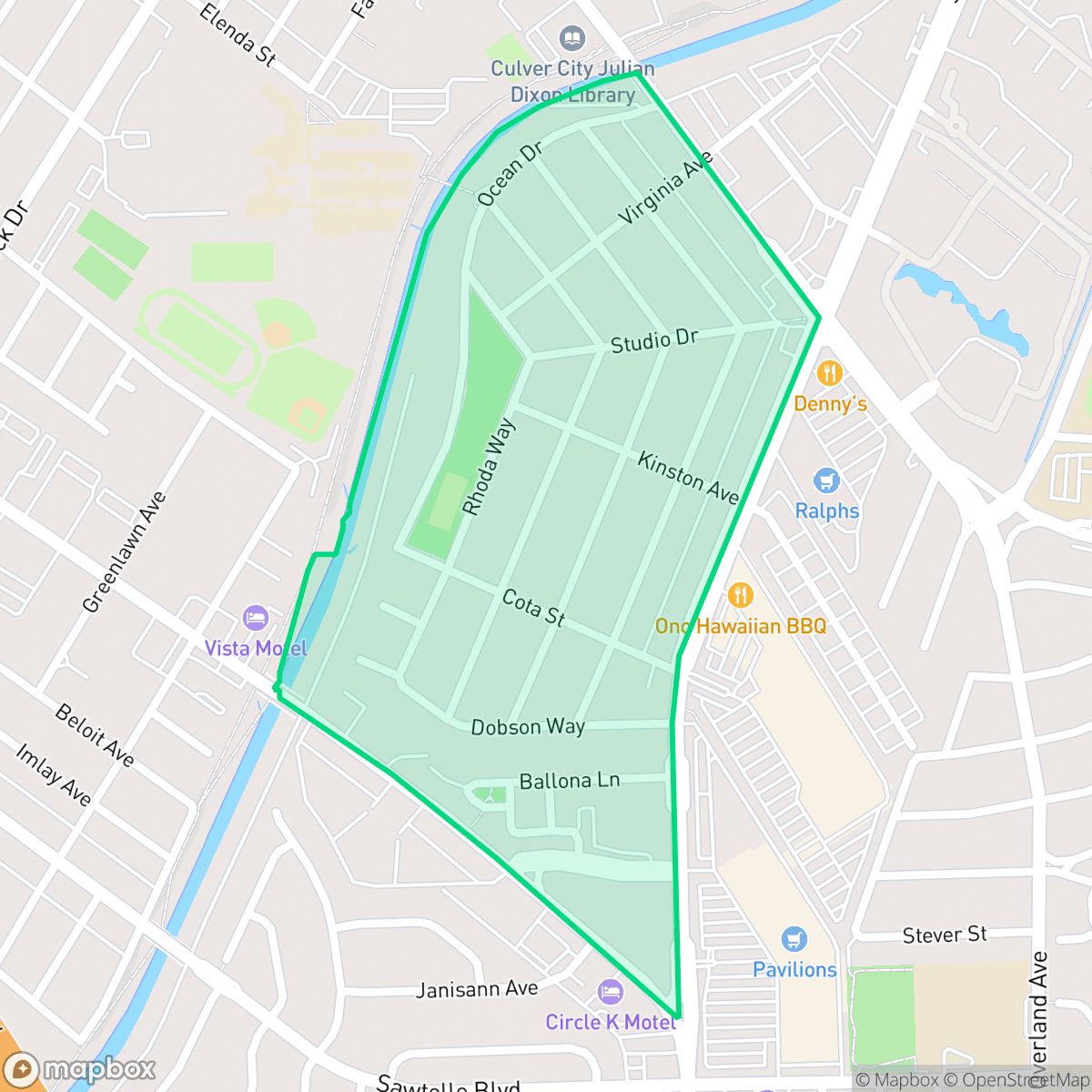
Located in Culver City, California, the Studio Village neighborhood is bounded by Ballona Creek between Overland Avenue and Sepulveda Boulevard. Historically, the area was home to a 1930s six-hole golf course frequented by Hollywood stars, which was later replaced in the 1950s when the Lugo Ranch at Jefferson Boulevard and Cota Street was sold to establish the Studio Village Shopping Center. The neighborhood also encompasses a portion of the former MGM Lot 3, a massive open-air backlot that once housed iconic movie sets. In 1965, the neighborhood made local history with the construction of the Studio Village Townhouses on the west side of Sepulveda Boulevard, marking the very first condominium development built in Culver City. Today, the neighborhood is centered around Lindberg Park, maintaining a quiet, community-oriented residential character.
The neighborhood functions as a stable residential pocket characterized by single-family homes and proximity to essential retail blocks. It benefits from the Culver City Unified School District, which is widely regarded for its academic standards and community support. The area maintains a consistent, suburban atmosphere that prioritizes residential life over high-density commercial activity, offering a balanced environment for those seeking a settled community feel within the broader Culver City area.
Livability in the area involves specific trade-offs. While the neighborhood is relatively walkable with a robust sidewalk network, the overall liveliness is moderate due to limited commercial options within immediate walking distance. Privacy is somewhat constrained by the density of the housing, where homes are often spaced closely together. Additionally, the acoustic environment is heavily influenced by road traffic, making it a better fit for those who prioritize neighborhood stability and school access over complete silence or a high-energy urban core.
Neighborhood Scores Across 15 Qualities
Residential spacing varies between closely set houses and multi-family units with shared courtyards, offering more separation than the Culver City average.
Pedestrian movement is easy due to a dense network of sidewalks and frequent crossings that are slightly more comprehensive than the Culver City average. Residents can navigate both residential and commercial zones with clear, well-maintained pathways on both sides of the streets.
Well-maintained properties and a high density of private backyard pools contribute to a visual environment that is more polished than the Culver City average. According to iHuus data, the area features frequent upscale amenities and spacious residential lots.
Wide grassy verges and nearby park access offer ample walking space for pets. This area provides significantly more accessible green space and safer walking conditions than the Culver City average, according to iHuus data.
Open land and scattered greenery are slightly more prevalent here than in the rest of Culver City. The landscape features a mix of single-family homes and low-rise residential blocks.
Low density and abundant greenery create a serene environment, though the area feels less active than the Culver City average. Local dining options are available, but many essential services require a short drive as few businesses are within walking distance.
Frequent disturbances from nearby railroad tracks and heavy freeway traffic characterize this area. Acoustic comfort is slightly lower than the Culver City average according to iHuus data.
Air quality remains consistently good with rare instances of elevated readings. This level of air purity is consistent with the average found throughout Culver City, according to iHuus data.
Industrial activity and hazardous facilities are entirely absent from this area. According to iHuus data, the neighborhood is significantly more free of industrial proximity than the Culver City average.
Health insurance enrollment is exceptionally high among residents, sitting well above the Culver City average according to iHuus data.
Voting patterns and census indicators reflect a deeply liberal political leaning, which aligns closely with the broader Culver City average.
Residents live alongside a balanced mix of young professionals, families, and seniors. This demographic spread is slightly more varied than the Culver City average, according to iHuus data.
Flood risk levels in this area are slightly higher than the Culver City average. According to iHuus data, the lack of a detailed FEMA study means the exact level of risk remains undetermined.
Address-Level Insights for Studio Village


iHuus Neighborhood Intelligence Insights
Get address-level neighborhood insights for Studio Village
- Street-level scores — see how individual blocks compare, not just neighborhood averages
- Micro-zone boundaries — identify quiet pockets, flood boundaries, and walkable clusters before you visit
- 15 dimensions in full — walkability, noise, air quality, school quality, insurance coverage, population age profile, urban/rural index, and more
- Boundary risk alerts — know if your address sits near a block boundary where scores drop, the kind of detail no listing will ever mention
- School insights — individual school ratings and insights, not just district-level data
- Compare before you commit — side-by-side data across neighborhoods, down to block precision
No credit card required
Compare with Any Neighborhood
| Dimension | Studio Village | Blair Hills |
|---|---|---|
| 🚶 Walkabilityavg 9.25 | ||
| 🔊 Acoustic Comfortavg 1.98 | ||
| 🤫 Privacy Indexavg 4.22 | ||
| 🎨 Visual Appealavg 6.37 | ||
| 🐕 Dog Friendlinessavg 5.1 | ||
| 🗺️ Urban-Rural Indexavg 6.22 | ||
| ✨ Neighborhood Vibeavg 5.3 | ||
| 🏥 Health Insurance Coverageavg 8.25 | ||
| 🌿 Air Qualityavg 8 | ||
| 🏭 Industrial Proximityavg 8.28 | ||
| 🌊 Flood Safetyavg 5.25 | ||
| 🗳️ Ideological Leanavg 9.89 | ||
| 👥 Population Age Profileavg 5.05 | ||
| 🔥 Fire Safetyavg 0.02 | ||
| 🏫 School Quality |
Studio Village Rankings
School Districts Serving Studio Village
School Insights for Studio Village
Below average outcomes; significant attendance and academic challenges.
School Insights
See what's really behind every school rating near Studio Village
- Individual school ratings — each school's own score with outcome context, not just a district average
- Enrollment & class size data — student-to-teacher ratio and how it compares to the state average
- Full demographics breakdown — ethnicity and gender composition for every school in the enrollment zone
- Every school in the district — all schools within the enrollment boundary ranked by rating, not just the closest one
- Grade levels & benchmarks — elementary through high school, with below/above state-average flags
No credit card required