Park West, Culver City
Updated · 3,164 residents
Park West is a highly walkable residential enclave in Culver City, defined by its quiet streets and proximity to community green spaces. While it offers excellent access to local amenities and schools, residents should be aware of elevated road noise levels and specific environmental safety considerations.
Key Highlights
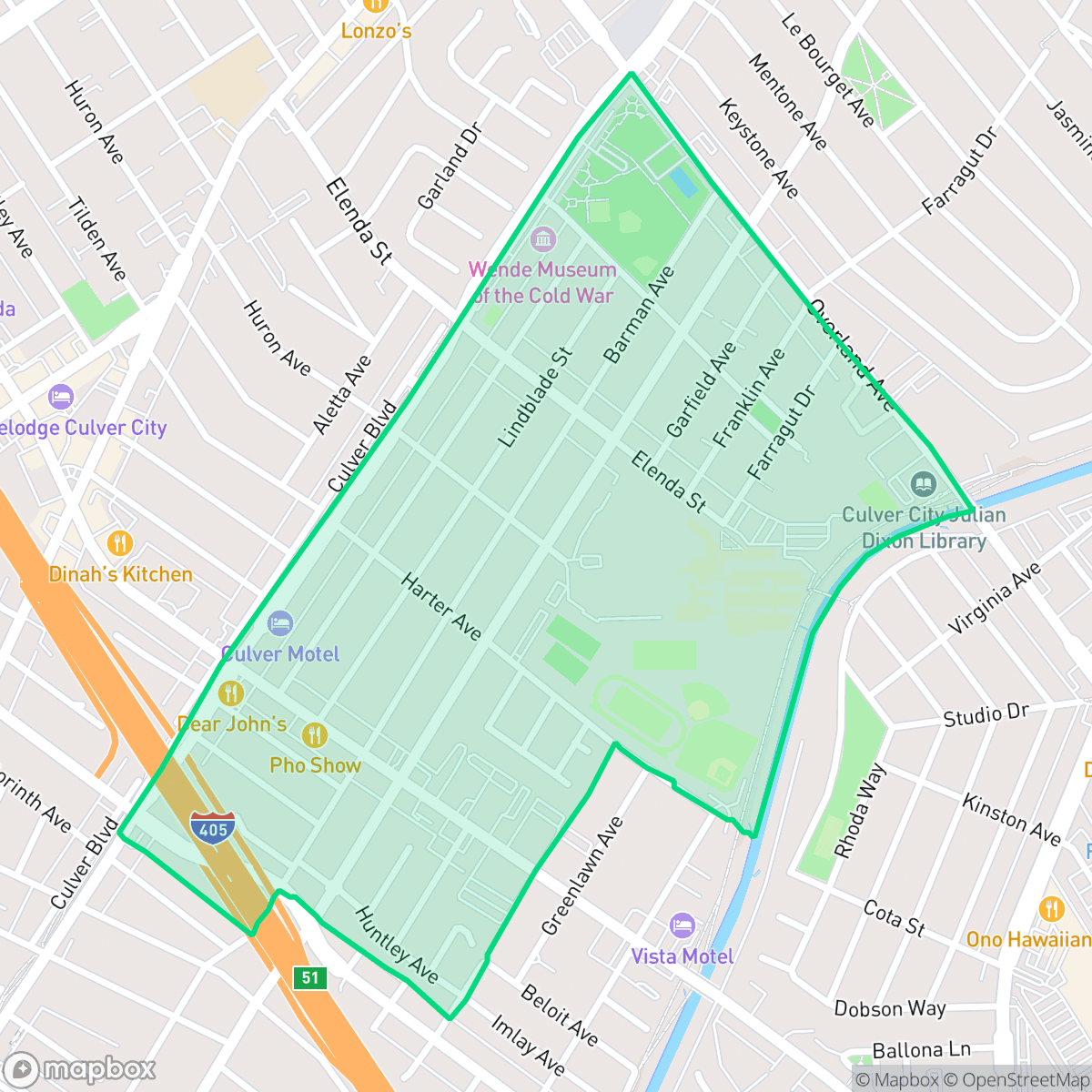
About Park West
Historically part of Rancho La Ballona, the Park West neighborhood of Culver City evolved from its agricultural roots into a tranquil residential enclave during the mid-20th century. Developed largely between the 1950s and 1970s, the neighborhood is characterized by tree-lined streets and classic Mid-Century Modern and Ranch-style homes. Its defining landmark is the 12.9-acre Veterans Memorial Park, established on land purchased by the city in 1938. At its corner stands the historic Veterans Memorial Building, dedicated in 1951. The building originally featured a "tourist tower" designed to allow visitors to view the active back lot movie sets of the adjacent Metro-Goldwyn-Mayer Studios. Today, this landmark facility also houses the Culver City Historical Society Archives and Museum, preserving the neighborhood's deep connection to early Hollywood.
The neighborhood functions as a central hub for residents who prioritize pedestrian access, boasting a perfect walkability score. The landscape is primarily residential, characterized by a mix of mid-century architecture and well-maintained green spaces like Coombs Parkette. It maintains a stable, suburban atmosphere that benefits from high levels of health insurance coverage and a strong connection to the Culver City Unified School District, which serves the local student population with high-performing schools like Farragut Elementary. Prospective residents should weigh the benefits of this central location against specific trade-offs. The area experiences higher than average ambient noise levels due to road traffic, and it is located in a region with significant flood and fire safety challenges. It is best suited for individuals or families who value a pedestrian-friendly lifestyle and proximity to the city core, provided they are comfortable with the acoustic and environmental realities of this specific urban environment.
Neighborhood Scores Across 15 Qualities
Residential spacing is relatively tight with some homes positioned very close to one another. This level of density provides more separation between neighbors than is typically found across Culver City.
Continuous sidewalks and frequent pedestrian crossings facilitate easy movement on foot throughout most residential and commercial streets. According to iHuus data, this connectivity is slightly above the Culver City average, though a major highway does bisect the neighborhood.
Well-maintained properties and a high density of private backyard pools contribute to a visual landscape that is slightly more polished than the Culver City average. According to iHuus data, the area features many well-valued homes with mature landscaping and upscale amenities.
Public walking options vary across the area, ranging from street corridors with wide grassy verges to sections where narrow sidewalks and small private yards predominate. According to iHuus data, the neighborhood offers slightly better access to green walking spaces than the Culver City average.
Residential layouts consist of a mix of single-family homes and mid-rise apartments, presenting a slightly more open landscape than the typical Culver City setting. According to iHuus data, the area maintains a balance of dense suburban fabric and low-density urban pockets.
A mix of lively street life and quiet, green pockets defines this area, which maintains a level of activity comparable to the rest of Culver City. While various local eateries and markets are accessible, many dining options require a short drive as walkable amenities are concentrated in specific pockets.
Frequent disturbances from nearby freeway and railroad traffic characterize this area. According to iHuus data, acoustic comfort is lower than the Culver City average.
Air quality remains consistently high with rare instances of elevated readings, matching the typical levels found throughout Culver City according to iHuus data.
Industrial activity and heavy warehouses are absent from this area. According to iHuus data, the neighborhood remains almost entirely residential and light commercial, which is notably cleaner than the Culver City average.
Health insurance enrollment is widespread among residents here, remaining slightly above the Culver City average according to iHuus data.
Voting patterns and census indicators show a very high concentration of liberal-leaning residents, mirroring the broader political landscape of Culver City according to iHuus data.
Residents live alongside a balanced variety of young adults, families, and seniors. This demographic distribution is slightly more varied than the Culver City average, according to iHuus data.
Flood risk in this area is slightly higher than the Culver City average. According to iHuus data, the specific risk level remains undetermined because a detailed federal study has not yet been completed for this part of the neighborhood.
Address-Level Insights for Park West


iHuus Neighborhood Intelligence Insights
Get address-level neighborhood insights for Park West
- Street-level scores — see how individual blocks compare, not just neighborhood averages
- Micro-zone boundaries — identify quiet pockets, flood boundaries, and walkable clusters before you visit
- 15 dimensions in full — walkability, noise, air quality, school quality, insurance coverage, population age profile, urban/rural index, and more
- Boundary risk alerts — know if your address sits near a block boundary where scores drop, the kind of detail no listing will ever mention
- School insights — individual school ratings and insights, not just district-level data
- Compare before you commit — side-by-side data across neighborhoods, down to block precision
No credit card required
Compare with Any Neighborhood
| Dimension | Park West | Blair Hills |
|---|---|---|
| 🚶 Walkabilityavg 9.25 | ||
| 🔊 Acoustic Comfortavg 1.98 | ||
| 🤫 Privacy Indexavg 4.22 | ||
| 🎨 Visual Appealavg 6.37 | ||
| 🐕 Dog Friendlinessavg 5.1 | ||
| 🗺️ Urban-Rural Indexavg 6.22 | ||
| ✨ Neighborhood Vibeavg 5.3 | ||
| 🏥 Health Insurance Coverageavg 8.25 | ||
| 🌿 Air Qualityavg 8 | ||
| 🏭 Industrial Proximityavg 8.28 | ||
| 🌊 Flood Safetyavg 5.25 | ||
| 🗳️ Ideological Leanavg 9.89 | ||
| 👥 Population Age Profileavg 5.05 | ||
| 🔥 Fire Safetyavg 0.02 | ||
| 🏫 School Quality |
Park West Rankings
School Districts Serving Park West
School Insights for Park West
Below average outcomes; significant attendance and academic challenges.
School Insights
See what's really behind every school rating near Park West
- Individual school ratings — each school's own score with outcome context, not just a district average
- Enrollment & class size data — student-to-teacher ratio and how it compares to the state average
- Full demographics breakdown — ethnicity and gender composition for every school in the enrollment zone
- Every school in the district — all schools within the enrollment boundary ranked by rating, not just the closest one
- Grade levels & benchmarks — elementary through high school, with below/above state-average flags
No credit card required