McManus, Culver City
Updated · 1,743 residents
McManus is a historic residential enclave in East Culver City that balances its early twentieth-century architectural roots with a vibrant, mixed-use atmosphere along Washington Boulevard. While the area offers high walkability and convenient access to local dining, residents should note that the neighborhood experiences consistent road noise and elevated risks regarding flood and fire safety.
Key Highlights
About McManus
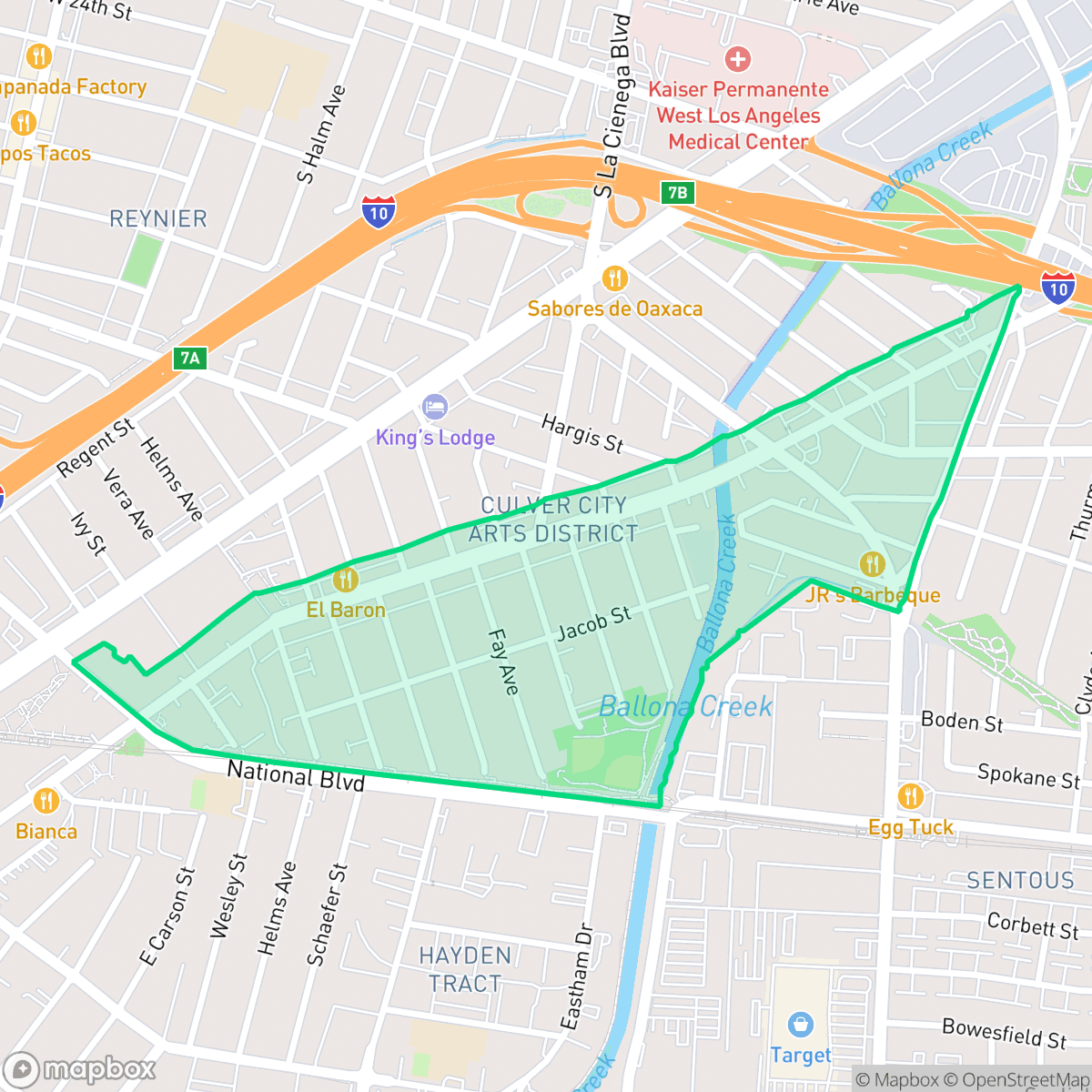
The McManus neighborhood, often referred to as East Culver City, is a historic enclave featuring pre-World War II homes built as early as 1905. Originally named by the City of Los Angeles before being annexed to Culver City, the neighborhood's early residential development was marked by racial covenants restricting homeownership to white residents. In 1925, the neighborhood expanded its local infrastructure with the opening of Washington School on McManus Street. A central landmark is Syd Kronenthal Park, located at the foot of McManus Street; originally acquired by the city in 1948 as McManus Park, it was later renamed to honor the city's long-serving Human Services Director. Today, McManus borders the vibrant Culver City Arts District along Washington Boulevard, blending its historic residential character with modern creative industries.
The neighborhood functions as a bridge between quiet residential streets and the active commercial corridor of the Culver City Arts District. It features a dense mix of mid-rise buildings and older housing stock, creating a landscape where diverse dining options and community spaces like Syd Kronenthal Park are easily accessible. According to iHuus data, the area maintains good air quality, though its proximity to major transit routes results in a higher volume of daytime commercial traffic and consistent road noise. This blend of residential and commercial activity creates a lively atmosphere that remains well-connected to the broader city infrastructure. Prospective residents should weigh the benefits of a central, walkable location against specific environmental considerations. The neighborhood presents a challenging profile regarding natural hazards, with data indicating high vulnerability to both flood and fire events. Additionally, the limited privacy inherent in its dense, mixed-use layout makes it better suited for individuals who prioritize proximity to urban amenities over seclusion. Families may find the nearby Culver City Unified School District a stable educational option, though the area remains an urban environment with the associated trade-offs in acoustic comfort.
Neighborhood Scores Across 15 Qualities
Residential buildings and houses are placed relatively close to one another, which is consistent with the density seen across Culver City. Residents may experience limited buffer zones between neighbors due to the presence of tightly spaced multi-unit complexes and shared walls.
Sidewalks are present on most streets, but the massive freeway interchange creates significant pedestrian barriers. This level of walkability is slightly lower than the Culver City average, according to iHuus data.
Standard tract housing and mid-sized apartment blocks define the landscape, featuring small yards and limited private luxury amenities. This level of visual variety is slightly below the Culver City average, according to iHuus data.
Public green space and wide sidewalks are scarce in this area. According to iHuus data, the lack of accessible parks and the presence of major highway barriers make this neighborhood less dog friendly than the Culver City average.
A mix of single-family homes and low-rise apartments provides a balance of greenery and built environment similar to the Culver City average. Street layouts vary between dense urban pockets and more open, suburban-style blocks.
Diverse dining and mid-rise blocks offer a sense of activity that is slightly more vibrant than the Culver City average. This energy is punctuated by a mix of suburban greenery and light industrial areas near major transit corridors.
Frequent acoustic disturbances from nearby transit corridors and flight paths characterize this area. According to iHuus data, noise levels are slightly higher than the Culver City average.
Air quality remains consistently high with rare instances of elevated readings. This level of cleanliness is in line with the average found throughout Culver City.
Large warehouses, electrical substations, and nearby freeway corridors introduce notable noise and air quality considerations. This level of industrial proximity is higher than the Culver City average, creating a landscape where residential pockets sit alongside active commercial and logistics operations.
Health insurance access among residents is high, though slightly below the Culver City average according to iHuus data.
Voting patterns and census indicators reflect a predominantly liberal political leaning, which is consistent with the broader Culver City average according to iHuus data.
Residents live alongside a balanced distribution of young adults, families, and older populations. This demographic spread is closely aligned with the broader Culver City average.
Property located within a designated 100-year floodplain face significant flood risks, making flood insurance typically a requirement. This risk level is notably higher than the Culver City average, according to iHuus data.
Address-Level Insights for McManus


iHuus Neighborhood Intelligence Insights
Get address-level neighborhood insights for McManus
- Street-level scores — see how individual blocks compare, not just neighborhood averages
- Micro-zone boundaries — identify quiet pockets, flood boundaries, and walkable clusters before you visit
- 15 dimensions in full — walkability, noise, air quality, school quality, insurance coverage, population age profile, urban/rural index, and more
- Boundary risk alerts — know if your address sits near a block boundary where scores drop, the kind of detail no listing will ever mention
- School insights — individual school ratings and insights, not just district-level data
- Compare before you commit — side-by-side data across neighborhoods, down to block precision
No credit card required
Compare with Any Neighborhood
| Dimension | McManus | Blair Hills |
|---|---|---|
| 🚶 Walkabilityavg 9.25 | ||
| 🔊 Acoustic Comfortavg 1.98 | ||
| 🤫 Privacy Indexavg 4.22 | ||
| 🎨 Visual Appealavg 6.37 | ||
| 🐕 Dog Friendlinessavg 5.1 | ||
| 🗺️ Urban-Rural Indexavg 6.22 | ||
| ✨ Neighborhood Vibeavg 5.3 | ||
| 🏥 Health Insurance Coverageavg 8.25 | ||
| 🌿 Air Qualityavg 8 | ||
| 🏭 Industrial Proximityavg 8.28 | ||
| 🌊 Flood Safetyavg 5.25 | ||
| 🗳️ Ideological Leanavg 9.89 | ||
| 👥 Population Age Profileavg 5.05 | ||
| 🔥 Fire Safetyavg 0.02 | ||
| 🏫 School Quality |
McManus Rankings
School Districts Serving McManus
School Insights for McManus
Below average outcomes; significant attendance and academic challenges.
School Insights
See what's really behind every school rating near McManus
- Individual school ratings — each school's own score with outcome context, not just a district average
- Enrollment & class size data — student-to-teacher ratio and how it compares to the state average
- Full demographics breakdown — ethnicity and gender composition for every school in the enrollment zone
- Every school in the district — all schools within the enrollment boundary ranked by rating, not just the closest one
- Grade levels & benchmarks — elementary through high school, with below/above state-average flags
No credit card required