Lucerne/Higuera, Culver City
Updated · 3,294 residents
Lucerne/Higuera is a vibrant, highly walkable neighborhood known for its blend of mid-century residential streets and creative office hubs. Residents enjoy a lively social atmosphere with frequent access to local dining and coffee shops, though the area experiences notable noise from nearby transit corridors.
Key Highlights
About Lucerne/Higuera
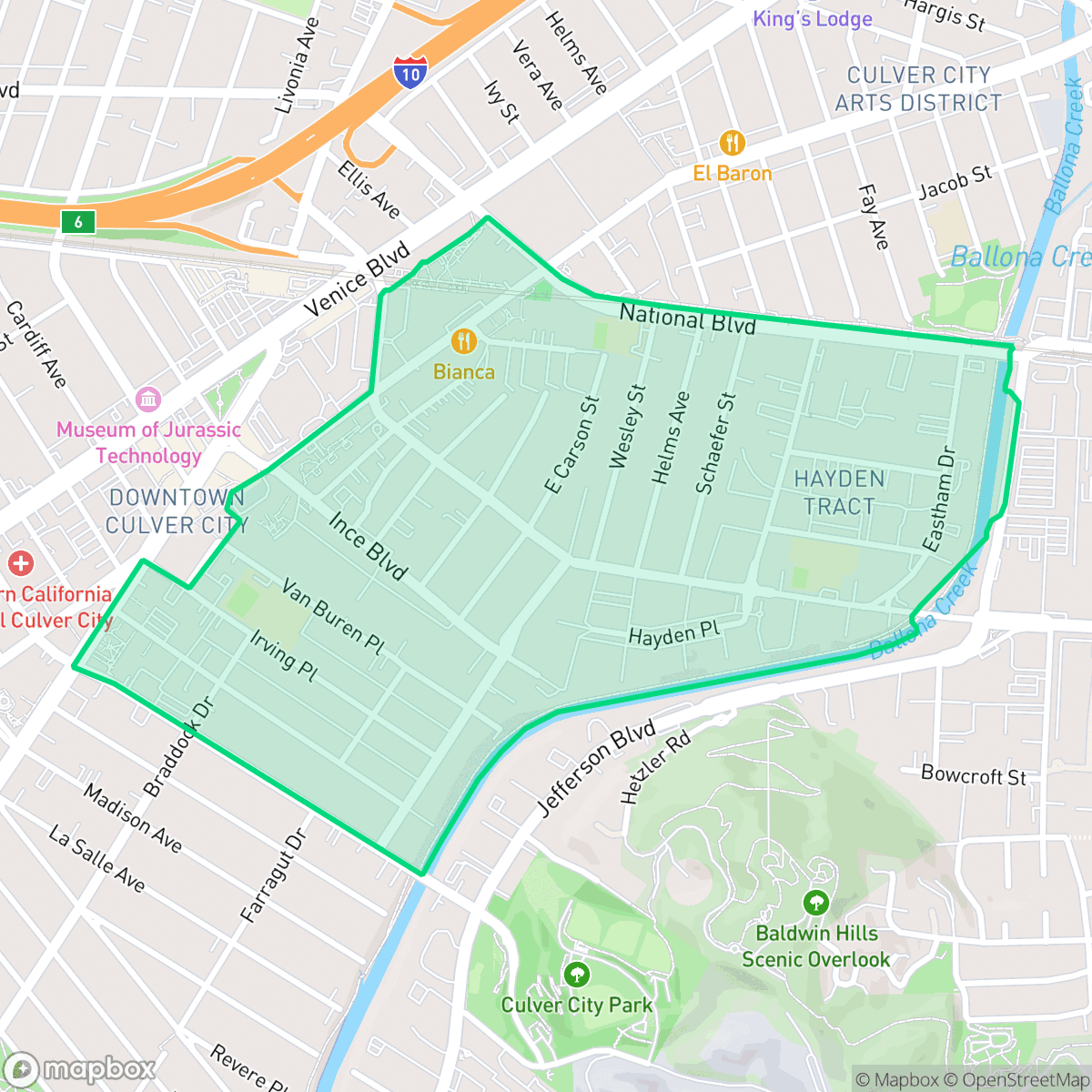
The Lucerne/Higuera neighborhood is situated on land once part of the 1821 Rancho Rincón de los Bueyes grant. Higuera Street is named after Bernardo J. Higuera, a descendant of the rancho's original owners and a member of Culver City's inaugural board of trustees. Historically, the area encompassed the Hayden Tract, a significant industrial zone developed by Sam Hayden in 1946. Designed to bolster the city's post-war economy, the tract featured reinforced concrete manufacturing plants that supported the Pacific Electric Railway. By the 1990s, the neighborhood underwent a major transformation, shifting from its industrial roots to a creative and tech-focused district. Today, it is known for blending mid-century residential architecture with innovative, adaptive-reuse office spaces, including notable architectural projects that define its current identity as a hub for media, design, and entrepreneurial activity.
The neighborhood balances its industrial legacy with a modern, creative identity, offering a mix of residential housing and adaptive-reuse office spaces. It maintains a highly walkable grid that provides easy access to local amenities, making it a convenient location for those who prioritize proximity to work and social hubs. The area attracts a diverse demographic, ranging from young professionals to families, who benefit from high levels of health insurance coverage and consistently clean air.
Living in the area requires navigating specific trade-offs, particularly regarding environmental safety and noise levels. Residents face elevated fire risks and should be aware of the lack of localized flood assessments, while the proximity to major freeways and railroad tracks results in frequent traffic noise. Despite limited public green space, the neighborhood remains a popular choice for those who value an active, urban-suburban lifestyle within a politically liberal community.
Neighborhood Scores Across 15 Qualities
Residential spacing is comparable to the rest of Culver City, featuring a mix of multi-unit buildings and closely positioned houses. Some areas lack significant buffers between neighbors, which is typical for this level of urban density.
Continuous sidewalks and frequent marked crosswalks make most errands easily accessible on foot. While the neighborhood remains slightly below the Culver City average due to the major freeway corridor, the residential and commercial streets maintain a well-defined, pedestrian-friendly grid.
Residential lots feature uniform tract housing with small yards and minimal private greenery. This landscape is slightly less lush than the Culver City average, as noted by iHuus data.
Narrow sidewalks and limited access to public parks mean residents mostly rely on private fenced yards for pet exercise. According to iHuus data, dog-friendly amenities in this area are roughly in line with the Culver City average.
A blend of single-family homes and multi-story apartments is interspersed with significant open natural space. This environment is less urbanized than the typical Culver City setting, offering a more even distribution of streets and greenery according to iHuus data.
Active blocks featuring a notable concentration of dining and social spots provide a more vibrant atmosphere than the Culver City average. Residents can find various amenities ranging from coffee shops to local eateries, particularly near mid-rise urban areas and waterfront locations.
Frequent noise from nearby freeways and railroad tracks characterizes this area. According to iHuus data, acoustic comfort is higher here than the Culver City average, though significant traffic sounds remain a constant factor.
Air quality in this area is consistently good, matching the average levels found throughout Culver City. Residents can expect mostly clean air with only rare instances of elevated readings.
Light commercial activity and occasional warehouses are present, though the area contains fewer industrial elements than the Culver City average. Residents may experience some truck traffic and noise from nearby transit corridors and commercial lots.
Health insurance access among residents is very high and slightly above the Culver City average, according to iHuus data.
Voting patterns and census indicators show a strongly liberal political landscape that is consistent with the broader Culver City area.
A diverse range of age groups resides here, including young professionals, families, and seniors. This demographic distribution is largely in line with the broader Culver City area.
Flood risk in this area is difficult to determine because FEMA has not completed a detailed study, making the level of safety lower than the Culver City average. According to iHuus data, residents should remain aware of potential vulnerabilities due to this lack of localized assessment.
Fire hazards in this area are significantly higher than the Culver City average. Residents should prepare for extreme fire safety risks and ensure maximum protection measures are in place, according to iHuus data.
Address-Level Insights for Lucerne/Higuera


iHuus Neighborhood Intelligence Insights
Get address-level neighborhood insights for Lucerne/Higuera
- Street-level scores — see how individual blocks compare, not just neighborhood averages
- Micro-zone boundaries — identify quiet pockets, flood boundaries, and walkable clusters before you visit
- 15 dimensions in full — walkability, noise, air quality, school quality, insurance coverage, population age profile, urban/rural index, and more
- Boundary risk alerts — know if your address sits near a block boundary where scores drop, the kind of detail no listing will ever mention
- School insights — individual school ratings and insights, not just district-level data
- Compare before you commit — side-by-side data across neighborhoods, down to block precision
No credit card required
Compare with Any Neighborhood
| Dimension | Lucerne/Higuera | Blair Hills |
|---|---|---|
| 🚶 Walkabilityavg 9.25 | ||
| 🔊 Acoustic Comfortavg 1.98 | ||
| 🤫 Privacy Indexavg 4.22 | ||
| 🎨 Visual Appealavg 6.37 | ||
| 🐕 Dog Friendlinessavg 5.1 | ||
| 🗺️ Urban-Rural Indexavg 6.22 | ||
| ✨ Neighborhood Vibeavg 5.3 | ||
| 🏥 Health Insurance Coverageavg 8.25 | ||
| 🌿 Air Qualityavg 8 | ||
| 🏭 Industrial Proximityavg 8.28 | ||
| 🌊 Flood Safetyavg 5.25 | ||
| 🗳️ Ideological Leanavg 9.89 | ||
| 👥 Population Age Profileavg 5.05 | ||
| 🔥 Fire Safetyavg 0.02 | ||
| 🏫 School Quality |
Lucerne/Higuera Rankings
School Districts Serving Lucerne/Higuera
School Insights for Lucerne/Higuera
Below average outcomes; significant attendance and academic challenges.
School Insights
See what's really behind every school rating near Lucerne/Higuera
- Individual school ratings — each school's own score with outcome context, not just a district average
- Enrollment & class size data — student-to-teacher ratio and how it compares to the state average
- Full demographics breakdown — ethnicity and gender composition for every school in the enrollment zone
- Every school in the district — all schools within the enrollment boundary ranked by rating, not just the closest one
- Grade levels & benchmarks — elementary through high school, with below/above state-average flags
No credit card required