Fox Hills, Culver City
Updated · 4,593 residents
Fox Hills is a dense, diverse residential neighborhood in Culver City known for its high walkability and central access to major commercial hubs like Westfield Culver City. While the area offers residents access to well-maintained green spaces and private amenities, the high density of apartment complexes results in limited privacy and elevated noise levels from nearby highway traffic.
Key Highlights
About Fox Hills
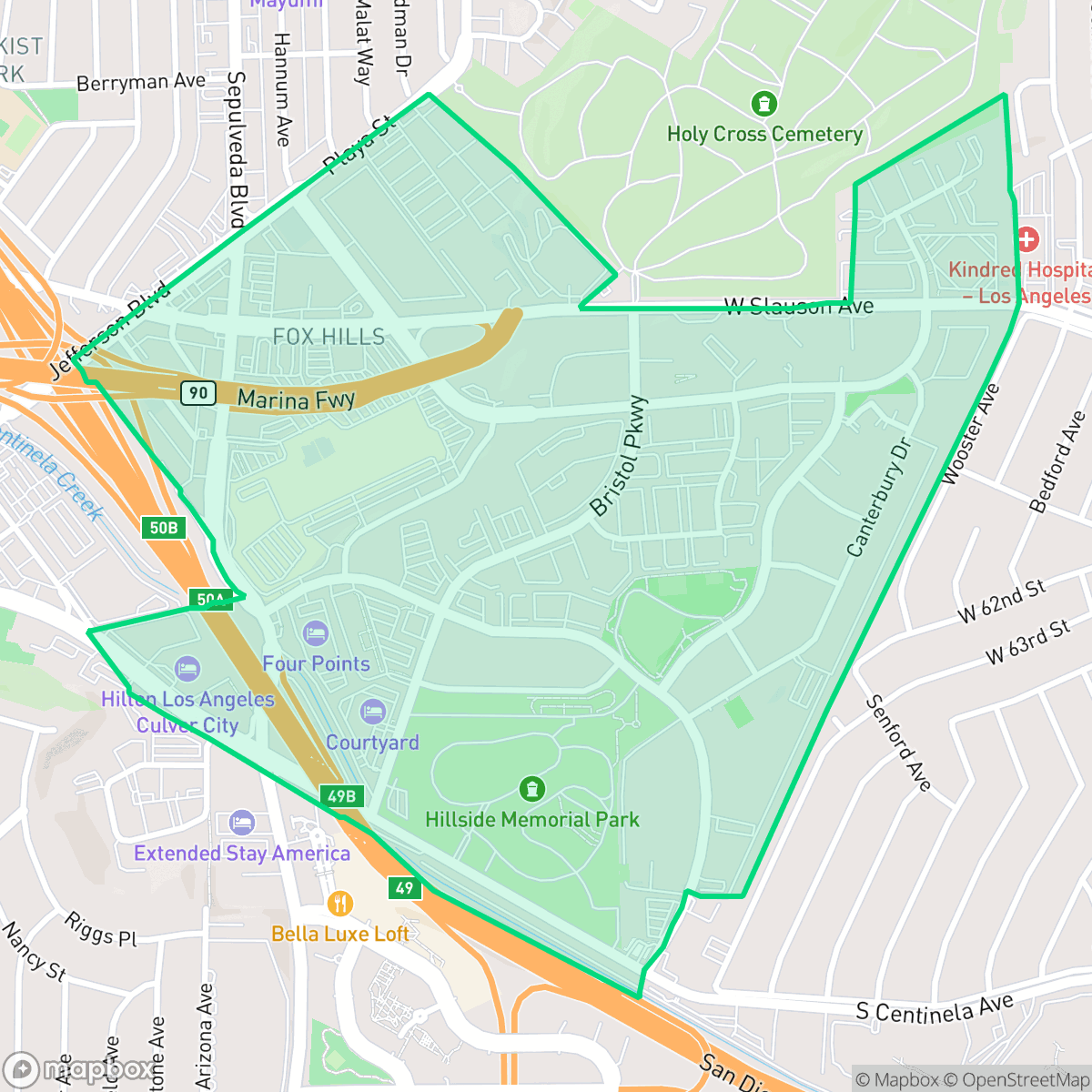
Annexed to Culver City in 1964, the Fox Hills neighborhood was previously undeveloped land defined by riding stables and the Fox Hills Country Club golf courses. During the 1970s, the area underwent a major transformation into a high-density residential enclave dominated by apartment and condominium complexes. In 1975, it became the site of Culver City's first major redevelopment project: the Fox Hills Mall (now Westfield Culver City). Designed by Gruen Associates, the mall was notable as the first three-level indoor shopping center in California. Additionally, the Marina Freeway off-ramp bordering the neighborhood served as the starting point for the marathon during the 1984 Los Angeles Olympics. Today, Fox Hills remains one of Culver City’s most diverse and densely populated neighborhoods.
The area functions as a compact, mixed-use environment that balances residential life with significant commercial infrastructure. Residents benefit from consistent sidewalk connectivity and proximity to local parks, which provide essential outdoor space for pets and recreation. The architectural landscape is defined by a blend of modern office structures and high-density housing, creating a unique urban atmosphere that feels distinct from the surrounding lower-density suburbs of Culver City.
Prospective residents should consider the trade-offs between convenience and acoustic comfort, as the neighborhood experiences noticeable noise from regional road traffic. While the area excels in health insurance coverage and maintains good air quality, the high-density nature of the housing stock means that private outdoor space is often limited. It is well-suited for professionals and small households who prioritize proximity to employment centers and retail, and who are comfortable with the trade-offs inherent in a bustling, transit-adjacent environment.
Neighborhood Scores Across 15 Qualities
Residential spacing provides more buffer between neighbors than is typically found in other parts of Culver City. While some multi-unit complexes feature shared walls, many properties maintain a moderate distance from adjacent structures.
Comprehensive sidewalk networks and low-traffic residential loops provide a safe environment for walking. While slightly below the Culver City average, the area features consistent pedestrian crossings and well-maintained paths throughout both residential and commercial blocks.
Large residential estates with private pools and well-maintained lawns characterize this area. According to iHuus data, the visual landscape is notably more polished than the Culver City average.
Expansive parklands and connected green spaces provide ample, traffic-safe areas for walking dogs. This accessibility to greenery and wide paths is significantly higher than the Culver City average.
Residential pockets feature a blend of single-family homes and multi-story apartments set among some open land. This layout is slightly more semi-rural than the typical Culver City neighborhood, according to iHuus data.
A mix of quiet, green residential blocks and high-energy dining hubs near the highway creates a vibe that is more active than the Culver City average. Local amenities range from serene parks to diverse, car-dependent restaurant clusters.
Frequent acoustic disturbances from nearby freeways and railroad corridors characterize this area. According to iHuus data, noise levels in Fox Hills are slightly higher than the Culver City average.
Air quality in Fox Hills is consistently good, matching the typical levels found throughout Culver City. According to iHuus data, residents can expect mostly clean air with only rare instances of elevated readings.
Residential, recreational, and light commercial uses dominate the area without visible industrial hazards. According to iHuus data, this lack of heavy industry makes the neighborhood slightly cleaner than the Culver City average.
Health insurance access is very high among Fox Hills residents, trending notably above the Culver City average according to iHuus data.
Voting patterns and census indicators show a deeply liberal political leaning that is consistent with the rest of Culver City. Residents can expect a political landscape that mirrors the citywide average according to iHuus data.
Residents live alongside a balanced mix of young professionals, families, and seniors. According to iHuus data, this demographic spread is slightly more varied than the typical profile found across Culver City.
Flood risk in this area is slightly higher than the Culver City average due to a lack of detailed federal studies for the zone. According to iHuus data, the area sits within a category of undetermined risk.
Fire safety protocols and coverage in Fox Hills are consistent with the rest of Culver City. Data from iHuus indicates that risk levels here align with the city average.
Address-Level Insights for Fox Hills


iHuus Neighborhood Intelligence Insights
Get address-level neighborhood insights for Fox Hills
- Street-level scores — see how individual blocks compare, not just neighborhood averages
- Micro-zone boundaries — identify quiet pockets, flood boundaries, and walkable clusters before you visit
- 15 dimensions in full — walkability, noise, air quality, school quality, insurance coverage, population age profile, urban/rural index, and more
- Boundary risk alerts — know if your address sits near a block boundary where scores drop, the kind of detail no listing will ever mention
- School insights — individual school ratings and insights, not just district-level data
- Compare before you commit — side-by-side data across neighborhoods, down to block precision
No credit card required
Compare with Any Neighborhood
| Dimension | Fox Hills | Blair Hills |
|---|---|---|
| 🚶 Walkabilityavg 9.25 | ||
| 🔊 Acoustic Comfortavg 1.98 | ||
| 🤫 Privacy Indexavg 4.22 | ||
| 🎨 Visual Appealavg 6.37 | ||
| 🐕 Dog Friendlinessavg 5.1 | ||
| 🗺️ Urban-Rural Indexavg 6.22 | ||
| ✨ Neighborhood Vibeavg 5.3 | ||
| 🏥 Health Insurance Coverageavg 8.25 | ||
| 🌿 Air Qualityavg 8 | ||
| 🏭 Industrial Proximityavg 8.28 | ||
| 🌊 Flood Safetyavg 5.25 | ||
| 🗳️ Ideological Leanavg 9.89 | ||
| 👥 Population Age Profileavg 5.05 | ||
| 🔥 Fire Safetyavg 0.02 | ||
| 🏫 School Quality |
Fox Hills Rankings
School Districts Serving Fox Hills
School Insights for Fox Hills
Below average outcomes; significant attendance and academic challenges.
School Insights
See what's really behind every school rating near Fox Hills
- Individual school ratings — each school's own score with outcome context, not just a district average
- Enrollment & class size data — student-to-teacher ratio and how it compares to the state average
- Full demographics breakdown — ethnicity and gender composition for every school in the enrollment zone
- Every school in the district — all schools within the enrollment boundary ranked by rating, not just the closest one
- Grade levels & benchmarks — elementary through high school, with below/above state-average flags
No credit card required