Downtown, Culver City
Updated · 1,029 residents
Downtown Culver City is a highly walkable, vibrant social hub defined by its dense mix of cafes, restaurants, and local markets. Residents enjoy a lively urban atmosphere, though they should anticipate limited privacy in multi-unit housing and elevated noise levels from nearby transit corridors.
Key Highlights
About Downtown
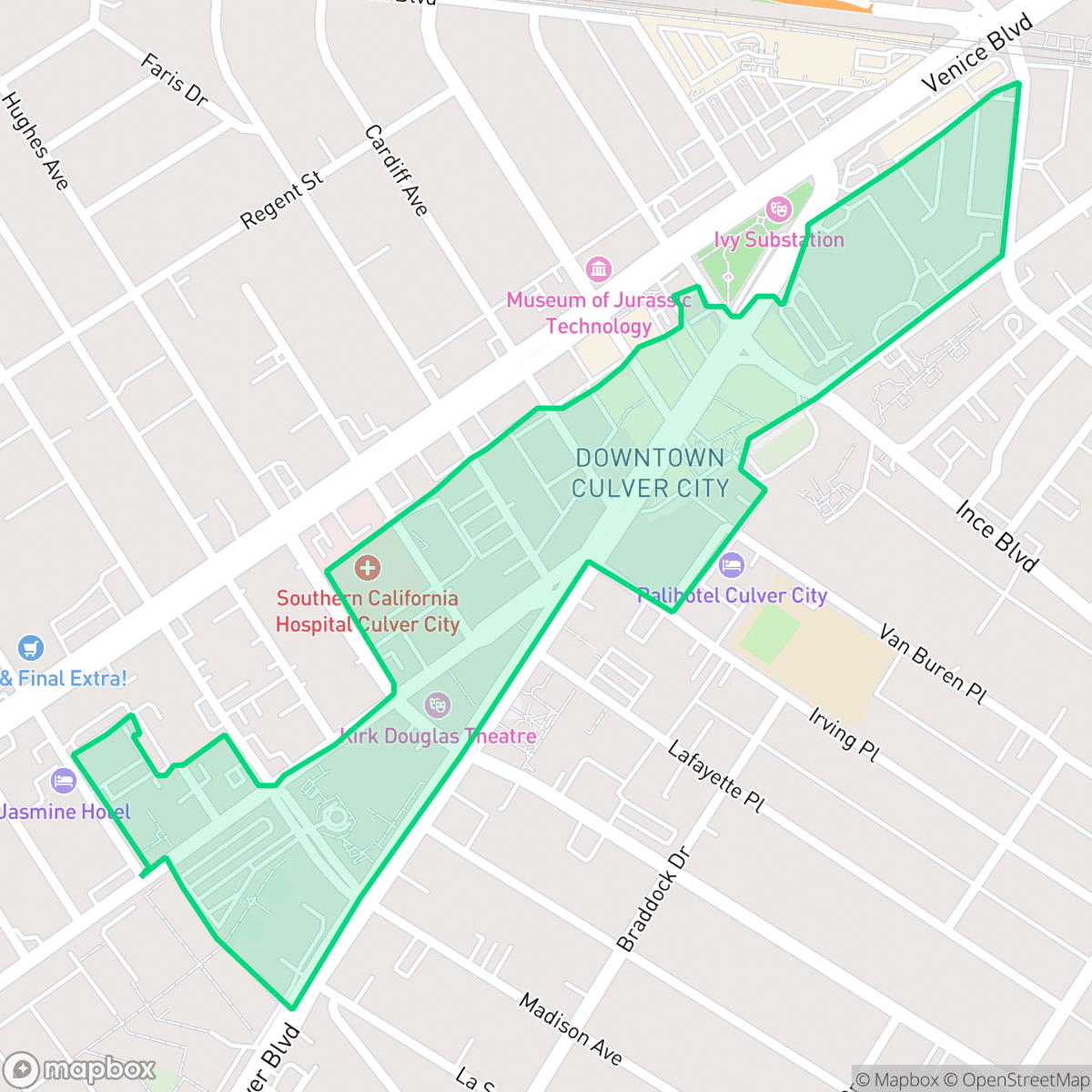
Downtown Culver City, centered at the intersection of Washington and Culver Boulevards, serves as the historic heart of the city founded by Harry Culver in 1917. Its architectural character is defined by notable structures like the 1924 Culver Hotel, a Renaissance Revival landmark, and the 1929 Citizen Building. Long known as the 'Heart of Screenland' due to its proximity to legendary studios like MGM and Sony Pictures, the neighborhood remains deeply tied to the motion picture industry. The area underwent a significant revitalization beginning in the 1990s, transforming its historic core into a pedestrian-oriented hub. Key landmarks, including the Kirk Douglas Theatre and the preserved Main Street, reflect the city’s early 20th-century origins and its ongoing evolution into a vibrant center for commerce, arts, and culture.
The area functions as a central social destination, characterized by its mid-rise commercial blocks and active street life. Beyond the well-known dining and cultural venues, the neighborhood supports a diverse, multi-generational population that benefits from clean air and high rates of health insurance coverage. While the local infrastructure is designed for pedestrians, the urban density results in a landscape of uniform residential buildings that prioritize central convenience over expansive private outdoor space. Prospective residents should weigh the benefits of a transit-connected, walkable lifestyle against the realities of a dense urban environment. The neighborhood experiences significant noise from nearby freeways and railroad tracks, and public green space is relatively scarce. It is an ideal setting for those who value immediate access to city amenities and a strong sense of community, provided they are comfortable with a compact living arrangement and the ambient sounds of an active metropolitan center.
Neighborhood Scores Across 15 Qualities
Residential properties and multi-unit buildings feature close spacing and shared walls, resulting in a privacy level that is slightly lower than the Culver City average. According to iHuus data, certain pockets of the area exhibit high density with minimal buffers between neighbors.
Continuous sidewalks and frequent marked crosswalks make much of the area easy to navigate on foot. While a major freeway corridor interrupts the local grid, the walkable infrastructure remains largely comparable to the rest of Culver City.
Residential views consist of uniform, mid-sized apartment blocks and standard tract housing with small yards. According to iHuus data, the visual variety in this area is slightly lower than the Culver City average.
Public green space and wide sidewalk verges are scarce in this area, making it less dog friendly than the Culver City average. According to iHuus data, most available greenery is contained within private fenced yards.
A combination of mid-rise commercial blocks and residential zones provides a blend of streetscape and greenery. This area feels more densely urbanized than the typical Culver City suburb according to iHuus data.
Concentrated pockets of dining and social venues create a notably more active atmosphere than the rest of Culver City. This mid-rise urban area features a dense mix of coffee shops, restaurants, and local markets according to iHuus data.
Persistent sounds from nearby railroad tracks and major freeways characterize this area. According to iHuus data, acoustic comfort in this neighborhood is notably lower than the Culver City average.
Air quality is consistently good with rare instances of elevated readings. This level of air cleanliness is consistent with the average found throughout Culver City.
Largely comprised of residential and light commercial uses, this area avoids the heavy industrial hazards or large warehouses found in other parts of the city. According to iHuus data, residents can expect fewer noise and air quality concerns typically associated with significant industrial zones.
Health insurance access is consistent with the Culver City average. According to iHuus data, most residents in this area are covered by a health insurance plan.
Voting patterns and census indicators show a very strong liberal leaning that is consistent with the rest of Culver City.
Residents live among a balanced spread of young adults, families, and older individuals. This demographic distribution is nearly identical to the Culver City average, according to iHuus data.
Flood risk in this area is difficult to determine because FEMA has not yet completed a detailed study for this location. According to iHuus data, the level of risk appears slightly higher than the Culver City average.
Address-Level Insights for Downtown


iHuus Neighborhood Intelligence Insights
Get address-level neighborhood insights for Downtown
- Street-level scores — see how individual blocks compare, not just neighborhood averages
- Micro-zone boundaries — identify quiet pockets, flood boundaries, and walkable clusters before you visit
- 15 dimensions in full — walkability, noise, air quality, school quality, insurance coverage, population age profile, urban/rural index, and more
- Boundary risk alerts — know if your address sits near a block boundary where scores drop, the kind of detail no listing will ever mention
- School insights — individual school ratings and insights, not just district-level data
- Compare before you commit — side-by-side data across neighborhoods, down to block precision
No credit card required
Compare with Any Neighborhood
| Dimension | Downtown | Blair Hills |
|---|---|---|
| 🚶 Walkabilityavg 9.25 | ||
| 🔊 Acoustic Comfortavg 1.98 | ||
| 🤫 Privacy Indexavg 4.22 | ||
| 🎨 Visual Appealavg 6.37 | ||
| 🐕 Dog Friendlinessavg 5.1 | ||
| 🗺️ Urban-Rural Indexavg 6.22 | ||
| ✨ Neighborhood Vibeavg 5.3 | ||
| 🏥 Health Insurance Coverageavg 8.25 | ||
| 🌿 Air Qualityavg 8 | ||
| 🏭 Industrial Proximityavg 8.28 | ||
| 🌊 Flood Safetyavg 5.25 | ||
| 🗳️ Ideological Leanavg 9.89 | ||
| 👥 Population Age Profileavg 5.05 | ||
| 🔥 Fire Safetyavg 0.02 | ||
| 🏫 School Quality |
Downtown Rankings
School Districts Serving Downtown
School Insights for Downtown
Below average outcomes; significant attendance and academic challenges.
School Insights
See what's really behind every school rating near Downtown
- Individual school ratings — each school's own score with outcome context, not just a district average
- Enrollment & class size data — student-to-teacher ratio and how it compares to the state average
- Full demographics breakdown — ethnicity and gender composition for every school in the enrollment zone
- Every school in the district — all schools within the enrollment boundary ranked by rating, not just the closest one
- Grade levels & benchmarks — elementary through high school, with below/above state-average flags
No credit card required