Clarkdale, Culver City
Updated · 4,192 residents
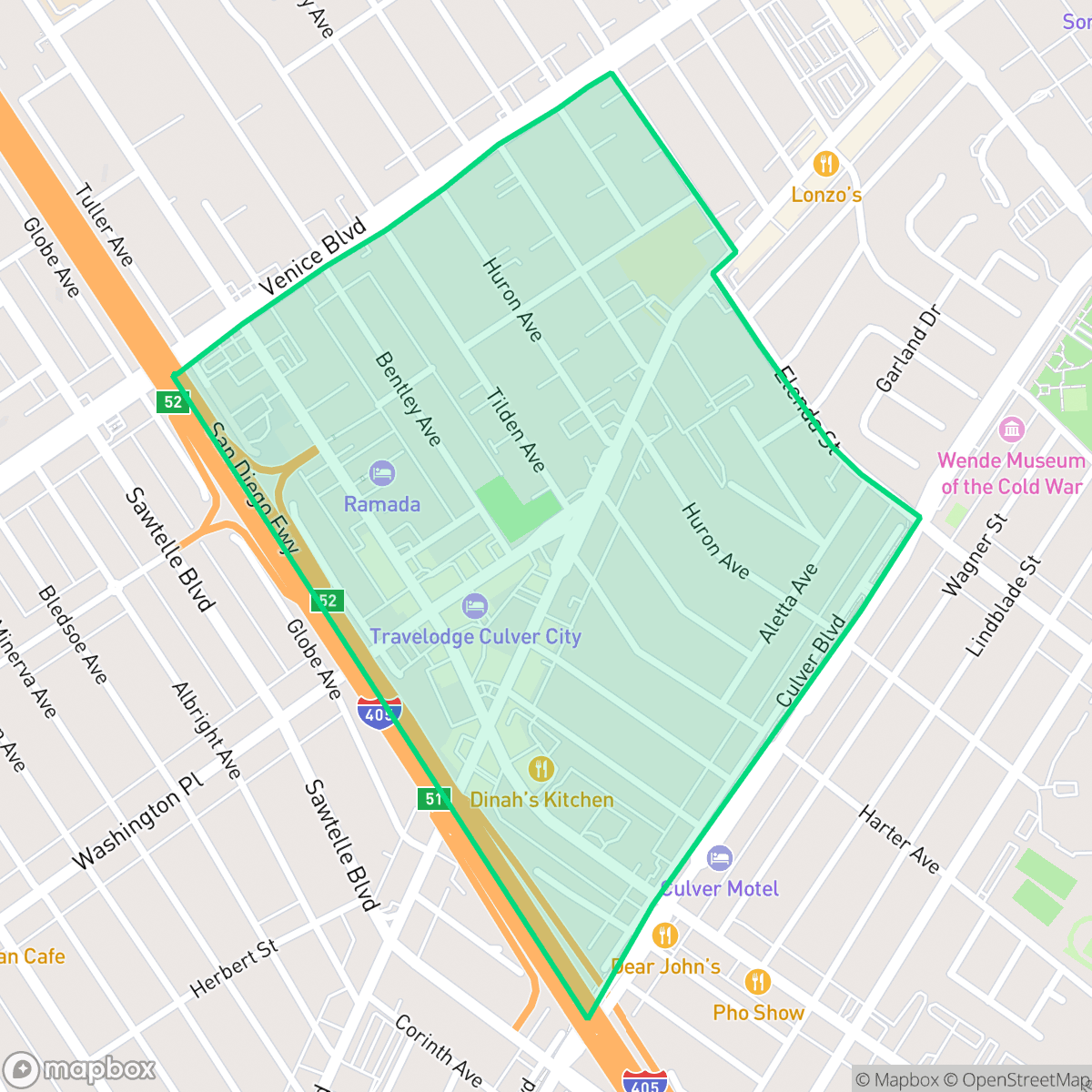
Clarkdale is a highly walkable Culver City neighborhood defined by its consistent grid layout and proximity to local dining along Sepulveda Boulevard. While the area offers convenient access to major transit routes, residents should anticipate elevated noise levels due to constant road traffic.
Key Highlights
About Clarkdale
Clarkdale is a well-established neighborhood in Culver City, California, tucked near Venice Boulevard, Sepulveda Boulevard, and the 405 freeway. Developed starting in 1920, the area is known for its tree-lined residential streets and well-preserved mid-century homes. Its central community hub is Tellefson Park, a 1.5-acre green space dedicated during the 1976 Bicentennial on the former site of the Rollerdrome skating rink. The park was named in honor of Mike Tellefson, a long-serving Culver City councilmember and city attorney. Culturally, Clarkdale's character is defined by iconic local establishments along Sepulveda Boulevard, including Johnnie’s Pastrami—a classic 1952 Googie-style diner featuring vintage jukeboxes—and The Cinema Bar, a historic, unpretentious dive bar celebrated as a Westside staple for live music.
This residential enclave maintains a dense suburban atmosphere, characterized by a consistent grid of sidewalks that makes daily errands and local transit highly accessible. The area benefits from a lack of heavy industrial activity, ensuring a clean, light-commercial environment that supports a variety of established eateries. Residents enjoy a stable, community-focused lifestyle supported by the Culver City Unified School District, which remains a primary draw for families seeking access to high-performing elementary and high school programs.
Prospective residents should weigh the neighborhood's exceptional walkability against the reality of its acoustic environment, as road traffic noise remains a consistent factor throughout the area. With its mix of mid-century residential architecture and apartment units, the neighborhood provides a range of housing options, though those seeking expansive green spaces or private yards may find the options limited. It is well-suited for professionals and families who prioritize urban connectivity and school access over quiet seclusion or extensive private outdoor space.
Neighborhood Scores Across 15 Qualities
Residential structures are somewhat closely spaced with varying degrees of separation between neighbors. This level of density is slightly higher than the Culver City average, meaning some shared walls or narrow gaps between homes are common according to iHuus data.
Pedestrian navigation is exceptionally easy due to a complete sidewalk network and clearly marked crossings on nearly every street. This connectivity is even more robust than the typical Culver City experience, providing reliable access across both residential and commercial zones.
Uniform tract housing and mid-density apartment complexes characterize the area, featuring boxy rooflines and modest yards. The visual landscape is slightly less varied than the Culver City average, according to iHuus data.
Public park access and wide green verges are sparse in this area. According to iHuus data, most available greenery is located within private backyards rather than in accessible public spaces, making this neighborhood less dog-friendly than the Culver City average.
Scattered open spaces and pockets of greenery provide a slightly more open feel than the typical Culver City urban density. This balance of residential grids and nearby greenery offers a landscape that is more spacious than the city average.
A mix of quiet residential streets and accessible dining hubs defines the area, offering a level of activity slightly above the Culver City average. While many blocks are serene and green, certain pockets feature a steady rhythm of local eateries and cafes near parklands.
Constant noise from nearby heavy rail and airport proximity significantly impacts acoustic comfort. This level of disturbance is notably more severe than the average found throughout Culver City, according to iHuus data.
Air quality in this area remains consistently good, matching the average levels found throughout Culver City. According to iHuus data, residents can expect mostly clean air with only rare instances of elevated readings.
Industrial presence is virtually nonexistent in this area, which consists entirely of residential and light commercial zones. This lack of heavy industry or large warehouses makes the neighborhood significantly cleaner of industrial hazards than the Culver City average, according to iHuus data.
Health insurance access among Clarkdale residents is nearly on par with the Culver City average. According to iHuus data, a significant majority of the population maintains coverage.
Voting patterns and census indicators reflect a deeply liberal political leaning, matching the broader Culver City average according to iHuus data.
Residents live alongside a balanced mix of young professionals, families, and seniors. This demographic distribution is consistent with the broader Culver City area according to iHuus data.
Flood risk in this area is slightly higher than the Culver City average, though current FEMA assessments lack a detailed study for this specific location. Residents should note that the risk level remains undetermined due to incomplete federal flood mapping.
Address-Level Insights for Clarkdale


iHuus Neighborhood Intelligence Insights
Get address-level neighborhood insights for Clarkdale
- Street-level scores — see how individual blocks compare, not just neighborhood averages
- Micro-zone boundaries — identify quiet pockets, flood boundaries, and walkable clusters before you visit
- 15 dimensions in full — walkability, noise, air quality, school quality, insurance coverage, population age profile, urban/rural index, and more
- Boundary risk alerts — know if your address sits near a block boundary where scores drop, the kind of detail no listing will ever mention
- School insights — individual school ratings and insights, not just district-level data
- Compare before you commit — side-by-side data across neighborhoods, down to block precision
No credit card required
Compare with Any Neighborhood
| Dimension | Clarkdale | Blair Hills |
|---|---|---|
| 🚶 Walkabilityavg 9.25 | ||
| 🔊 Acoustic Comfortavg 1.98 | ||
| 🤫 Privacy Indexavg 4.22 | ||
| 🎨 Visual Appealavg 6.37 | ||
| 🐕 Dog Friendlinessavg 5.1 | ||
| 🗺️ Urban-Rural Indexavg 6.22 | ||
| ✨ Neighborhood Vibeavg 5.3 | ||
| 🏥 Health Insurance Coverageavg 8.25 | ||
| 🌿 Air Qualityavg 8 | ||
| 🏭 Industrial Proximityavg 8.28 | ||
| 🌊 Flood Safetyavg 5.25 | ||
| 🗳️ Ideological Leanavg 9.89 | ||
| 👥 Population Age Profileavg 5.05 | ||
| 🔥 Fire Safetyavg 0.02 | ||
| 🏫 School Quality |
Clarkdale Rankings
School Districts Serving Clarkdale
School Insights for Clarkdale
Below average outcomes; significant attendance and academic challenges.
School Insights
See what's really behind every school rating near Clarkdale
- Individual school ratings — each school's own score with outcome context, not just a district average
- Enrollment & class size data — student-to-teacher ratio and how it compares to the state average
- Full demographics breakdown — ethnicity and gender composition for every school in the enrollment zone
- Every school in the district — all schools within the enrollment boundary ranked by rating, not just the closest one
- Grade levels & benchmarks — elementary through high school, with below/above state-average flags
No credit card required