Blanco/Culver Crest, Culver City
Updated · 2,648 residents
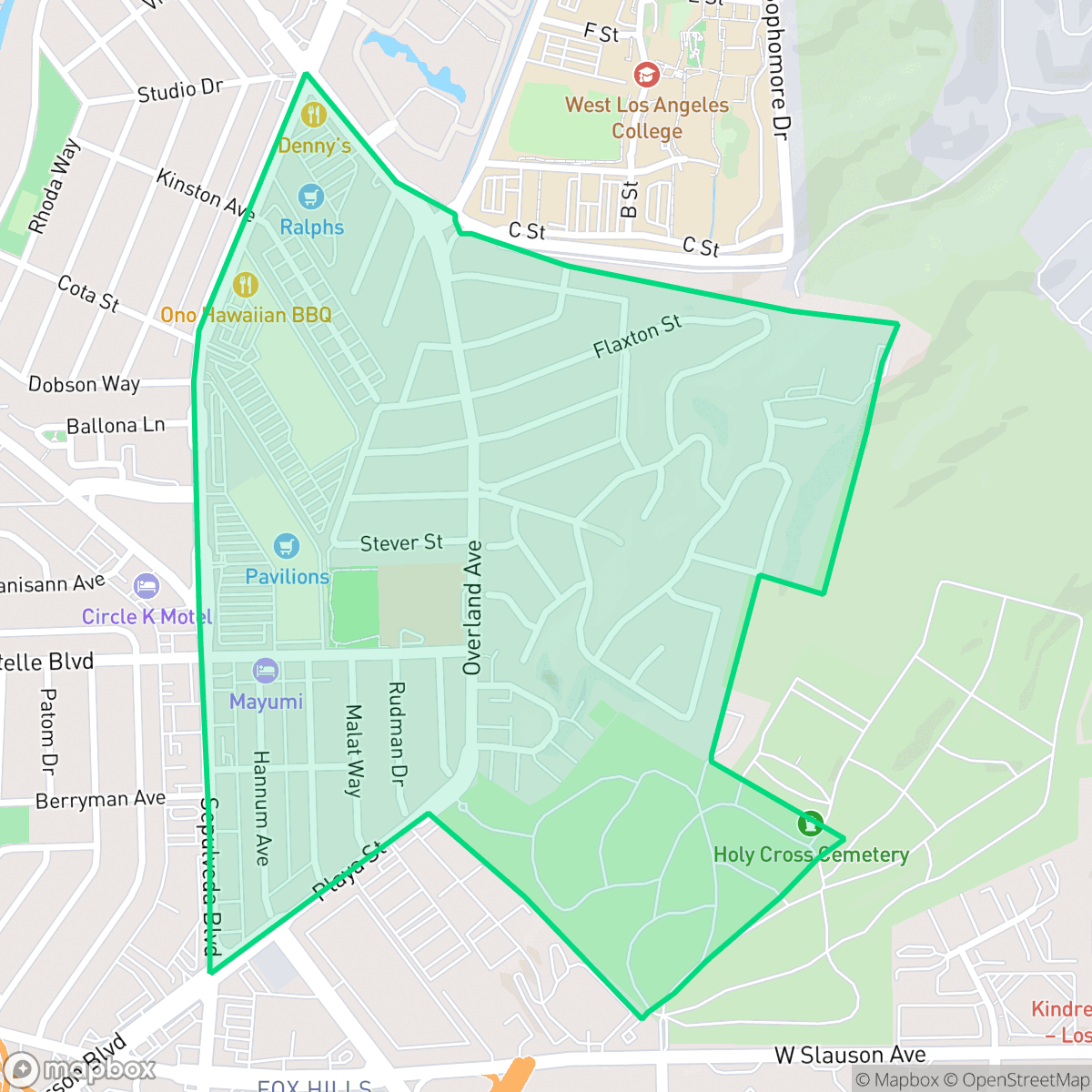
Blanco/Culver Crest is a hilly, mid-century residential neighborhood known for its expansive views and well-manicured properties. Residents enjoy a highly walkable environment with extensive sidewalk infrastructure, though the area experiences notable acoustic disturbance from nearby freeway traffic.
Key Highlights
About Blanco/Culver Crest
Developed between 1952 and 1956 by businessman Lewis Astin Crank and contractor R.J. Blanco, the Blanco/Culver Crest neighborhood emerged as a post-war residential expansion in the Baldwin Hills. The area is characterized by its hilly topography and mid-century ranch-style homes, many of which were designed to take advantage of expansive views from the Palos Verdes Peninsula to downtown Los Angeles. The neighborhood's street names, such as Esterina Way and Cranks Road, reflect the personal history of developer Lewis Crank. A notable landmark is Marycrest Manor, a former private estate and Mediterranean-style mansion later converted into a religious retirement facility. El Rincon Elementary School and the adjacent Blanco Park serve as central community hubs, anchoring the neighborhood at the base of the hill.
The area offers a semi-rural atmosphere characterized by open land and woodland surroundings that distinguish it from the denser parts of the city. The landscape is dominated by upscale, well-maintained homes with private pools and spacious driveways, contributing to a polished visual aesthetic. Residents benefit from high levels of health insurance coverage and clean air, while the lack of heavy industrial presence ensures a focus on residential and light commercial activity.
While the neighborhood provides a serene environment, it is best suited for those who prioritize walkability and a quiet suburban rhythm over complete silence. Potential residents should be aware that the proximity to major transit corridors results in persistent traffic noise. The community supports a diverse age range, making it a stable choice for families and professionals who value a blend of suburban space and access to the wider Culver City Unified School District.
Neighborhood Scores Across 15 Qualities
Residential spacing offers a moderate level of separation between properties, which is notably higher than the Culver City average. While some areas feature closely situated homes, others provide more significant buffers between neighbors.
Extensive sidewalk networks and frequent crosswalks make navigating the area on foot easy. Pedestrian infrastructure is notably superior to the Culver City average, particularly near residential and commercial intersections.
Large homes and frequent private backyard pools contribute to a visual landscape that is more polished than the Culver City average. Well-maintained properties and spacious driveways characterize much of the area according to iHuus data.
Wide grassy verges and proximity to open parks provide ample space for pets. According to iHuus data, the availability of connected green spaces and safe walking paths is significantly higher than the Culver City average.
Frequent open land and scattered homes amidst woodland areas provide a more semi-rural character than the typical Culver City landscape. This area offers more greenery and space compared to the more densely developed city average.
Suburban blocks provide a serene environment with limited local commerce within walking distance. This area is notably calmer than the Culver City average, featuring a steady but low-intensity rhythm of residential life and occasional dining options.
Frequent noise from nearby freeways and major transit corridors is a persistent feature here. According to iHuus data, acoustic disturbance in this area is higher than the Culver City average.
Air quality remains consistently high with rare instances of elevated readings. This level of cleanliness is consistent with the average found throughout Culver City.
Residential and light commercial uses dominate the area, with no visible heavy industry or hazardous facilities. This lack of industrial activity is slightly more pronounced than the Culver City average, according to iHuus data.
Health insurance accessibility is strong in this area, sitting slightly above the Culver City average according to iHuus data.
Voting patterns and census indicators reflect a predominantly liberal political leaning, which is consistent with the broader Culver City average according to iHuus data.
Residents live in an area with a balanced distribution of young adults, families, and older individuals. This demographic variety is slightly higher than the Culver City average according to iHuus data.
Flood risk levels remain undetermined due to a lack of detailed local studies, though the area presents a slightly higher level of uncertainty compared to the Culver City average according to iHuus data.
Fire safety conditions in this neighborhood are consistent with the rest of Culver City. No significant deviations in risk levels were identified via iHuus data.
Address-Level Insights for Blanco/Culver Crest


iHuus Neighborhood Intelligence Insights
Get address-level neighborhood insights for Blanco/Culver Crest
- Street-level scores — see how individual blocks compare, not just neighborhood averages
- Micro-zone boundaries — identify quiet pockets, flood boundaries, and walkable clusters before you visit
- 15 dimensions in full — walkability, noise, air quality, school quality, insurance coverage, population age profile, urban/rural index, and more
- Boundary risk alerts — know if your address sits near a block boundary where scores drop, the kind of detail no listing will ever mention
- School insights — individual school ratings and insights, not just district-level data
- Compare before you commit — side-by-side data across neighborhoods, down to block precision
No credit card required
Compare with Any Neighborhood
| Dimension | Blanco/Culver Crest | Blair Hills |
|---|---|---|
| 🚶 Walkabilityavg 9.25 | ||
| 🔊 Acoustic Comfortavg 1.98 | ||
| 🤫 Privacy Indexavg 4.22 | ||
| 🎨 Visual Appealavg 6.37 | ||
| 🐕 Dog Friendlinessavg 5.1 | ||
| 🗺️ Urban-Rural Indexavg 6.22 | ||
| ✨ Neighborhood Vibeavg 5.3 | ||
| 🏥 Health Insurance Coverageavg 8.25 | ||
| 🌿 Air Qualityavg 8 | ||
| 🏭 Industrial Proximityavg 8.28 | ||
| 🌊 Flood Safetyavg 5.25 | ||
| 🗳️ Ideological Leanavg 9.89 | ||
| 👥 Population Age Profileavg 5.05 | ||
| 🔥 Fire Safetyavg 0.02 | ||
| 🏫 School Quality |
Blanco/Culver Crest Rankings
School Districts Serving Blanco/Culver Crest
School Insights for Blanco/Culver Crest
Below average outcomes; significant attendance and academic challenges.
School Insights
See what's really behind every school rating near Blanco/Culver Crest
- Individual school ratings — each school's own score with outcome context, not just a district average
- Enrollment & class size data — student-to-teacher ratio and how it compares to the state average
- Full demographics breakdown — ethnicity and gender composition for every school in the enrollment zone
- Every school in the district — all schools within the enrollment boundary ranked by rating, not just the closest one
- Grade levels & benchmarks — elementary through high school, with below/above state-average flags
No credit card required