Walnut Country, Concord
Updated · 1,817 residents
Walnut Country, also known as The Crossings, is a highly walkable master-planned community in Concord characterized by its abundant green space and pet-friendly trails. Residents enjoy well-maintained suburban aesthetics with private pools and manicured lawns, though the area is notably noisy due to surrounding traffic.
Key Highlights
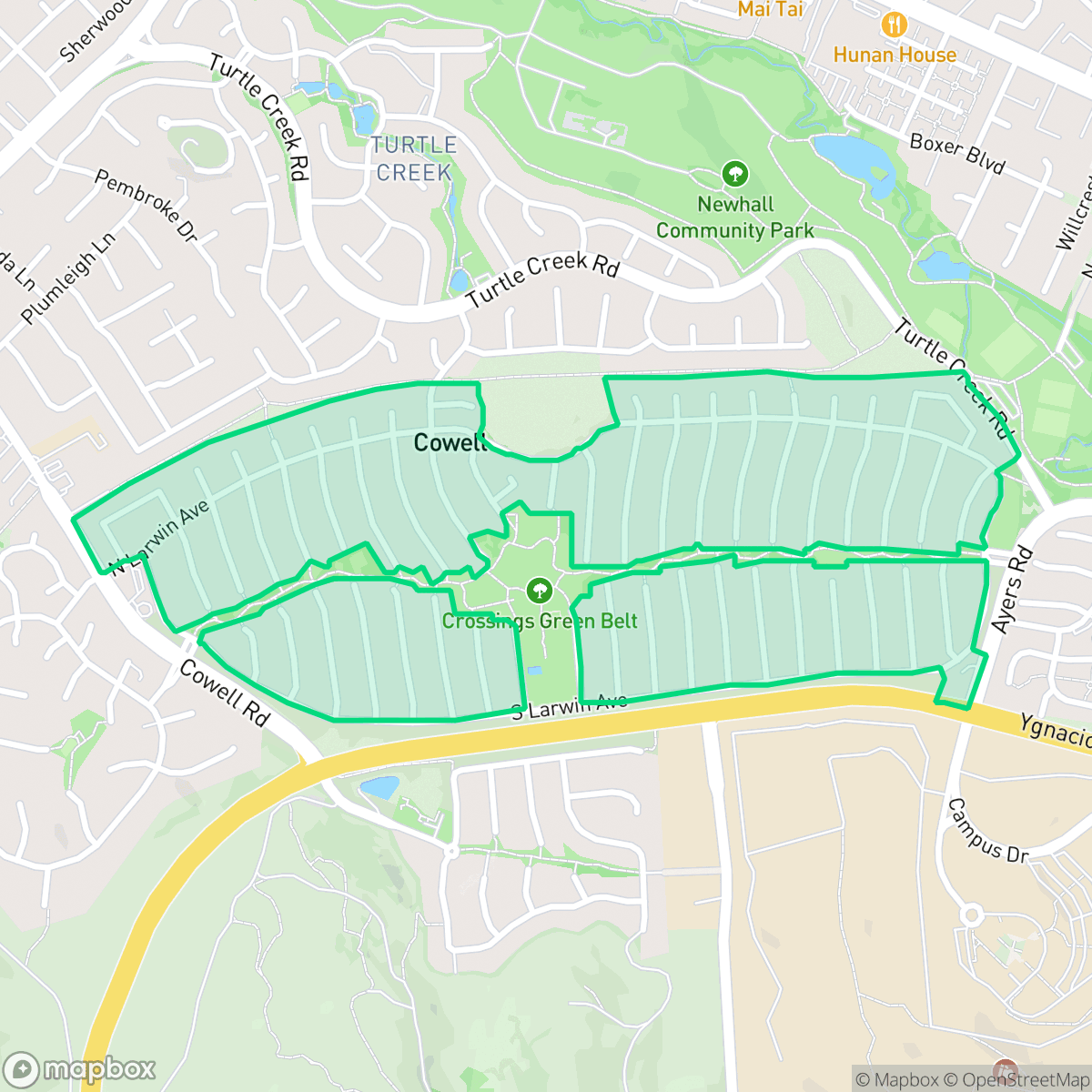
About Walnut Country
The Walnut Country neighborhood in Concord, also known as The Crossings, was originally the historic company town of Cowell. Established in 1908 by Henry Cowell, the site was home to the Cowell Portland Cement Company and featured 54 family residences, a town hall, a school, and a hospital. Small trains transported limestone along a railway that inspired the name "The Crossings". A landmark 235-foot concrete smokestack, erected in 1935 to mitigate dust, stood for decades before its demolition in 2009. Following the cement plant's 1946 closure, the Larwin Company purchased the land and began constructing the Walnut Country subdivision in 1972. Today, the 1,062-home master-planned community retains only the original Cowell firehouse as a physical link to its industrial past.
Walnut Country is a quiet, 1,062-home residential enclave that prioritizes pedestrian access through an extensive network of sidewalks and dedicated park paths. The neighborhood is defined by its strong visual appeal, featuring large single-family homes, private swimming pools, and consistently manicured landscaping. It is an ideal environment for those who value outdoor recreation and pet-friendly amenities, as the layout encourages walking and provides immediate access to communal green spaces.
While the neighborhood offers a high standard of living with excellent health insurance coverage and no industrial hazards, prospective residents should consider specific livability trade-offs. The area experiences significant ambient noise, and the local Mount Diablo Unified School District is currently navigating structural budget deficits and facility maintenance challenges. This neighborhood is best suited for families or individuals seeking a structured suburban lifestyle with strong recreational access, provided they are prepared for the prevailing acoustic environment and the complexities of the local school district.
Neighborhood Scores Across 15 Qualities
Residential lots offer a moderate level of separation with some buffer between neighbors. This spacing is slightly higher than the average for Concord, according to iHuus data.
Extensive sidewalk networks and dedicated park paths allow for easy pedestrian movement throughout the area. This level of connectivity and accessibility is notably higher than the Concord average, according to iHuus data.
Manicured lawns, large homes, and private swimming pools contribute to a visual landscape that is more polished than the Concord average. According to iHuus data, the area features frequent upscale amenities and spacious residential lots.
Expansive green parks, walking trails, and large open fields are readily available throughout the residential area. According to iHuus data, the abundance of accessible outdoor space and trails makes this neighborhood significantly more dog friendly than the Concord average.
Frequent open land and scattered homes amid fields or woodland provide a more rural feel than the typical Concord landscape. According to iHuus data, this area offers more greenery and open space compared to the city average.
Suburban streets and low-density open spaces provide a serene atmosphere, though the area lacks the activity levels found elsewhere in Concord. Residents will find a tranquil environment near parks and water, but service density is lower than the city average.
Frequent acoustic disturbances from nearby railroad tracks and heavy freeway traffic are prevalent here. This level of noise is significantly higher than the Concord average, according to iHuus data.
Air quality in this area is consistently good with rare instances of elevated readings. This level of cleanliness is roughly in line with the average found throughout Concord.
Industrial facilities, warehouses, and hazard sites are entirely absent from this area. According to iHuus data, this neighborhood offers a more purely residential environment than the Concord average.
Nearly all residents in this area are covered by health insurance, a rate significantly higher than the average for Concord. According to iHuus data, this reflects a high level of access to healthcare resources within the community.
Voting patterns and census indicators show a predominantly liberal political leaning, which aligns with the broader Concord area.
A balanced mix of young adults, families, and older residents defines the area. This demographic spread is slightly more varied than the average seen across Concord, according to iHuus data.
Properties in this area are located within a designated floodplain, which indicates a higher risk of flooding compared to the Concord average. Residents should be aware that flood insurance is typically a requirement for homes in this zone, according to iHuus data.
Fire hazards in this area are significantly higher than the Concord average, requiring maximum protection measures for residents. According to iHuus data, the neighborhood faces a severe risk of wildfire.
Address-Level Insights for Walnut Country


iHuus Neighborhood Intelligence Insights
Get address-level neighborhood insights for Walnut Country
- Street-level scores — see how individual blocks compare, not just neighborhood averages
- Micro-zone boundaries — identify quiet pockets, flood boundaries, and walkable clusters before you visit
- 15 dimensions in full — walkability, noise, air quality, school quality, insurance coverage, population age profile, urban/rural index, and more
- Boundary risk alerts — know if your address sits near a block boundary where scores drop, the kind of detail no listing will ever mention
- School insights — individual school ratings and insights, not just district-level data
- Compare before you commit — side-by-side data across neighborhoods, down to block precision
No credit card required
Compare with Any Neighborhood
| Dimension | Walnut Country | Brookview Park |
|---|---|---|
| 🚶 Walkabilityavg 8.62 | ||
| 🔊 Acoustic Comfortavg 2.99 | ||
| 🤫 Privacy Indexavg 5.61 | ||
| 🎨 Visual Appealavg 6.8 | ||
| 🐕 Dog Friendlinessavg 7.31 | ||
| 🗺️ Urban-Rural Indexavg 6.91 | ||
| ✨ Neighborhood Vibeavg 5.26 | ||
| 🏥 Health Insurance Coverageavg 7.69 | ||
| 🌿 Air Qualityavg 8.24 | ||
| 🏭 Industrial Proximityavg 9.12 | ||
| 🌊 Flood Safetyavg 1.99 | ||
| 🗳️ Ideological Leanavg 9.22 | ||
| 👥 Population Age Profileavg 5.08 | ||
| 🔥 Fire Safetyavg 0.14 | ||
| 🏫 School Quality |
Walnut Country Rankings
School Districts Serving Walnut Country
School Insights for Walnut Country
Below average outcomes; significant attendance and academic challenges.
School Insights
See what's really behind every school rating near Walnut Country
- Individual school ratings — each school's own score with outcome context, not just a district average
- Enrollment & class size data — student-to-teacher ratio and how it compares to the state average
- Full demographics breakdown — ethnicity and gender composition for every school in the enrollment zone
- Every school in the district — all schools within the enrollment boundary ranked by rating, not just the closest one
- Grade levels & benchmarks — elementary through high school, with below/above state-average flags
No credit card required