Clayton Valley Highlands, Concord
Updated · 2,787 residents
Known locally as the State Streets for its unique naming convention, this Concord neighborhood offers high pedestrian connectivity and a well-maintained suburban atmosphere. Residents benefit from a robust sidewalk network and proximity to essential shopping, though the area experiences notable ambient noise from nearby road traffic.
Key Highlights
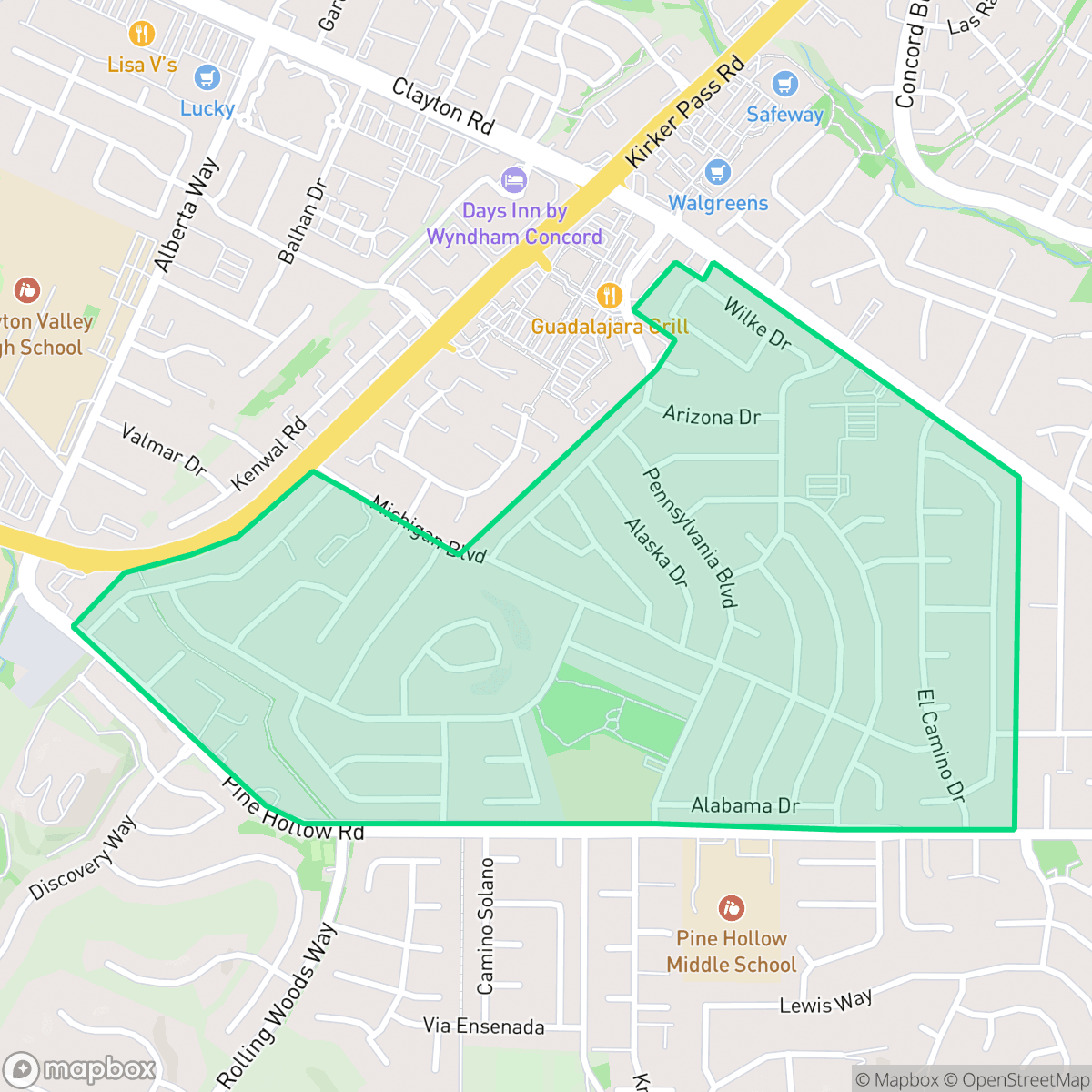
About Clayton Valley Highlands
Located in southeast Concord, the Clayton Valley Highlands neighborhood is affectionately known as the "State Streets" because its streets are named after U.S. states, such as Wisconsin, Nebraska, and Michigan. Before suburban development, the area was agricultural, producing wheat, tomatoes, and walnuts. Residential construction began in the 1950s, with the majority of homes built in the 1960s and 1970s by builder Baldocchi and marketed by the Argo sales company. Today, the neighborhood is known for its strong sense of community, high walkability, and close cultural ties to the neighboring city of Clayton, with residents frequently attending Clayton's local festivals. It is served by Highlands Elementary School and sits adjacent to the Clayton Valley Shopping Center.
The area is characterized by its classic mid-century suburban layout, featuring spacious homes with multi-car driveways and frequent backyard pools. It maintains a lively community atmosphere, supported by local wellness hubs and easy access to the Clayton Valley Shopping Center. The neighborhood is particularly well-suited for families and those who value a walkable environment within a traditional suburban setting, as the comprehensive sidewalk network allows for easy movement throughout the residential blocks.
Prospective residents should consider the trade-offs associated with the location, specifically the elevated noise levels from regional road traffic. While the neighborhood enjoys high health insurance coverage and good air quality, it faces regional challenges common to the Mount Diablo Unified School District, including facility maintenance needs. The area is also situated in a region with specific fire and flood safety considerations, making it important for homeowners to review local hazard reports.
Neighborhood Scores Across 15 Qualities
Typical suburban spacing provides a moderate level of separation between homes, which is slightly higher than the Concord average. According to iHuus data, houses are generally set apart by fenced backyards and consistent gaps between neighboring structures.
Low traffic cul-de-sacs and a reliable sidewalk network provide safe routes for walking, though overall connectivity is slightly lower than the Concord average.
Large homes, spacious driveways, and private swimming pools characterize this area. According to iHuus data, the visual appeal of this neighborhood is notably higher than the Concord average.
Large public parks and private backyards provide good opportunities for pets, though overall accessibility to connected green spaces is slightly below the Concord average according to iHuus data.
Residential pockets feature a dense suburban layout with single-family homes and easy access to shopping centers; however, the area is slightly less open than the Concord average.
Residential streets offer a balanced mix of green space and social hubs, providing a slightly more active atmosphere than the typical Concord neighborhood. While some areas are quiet, local wellness spots and community centers provide pockets of activity near the suburban blocks.
Frequent sounds from nearby freeway and railroad activity characterize this area. According to iHuus data, noise levels are slightly higher than the Concord average.
Air quality is generally high with only rare instances of elevated readings. This level of cleanliness is nearly consistent with the average seen throughout Concord.
Industrial activity is virtually nonexistent here, offering a cleaner environment than most of Concord. While a large electrical substation is located on the western edge, the area remains almost exclusively residential with no detected warehouses or hazard sites according to iHuus data.
Health insurance access is very high among residents, significantly exceeding the average found across Concord according to iHuus data.
Residents will find a liberal majority in the community, though the area leans slightly less progressive than the broader Concord average according to iHuus data.
Residents live among a diverse range of age groups, including young adults, families, and older adults. This demographic spread is roughly in line with the average seen throughout Concord.
Flood risk in this area is difficult to determine because FEMA has not yet completed a detailed study for this specific location. According to iHuus data, the potential for flooding is higher than the average seen throughout Concord.
Address-Level Insights for Clayton Valley Highlands


iHuus Neighborhood Intelligence Insights
Get address-level neighborhood insights for Clayton Valley Highlands
- Street-level scores — see how individual blocks compare, not just neighborhood averages
- Micro-zone boundaries — identify quiet pockets, flood boundaries, and walkable clusters before you visit
- 15 dimensions in full — walkability, noise, air quality, school quality, insurance coverage, population age profile, urban/rural index, and more
- Boundary risk alerts — know if your address sits near a block boundary where scores drop, the kind of detail no listing will ever mention
- School insights — individual school ratings and insights, not just district-level data
- Compare before you commit — side-by-side data across neighborhoods, down to block precision
No credit card required
Compare with Any Neighborhood
| Dimension | Clayton Valley Highlands | Brookview Park |
|---|---|---|
| 🚶 Walkabilityavg 8.62 | ||
| 🔊 Acoustic Comfortavg 2.99 | ||
| 🤫 Privacy Indexavg 5.61 | ||
| 🎨 Visual Appealavg 6.8 | ||
| 🐕 Dog Friendlinessavg 7.31 | ||
| 🗺️ Urban-Rural Indexavg 6.91 | ||
| ✨ Neighborhood Vibeavg 5.26 | ||
| 🏥 Health Insurance Coverageavg 7.69 | ||
| 🌿 Air Qualityavg 8.24 | ||
| 🏭 Industrial Proximityavg 9.12 | ||
| 🌊 Flood Safetyavg 1.99 | ||
| 🗳️ Ideological Leanavg 9.22 | ||
| 👥 Population Age Profileavg 5.08 | ||
| 🔥 Fire Safetyavg 0.14 | ||
| 🏫 School Quality |
Clayton Valley Highlands Rankings
School Districts Serving Clayton Valley Highlands
School Insights for Clayton Valley Highlands
Below average outcomes; significant attendance and academic challenges.
School Insights
See what's really behind every school rating near Clayton Valley Highlands
- Individual school ratings — each school's own score with outcome context, not just a district average
- Enrollment & class size data — student-to-teacher ratio and how it compares to the state average
- Full demographics breakdown — ethnicity and gender composition for every school in the enrollment zone
- Every school in the district — all schools within the enrollment boundary ranked by rating, not just the closest one
- Grade levels & benchmarks — elementary through high school, with below/above state-average flags
No credit card required