Sylvan Old Auburn Road, Citrus Heights
Updated · 11,102 residents
Sylvan Old Auburn Road is a highly walkable suburban neighborhood characterized by its blend of single-family homes and multi-family residences. While it offers convenient access to local services and pedestrian-friendly streets, residents should expect moderate noise levels due to surrounding road traffic.
Key Highlights
About Sylvan Old Auburn Road
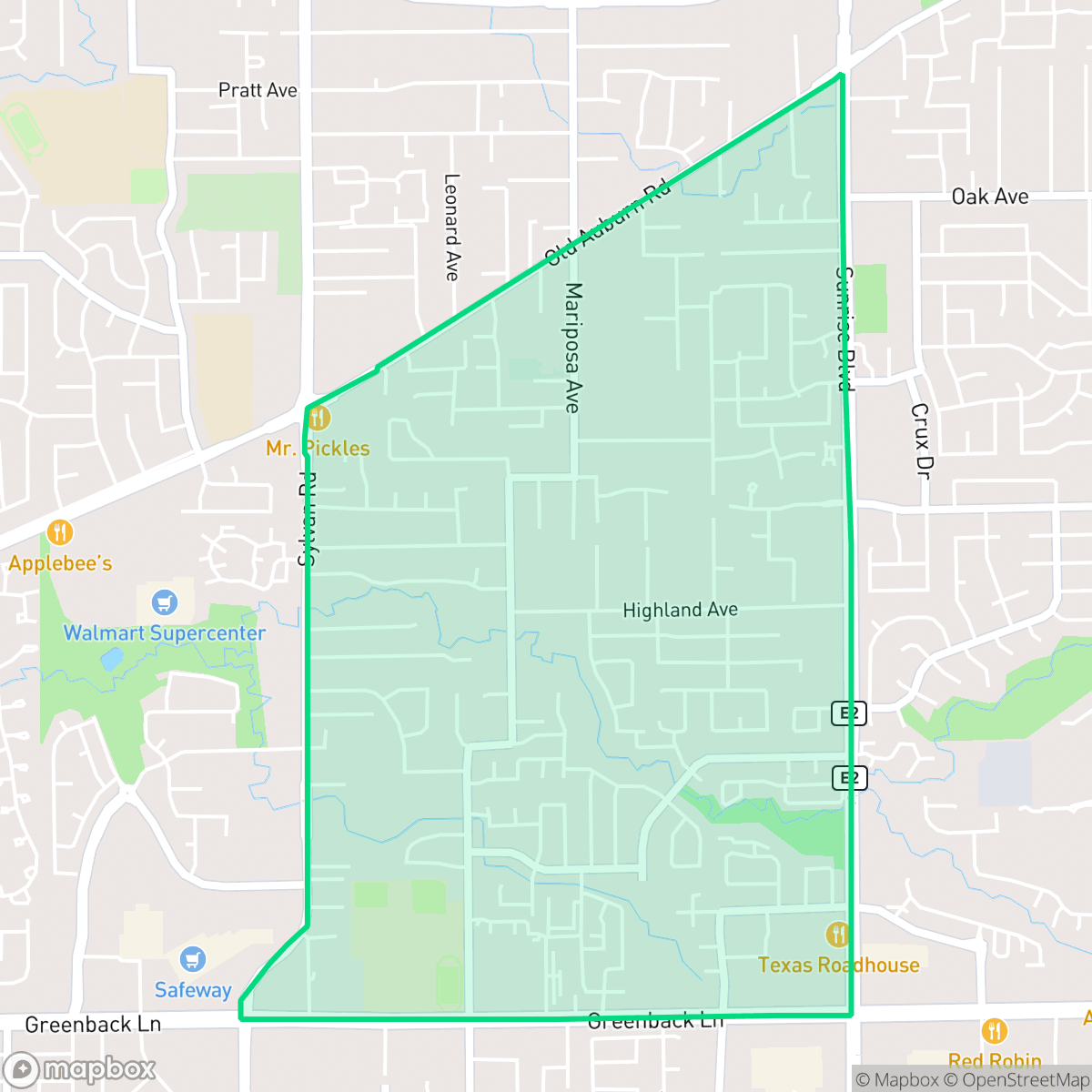
Centering on the historic Sylvan Corners intersection—where Sylvan Road, Old Auburn Road, and Auburn Boulevard meet—the Sylvan Old Auburn Road neighborhood lies at the heart of Citrus Heights’ earliest history. Originally known as the Sylvan District, the area was settled in the mid-19th century. In 1862, the historic Sylvan School was built at Sylvan Corners; it served as a vital community hub before being relocated down Sylvan Road in 1926 to make way for a newer facility. The neighborhood also welcomed the city's first church, the Citrus Heights Friends Church, which dedicated its meeting house on Old Auburn Road in 1921. Today, Sylvan Corners is marked by seven illuminated historical towers that commemorate the area’s transition from a 19th-century agricultural hub along historic Highway 40 to a modern suburban community.
The neighborhood functions as a central hub for Citrus Heights, featuring a balanced mix of residential housing and light commercial activity. The streetscape is defined by a comprehensive network of sidewalks and pedestrian connections, making it one of the more accessible areas in the city for those who prefer to travel on foot. According to iHuus data, the absence of industrial hazards contributes to a clean, residential-focused environment that blends suburban quietude with essential daily amenities. The visual character is standard for the region, featuring a mix of tract housing and occasional private pools, set within a well-connected suburban grid.
Potential residents should note that the area experiences moderate acoustic impact from road traffic, which is a common trade-off for its central location. While the community offers a stable environment, families should evaluate the local school options within the San Juan Unified School District, as academic performance varies across the region. The area is best suited for individuals or families seeking a walkable, established community with easy access to local services and a consistent suburban layout.
Neighborhood Scores Across 15 Qualities
Housing arrangements range from shared apartment walls to detached homes with moderate spacing. This level of privacy and separation between neighbors is consistent with the average density found throughout Citrus Heights.
Extensive sidewalk networks and interconnected trail systems allow for easy pedestrian movement through residential streets and cul-de-sacs. This connectivity is notably more comprehensive than the typical walkability found across Citrus Heights, according to iHuus data.
Manicured lawns and private pools characterize much of the area, though the visual landscape is slightly below the Citrus Heights average. Property features range from spacious, upscale estates to denser, standard suburban tract housing.
Central greenbelts and large athletic fields in the northwest offer ample walking space for pets. While sidewalk verges are present, they are narrower in many residential areas compared to the Citrus Heights average.
Residential layouts here feature a blend of single-family homes and apartment complexes alongside commercial retail centers. This density of development is slightly lower than the typical Citrus Heights average, offering a transition between dense suburban pockets and more open terrain.
Diverse dining options and local social spots create a more active atmosphere than much of Citrus Heights, though the layout remains largely car-dependent. While various restaurants and parks provide pockets of liveliness, many services are not easily accessible on foot according to iHuus data.
Frequent noise from nearby railroad tracks and major thoroughfares is a notable feature of this area. This level of acoustic disturbance is consistent with the average found throughout Citrus Heights.
Air quality in this area typically fluctuates between acceptable and unhealthy levels, matching the city average. Sensitive individuals may experience occasional concern during certain periods according to iHuus data.
Residential and light commercial uses dominate the landscape with no detectable warehouses or heavy industrial hazards. This area matches the city average for lack of industrial proximity, though a central electrical substation is present.
Health insurance accessibility in this area is lower than the Citrus Heights average, according to iHuus data.
Political leanings in this area are closely aligned with the broader Citrus Heights community, reflecting a relatively even split between conservative and liberal perspectives.
Residents live alongside a balanced mix of young adults, families, and seniors. This age distribution is slightly more varied than the typical profile seen across Citrus Heights.
Flood risk in this area remains undetermined because a detailed study has not been completed by FEMA. This level of uncertainty is roughly in line with the average across Citrus Heights, according to iHuus data.
Address-Level Insights for Sylvan Old Auburn Road


iHuus Neighborhood Intelligence Insights
Get address-level neighborhood insights for Sylvan Old Auburn Road
- Street-level scores — see how individual blocks compare, not just neighborhood averages
- Micro-zone boundaries — identify quiet pockets, flood boundaries, and walkable clusters before you visit
- 15 dimensions in full — walkability, noise, air quality, school quality, insurance coverage, population age profile, urban/rural index, and more
- Boundary risk alerts — know if your address sits near a block boundary where scores drop, the kind of detail no listing will ever mention
- School insights — individual school ratings and insights, not just district-level data
- Compare before you commit — side-by-side data across neighborhoods, down to block precision
No credit card required
Compare with Any Neighborhood
| Dimension | Sylvan Old Auburn Road | Arcade Creek |
|---|---|---|
| 🚶 Walkabilityavg 7.64 | ||
| 🔊 Acoustic Comfortavg 3.51 | ||
| 🤫 Privacy Indexavg 5.76 | ||
| 🎨 Visual Appealavg 6.71 | ||
| 🐕 Dog Friendlinessavg 6.51 | ||
| 🗺️ Urban-Rural Indexavg 6.7 | ||
| ✨ Neighborhood Vibeavg 4.83 | ||
| 🏥 Health Insurance Coverageavg 7.48 | ||
| 🌿 Air Qualityavg 6 | ||
| 🏭 Industrial Proximityavg 9.36 | ||
| 🌊 Flood Safetyavg 4.4 | ||
| 🗳️ Ideological Leanavg 4.27 | ||
| 👥 Population Age Profileavg 5.07 | ||
| 🔥 Fire Safety | ||
| 🏫 School Quality |
Sylvan Old Auburn Road Rankings
School Districts Serving Sylvan Old Auburn Road
School Insights for Sylvan Old Auburn Road
Below average outcomes; significant attendance and academic challenges.
School Insights
See what's really behind every school rating near Sylvan Old Auburn Road
- Individual school ratings — each school's own score with outcome context, not just a district average
- Enrollment & class size data — student-to-teacher ratio and how it compares to the state average
- Full demographics breakdown — ethnicity and gender composition for every school in the enrollment zone
- Every school in the district — all schools within the enrollment boundary ranked by rating, not just the closest one
- Grade levels & benchmarks — elementary through high school, with below/above state-average flags
No credit card required