Rusch Park, Citrus Heights
Updated · 11,235 residents
Rusch Park is a suburban neighborhood in Citrus Heights defined by its expansive namesake community park and a mix of single-family homes and apartment complexes. While the area offers a quiet residential atmosphere with access to local dining, residents should expect notable noise levels from nearby road traffic and a car-dependent lifestyle.
Key Highlights
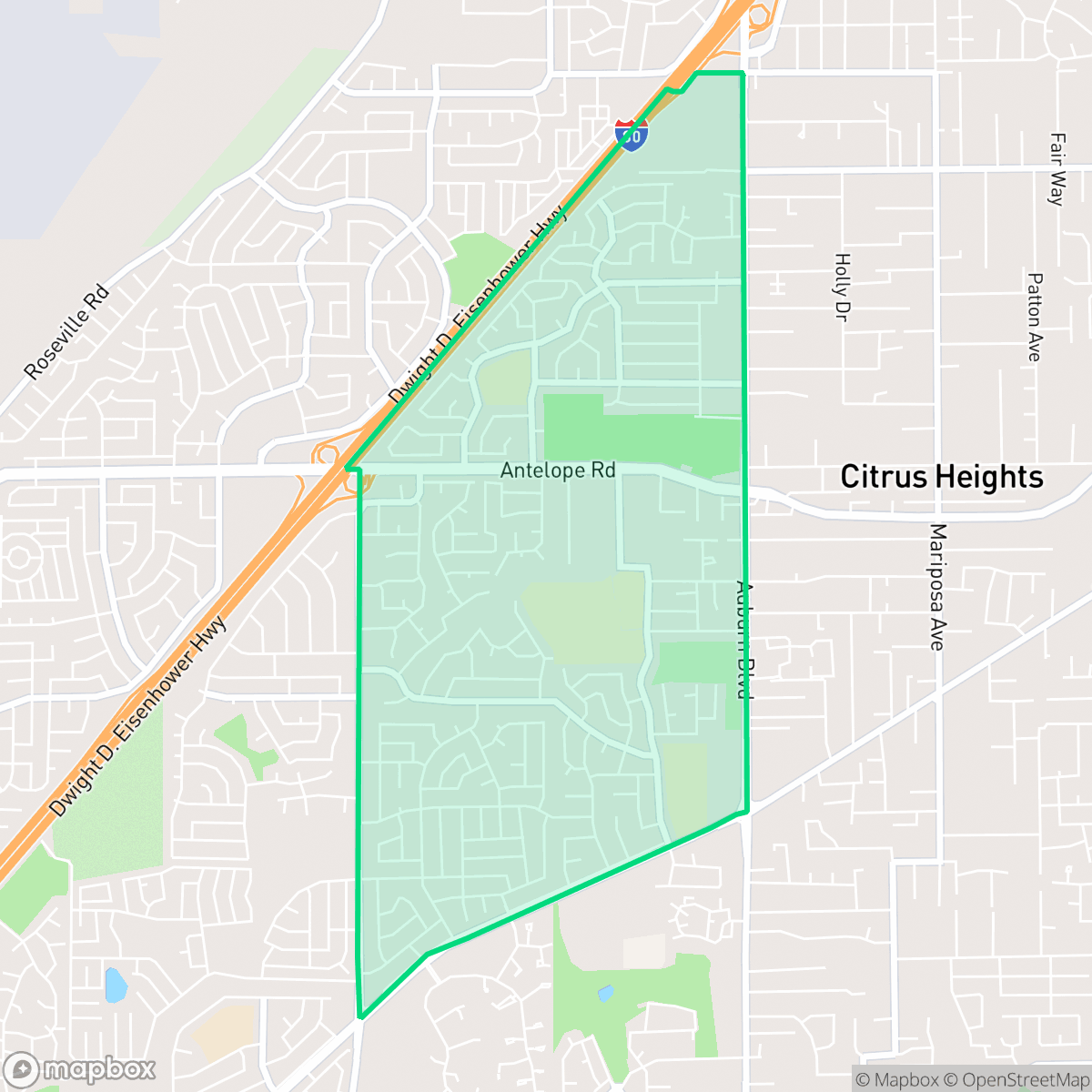
About Rusch Park
The Rusch Park neighborhood in Citrus Heights is centered around the historic 48-acre Rusch Community Park, which originated as a 480-acre ranch established in 1858 by Fred and Julia Volle. In 1950, their grandchildren, Fred and Julia Rusch, donated 15 acres of the ranch—including their home—to the public, prompting the creation of the Sunrise Recreation and Park District. The centerpiece of the neighborhood is the Historic Rusch Home, a Craftsman-style residence built in 1916 after a fire destroyed the original homestead. Designated as a California Point of Historical Interest, the home is flanked by the 1916 Rusch Botanical Gardens, which showcase seven distinct California biomes. Other local landmarks include a historic World War II memorial and a covered bridge constructed from a Southern Pacific Railroad boxcar frame.
The neighborhood functions as a classic suburban hub, characterized by a grid of residential cul-de-sacs interspersed with commercial retail strips along major thoroughfares. Residents benefit from a diverse selection of local eateries, including spots like Ciro's Pizza and Mi Lindo Jalisco, which contribute to a steady level of local activity. The architectural landscape is consistent with mid-century suburban development, featuring detached single-family homes with private backyards alongside various multi-unit apartment complexes.
Prospective residents should consider the trade-offs inherent to this location, particularly the high ambient noise levels resulting from proximity to major roadways. While the area provides a straightforward suburban living experience, it is highly car-dependent, as most daily services and commercial destinations are not within a comfortable walking distance. Families should also note that local educational options are stratified, with school performance varying significantly across the district, making careful research into specific school boundaries essential.
Neighborhood Scores Across 15 Qualities
Housing layouts feature a mix of suburban spacing and tighter multi-family clusters, matching the typical density found across Citrus Heights. According to iHuus data, property separation varies from detached homes with private yards to more compressed residential units.
Sidewalks are consistently available along residential streets and main roads, providing slightly better connectivity than the Citrus Heights average. While many cul-de-sacs offer quiet routes for pedestrians, the proximity to high-traffic areas can limit easy access to commercial zones.
Residential views consist of a mix of large homes with private pools and denser, more modest housing developments. This visual variety is generally in line with the average found throughout Citrus Heights.
Accessible green corridors and a large central wooded park provide ample space for pets; according to iHuus data, this level of pet accessibility is slightly above the Citrus Heights average.
Open land and scattered homes amidst woodland are common throughout this area. This landscape is slightly less dense than the typical Citrus Heights suburban layout, according to iHuus data.
A variety of local dining and fitness options provide steady activity throughout the area, offering a slightly more vibrant atmosphere than the Citrus Heights average. While many social hubs and eateries are accessible via walkable paths, certain parts of the neighborhood remain quiet and primarily residential.
Persistent noise from nearby freeway and railroad traffic characterizes this area. According to iHuus data, acoustic comfort is significantly lower than the Citrus Heights average.
Air quality levels in this area are consistent with the Citrus Heights average, presenting a mix of acceptable and unhealthy days. Sensitive individuals may experience occasional concern during certain periods according to iHuus data.
Industrial zones, warehouses, and heavy machinery are entirely absent from this area. This neighborhood maintains a purely residential and recreational character that is even more free of industrial presence than the Citrus Heights average, according to iHuus data.
Health insurance accessibility is strong in this area, with coverage rates appearing higher than the Citrus Heights average according to iHuus data.
Political views in this area are relatively balanced, closely mirroring the broader ideological split seen across Citrus Heights according to iHuus data.
Residents experience a diverse demographic blend of young adults, families, and seniors. This age distribution remains largely in line with the average seen across Citrus Heights.
Properties in this area are located within a designated floodplain, which may necessitate flood insurance. This risk level is higher than the average found throughout Citrus Heights, according to iHuus data.
Address-Level Insights for Rusch Park


iHuus Neighborhood Intelligence Insights
Get address-level neighborhood insights for Rusch Park
- Street-level scores — see how individual blocks compare, not just neighborhood averages
- Micro-zone boundaries — identify quiet pockets, flood boundaries, and walkable clusters before you visit
- 15 dimensions in full — walkability, noise, air quality, school quality, insurance coverage, population age profile, urban/rural index, and more
- Boundary risk alerts — know if your address sits near a block boundary where scores drop, the kind of detail no listing will ever mention
- School insights — individual school ratings and insights, not just district-level data
- Compare before you commit — side-by-side data across neighborhoods, down to block precision
No credit card required
Compare with Any Neighborhood
| Dimension | Rusch Park | Arcade Creek |
|---|---|---|
| 🚶 Walkabilityavg 7.64 | ||
| 🔊 Acoustic Comfortavg 3.51 | ||
| 🤫 Privacy Indexavg 5.76 | ||
| 🎨 Visual Appealavg 6.71 | ||
| 🐕 Dog Friendlinessavg 6.51 | ||
| 🗺️ Urban-Rural Indexavg 6.7 | ||
| ✨ Neighborhood Vibeavg 4.83 | ||
| 🏥 Health Insurance Coverageavg 7.48 | ||
| 🌿 Air Qualityavg 6 | ||
| 🏭 Industrial Proximityavg 9.36 | ||
| 🌊 Flood Safetyavg 4.4 | ||
| 🗳️ Ideological Leanavg 4.27 | ||
| 👥 Population Age Profileavg 5.07 | ||
| 🔥 Fire Safety | ||
| 🏫 School Quality |
Rusch Park Rankings
School Districts Serving Rusch Park
School Insights for Rusch Park
Below average outcomes; significant attendance and academic challenges.
School Insights
See what's really behind every school rating near Rusch Park
- Individual school ratings — each school's own score with outcome context, not just a district average
- Enrollment & class size data — student-to-teacher ratio and how it compares to the state average
- Full demographics breakdown — ethnicity and gender composition for every school in the enrollment zone
- Every school in the district — all schools within the enrollment boundary ranked by rating, not just the closest one
- Grade levels & benchmarks — elementary through high school, with below/above state-average flags
No credit card required