Rancho Del Rey II, Chula Vista
Updated · 2,202 residents
Rancho Del Rey II is a quiet, suburban neighborhood in Chula Vista characterized by its abundant green spaces and low-density residential layout. While the area offers a peaceful environment with high visual appeal, it is a car-dependent community with limited local business activity.
Key Highlights
About Rancho Del Rey II
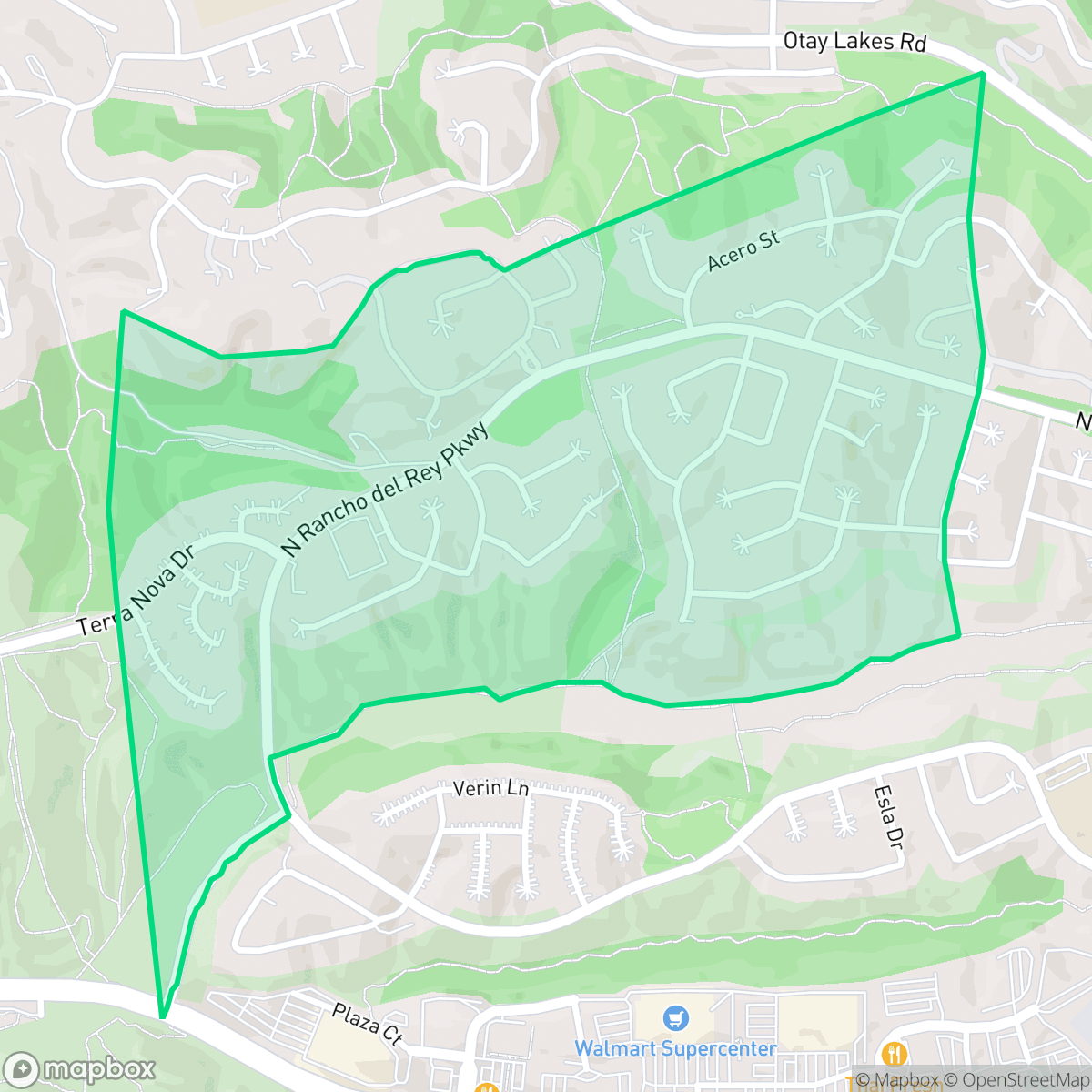
Located within the broader Chula Vista landscape, this neighborhood is defined by its tranquil, residential atmosphere and significant integration of open green spaces. Residents benefit from a high level of visual appeal and a strong sense of community privacy, supported by local landmarks such as Marisol Park. The area maintains a suburban character that prioritizes quiet, low-density living over commercial convenience, making it a distinct retreat from the more bustling urban centers nearby.
Living in the area requires a reliance on personal vehicles for daily errands, as the neighborhood features few commercial establishments within walking distance. While the environment is highly favorable for dog owners and those seeking a scenic, suburban setting, prospective residents should be aware of the trade-offs regarding acoustic comfort and the necessity of commuting for most services. The neighborhood is well-suited for families and individuals who prioritize a calm, green environment and proximity to reputable local school districts over immediate access to urban amenities.
Neighborhood Scores Across 15 Qualities
Housing density is moderate, providing a balance of mixed spacing and some buffer between neighbors. According to iHuus data, this level of privacy is higher than the Chula Vista average.
Pedestrian access is facilitated by sidewalks on one side of the street and designated safe crossings. While the area is highly navigable, it is slightly less walkable than the Chula Vista average.
Large homes and frequent upscale amenities create an aesthetically pleasing environment that is notably more visually appealing than the Chula Vista average. According to iHuus data, the area features spacious driveways and well-maintained properties.
Wide paths and interconnected green spaces provide safe, traffic-free areas for pet owners. This level of accessibility for walking pets is notably higher than the Chula Vista average, according to iHuus data.
Frequent open spaces and scattered residences provide a more open, semi-rural character than the Chula Vista average, according to iHuus data.
Low density and significant open space create a calm, suburban atmosphere, but a lack of nearby businesses makes the area much less lively than the Chula Vista average. Most daily needs and dining options require a vehicle, as the neighborhood lacks a concentrated commercial center.
Frequent noise from nearby freeways and railroad tracks characterizes this area. According to iHuus data, acoustic comfort levels in this neighborhood are roughly equivalent to the Chula Vista average.
Air quality levels in this area are consistent with the Chula Vista average, though sensitive groups may experience occasional concern on certain days.
No warehouses or industrial facilities are present in this area, offering a landscape that is even more residential than the Chula Vista average. According to iHuus data, the neighborhood consists of quiet streets and open green spaces with no detected hazard sites.
Health insurance access is higher in this area than the Chula Vista average, according to iHuus data. Most residents in this neighborhood have access to medical coverage.
Political leanings in this area are largely liberal, though the community shows a slightly more moderate profile than the Chula Vista average according to iHuus data.
Residents live among a diverse range of age groups, including young adults, families, and seniors. This demographic spread is slightly more varied than the average seen across Chula Vista, according to iHuus data.
Flood risk is notable in this area due to its location within a designated floodplain; according to iHuus data, this risk is higher than the Chula Vista average and may necessitate flood insurance.
Significant fire hazards are present in this area, though the risk remains notably higher than the Chula Vista average according to iHuus data.
Address-Level Insights for Rancho Del Rey II


iHuus Neighborhood Intelligence Insights
Get address-level neighborhood insights for Rancho Del Rey II
- Street-level scores — see how individual blocks compare, not just neighborhood averages
- Micro-zone boundaries — identify quiet pockets, flood boundaries, and walkable clusters before you visit
- 15 dimensions in full — walkability, noise, air quality, school quality, insurance coverage, population age profile, urban/rural index, and more
- Boundary risk alerts — know if your address sits near a block boundary where scores drop, the kind of detail no listing will ever mention
- School insights — individual school ratings and insights, not just district-level data
- Compare before you commit — side-by-side data across neighborhoods, down to block precision
No credit card required
Compare with Any Neighborhood
| Dimension | Rancho Del Rey II | Amphitheater and Water Park |
|---|---|---|
| 🚶 Walkabilityavg 8.8 | ||
| 🔊 Acoustic Comfortavg 3.52 | ||
| 🤫 Privacy Indexavg 4.85 | ||
| 🎨 Visual Appealavg 6.83 | ||
| 🐕 Dog Friendlinessavg 6.92 | ||
| 🗺️ Urban-Rural Indexavg 6.8 | ||
| ✨ Neighborhood Vibeavg 5.11 | ||
| 🏥 Health Insurance Coverageavg 7.16 | ||
| 🌿 Air Qualityavg 6 | ||
| 🏭 Industrial Proximityavg 8.97 | ||
| 🌊 Flood Safetyavg 2.79 | ||
| 🗳️ Ideological Leanavg 8.28 | ||
| 👥 Population Age Profileavg 4.75 | ||
| 🔥 Fire Safetyavg 0.51 | ||
| 🏫 School Quality |
Rancho Del Rey II Rankings
School Districts Serving Rancho Del Rey II
School Insights for Rancho Del Rey II
Below average outcomes; significant attendance and academic challenges.
School Insights
See what's really behind every school rating near Rancho Del Rey II
- Individual school ratings — each school's own score with outcome context, not just a district average
- Enrollment & class size data — student-to-teacher ratio and how it compares to the state average
- Full demographics breakdown — ethnicity and gender composition for every school in the enrollment zone
- Every school in the district — all schools within the enrollment boundary ranked by rating, not just the closest one
- Grade levels & benchmarks — elementary through high school, with below/above state-average flags
No credit card required