Northwest, Chula Vista
Updated · 57,183 residents
Northwest Chula Vista is a highly walkable historic urban core defined by its grid-patterned streets and proximity to the evolving bayfront. Residents enjoy excellent pedestrian access to local amenities, though the neighborhood features high-density housing with limited privacy and notable road traffic noise.
Key Highlights
About Northwest
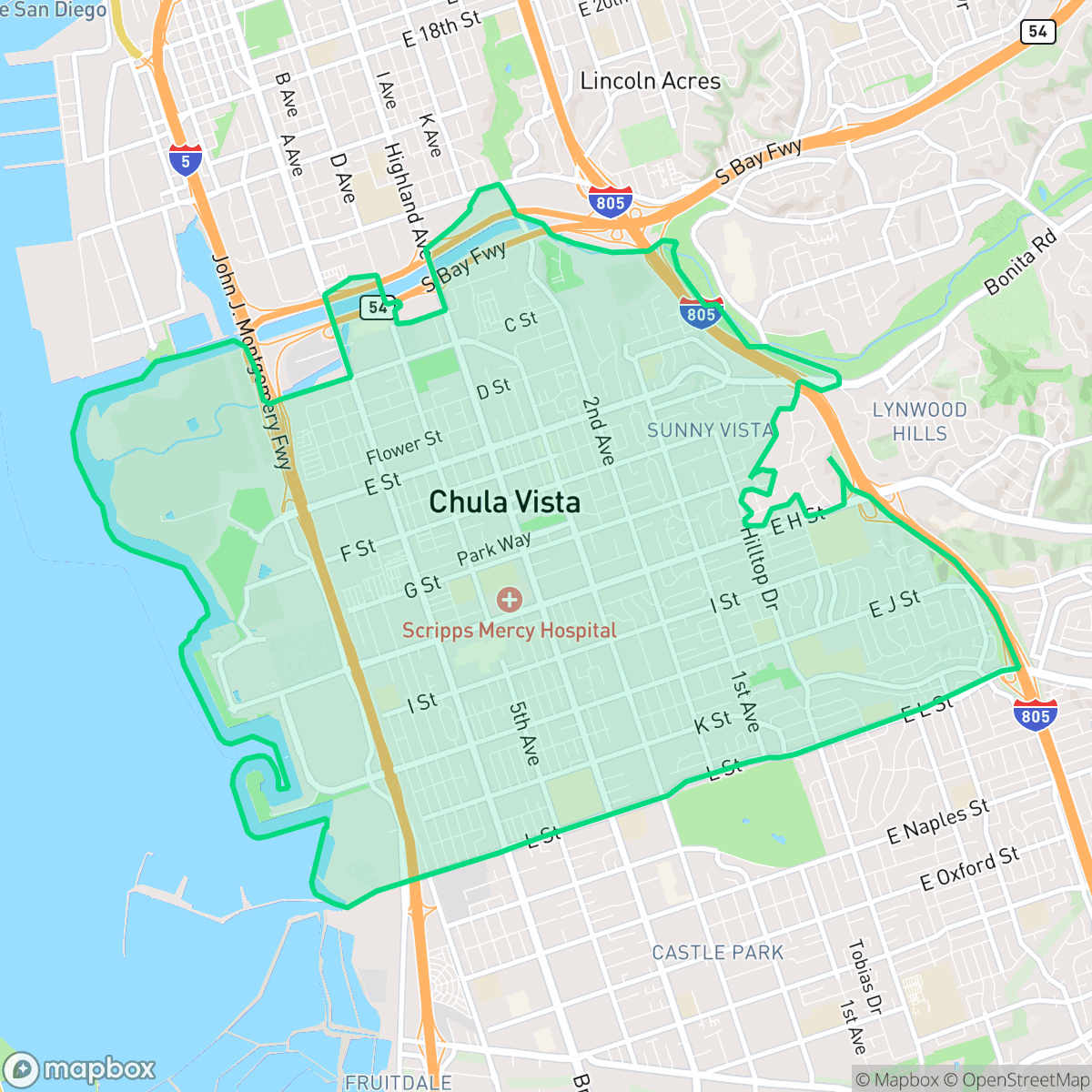
Northwest Chula Vista serves as the city’s historic urban core, bounded generally north of L Street and west of Interstate 805. Originally subdivided into five-acre agricultural plots in the late 1880s, the neighborhood was the epicenter of the city’s era as the "Lemon Capital of the World". It is characterized by its grid-patterned, tree-lined streets and a high concentration of custom-built historic residences. These include late 19th-century Victorian and early 20th-century Craftsman "orchard houses" built for early citrus growers, particularly along Second and Del Mar Avenues. Notable landmarks include the 1910 Greg Rogers House and the historic Third Avenue Village commercial corridor. Today, the neighborhood is experiencing a major transformation driven by the massive Chula Vista Bayfront redevelopment project.
The area functions as a dense, transit-oriented environment where the historic grid layout facilitates high walkability. According to iHuus data, the neighborhood maintains a consistent sidewalk network, making it one of the more accessible parts of the city for pedestrians. However, this density results in limited physical privacy, as many properties feature shared walls or close spacing between structures. The atmosphere is characterized by a mix of residential and light commercial activity, with significant industrial logistics hubs located toward the western edges near the coastline.
Prospective residents should be aware of the trade-offs associated with this central location. While the area offers convenient access to diverse dining and community services, it experiences higher noise levels from road traffic, averaging 60 decibels. The educational landscape is diverse, ranging from high-performing charter schools to district campuses with varying proficiency levels. This neighborhood is best suited for individuals who prioritize walkability and proximity to urban amenities over the seclusion and quiet typically found in lower-density suburban environments.
Neighborhood Scores Across 15 Qualities
Closely spaced residential structures and shared walls result in lower privacy levels than the Chula Vista average. Many homes and apartment units are positioned very near one another with minimal setbacks between neighbors.
Continuous sidewalks and clear crosswalks facilitate easy movement throughout the residential grid. This level of accessibility is nearly identical to the Chula Vista average.
Standard tract housing and high-density apartments define the landscape, featuring uniform rooflines and modest yards. The area lacks the lush, manicured aesthetic found in more visually prominent parts of Chula Vista.
Public park access and green verges for dog walking are below the Chula Vista average. While some areas feature large sports fields and marshland paths, other residential pockets consist of dense housing with minimal shared green space.
This area features a diverse landscape of undeveloped wetlands and industrial zones alongside established suburban residential blocks. The level of open land and scattered development is slightly lower than the Chula Vista average, according to iHuus data.
Diverse dining and various social hubs provide a more active atmosphere than the Chula Vista average. While many areas feature a quiet, suburban rhythm, much of the neighborhood remains car-dependent due to the proximity of industrial units and major highways.
Frequent acoustic disturbances from nearby freeway and railroad corridors are common in this area. According to iHuus data, noise levels are slightly higher than the Chula Vista average.
Air quality in this area fluctuates between acceptable and unhealthy levels, which may cause occasional concern for sensitive groups. According to iHuus data, the air quality here is consistent with the Chula Vista average.
Minimal industrial presence defines this area, which consists almost entirely of residential and light commercial uses. While slightly below the Chula Vista average for industrial separation, residents will find no significant heavy warehouses or industrial hazards nearby.
Health insurance access is lower in this area compared to the Chula Vista average, according to iHuus data.
Political leanings in this area trend more liberal than the Chula Vista average, according to iHuus data.
Residents live among a diverse mix of young adults, families, and seniors. This age distribution is consistent with the broader Chula Vista area, according to iHuus data.
Property locations in this area fall within a known floodplain, which may necessitate flood insurance. According to iHuus data, the risk level in Northwest is consistent with the city average for Chula Vista.
Address-Level Insights for Northwest


iHuus Neighborhood Intelligence Insights
Get address-level neighborhood insights for Northwest
- Street-level scores — see how individual blocks compare, not just neighborhood averages
- Micro-zone boundaries — identify quiet pockets, flood boundaries, and walkable clusters before you visit
- 15 dimensions in full — walkability, noise, air quality, school quality, insurance coverage, population age profile, urban/rural index, and more
- Boundary risk alerts — know if your address sits near a block boundary where scores drop, the kind of detail no listing will ever mention
- School insights — individual school ratings and insights, not just district-level data
- Compare before you commit — side-by-side data across neighborhoods, down to block precision
No credit card required
Compare with Any Neighborhood
| Dimension | Northwest | Amphitheater and Water Park |
|---|---|---|
| 🚶 Walkabilityavg 8.8 | ||
| 🔊 Acoustic Comfortavg 3.52 | ||
| 🤫 Privacy Indexavg 4.85 | ||
| 🎨 Visual Appealavg 6.83 | ||
| 🐕 Dog Friendlinessavg 6.92 | ||
| 🗺️ Urban-Rural Indexavg 6.8 | ||
| ✨ Neighborhood Vibeavg 5.11 | ||
| 🏥 Health Insurance Coverageavg 7.16 | ||
| 🌿 Air Qualityavg 6 | ||
| 🏭 Industrial Proximityavg 8.97 | ||
| 🌊 Flood Safetyavg 2.79 | ||
| 🗳️ Ideological Leanavg 8.28 | ||
| 👥 Population Age Profileavg 4.75 | ||
| 🔥 Fire Safetyavg 0.51 | ||
| 🏫 School Quality |
Northwest Rankings
School Districts Serving Northwest
School Insights for Northwest
Below average outcomes; significant attendance and academic challenges.
School Insights
See what's really behind every school rating near Northwest
- Individual school ratings — each school's own score with outcome context, not just a district average
- Enrollment & class size data — student-to-teacher ratio and how it compares to the state average
- Full demographics breakdown — ethnicity and gender composition for every school in the enrollment zone
- Every school in the district — all schools within the enrollment boundary ranked by rating, not just the closest one
- Grade levels & benchmarks — elementary through high school, with below/above state-average flags
No credit card required