East Lake I, Chula Vista
Updated · 6,604 residents
East Lake I is a highly walkable suburban community defined by its central lake, manicured landscaping, and well-established residential atmosphere. While it offers excellent pedestrian access to local amenities and schools, residents may experience elevated noise levels due to nearby highway traffic.
Key Highlights
About East Lake I
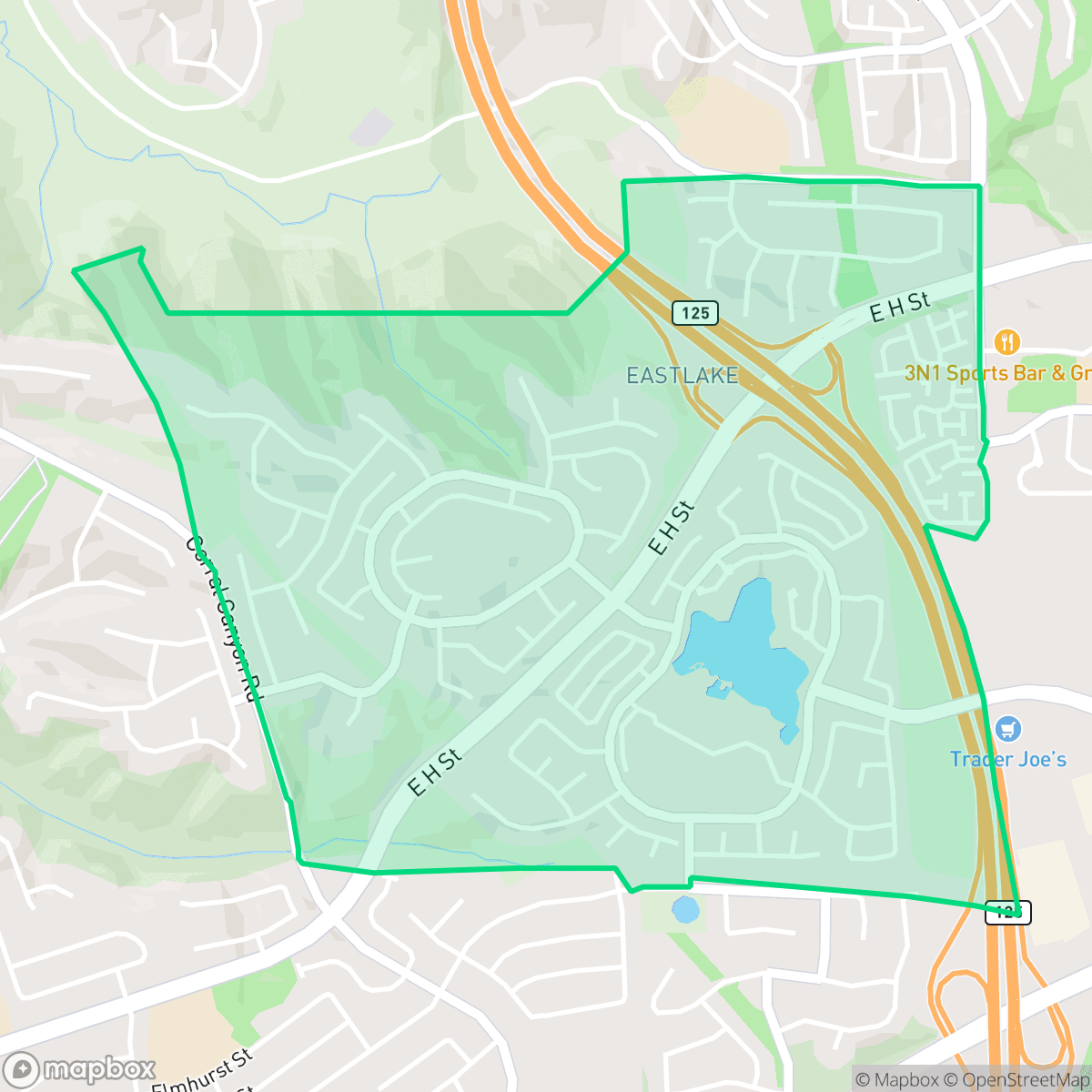
East Lake I is the pioneering first phase of Chula Vista’s first master-planned community, Eastlake. Breaking ground in 1986, the development was built on the former Janal Ranch, a historic Mexican land grant once owned by José Antonio Estudillo. Developed by the Eastlake Development Company—led by Bob Santos, Ron Lane, and David B. Kuhn Jr.—the community’s layout was heavily inspired by the master-planned Woodbridge development in Irvine. East Lake I established the area's identity through its two original neighborhoods, Eastlake Hills and Eastlake Shores. Its defining landmark is the Eastlake Shores Beach Club, which features a 15-acre man-made lake and a 15,000-square-foot freshwater swimming lagoon. The phase also integrated the 34-acre Eastlake Village Center and a 140-acre business center, setting a template for subsequent suburban expansions.
The area functions as a quiet, residential hub within Chula Vista, characterized by its dense suburban layout and high visual appeal. Residents benefit from a complete sidewalk network that connects homes to green spaces and the local lake, fostering an active environment for dog owners and pedestrians. The community maintains a strong sense of stability, supported by high rates of health insurance coverage and proximity to top-rated educational facilities like Eastlake Elementary.
Prospective residents should note that the neighborhood is situated near a major highway, which contributes to a noticeable ambient noise level throughout the day. While the housing density results in smaller private yards, the trade-off is a highly maintained, secure environment with no industrial presence. This community is particularly well-suited for families seeking a predictable, suburban lifestyle with immediate access to recreational paths and high-quality local schools.
Neighborhood Scores Across 15 Qualities
Residential spacing provides a moderate level of separation between homes, offering more buffer between neighbors than is typical for the Chula Vista area. According to iHuus data, many properties feature relatively narrow setbacks and closely positioned structures.
Extensive sidewalk networks and pedestrian-priority paths around the lake make navigating the area on foot easy. This connectivity is notably better than the Chula Vista average, though some large blocks and nearby highways can impact continuous movement.
Manicured landscapes and large homes with private pools characterize this area, providing a visual quality that is higher than the Chula Vista average. According to iHuus data, the neighborhood features well-maintained properties and frequent upscale amenities.
Continuous sidewalks and access to a central lake with park paths offer excellent walking options for pets. This area provides more connected green spaces and safer walking routes than the Chula Vista average.
Residential layouts consist of a blend of single-family homes, apartment clusters, and larger commercial warehouses. This landscape reflects a level of development and open space consistent with the broader Chula Vista area.
Residential streets and green spaces offer a serene environment, though the area feels slightly less active than the Chula Vista average. While some pockets near major roadways feature accessible dining and services, other parts of the neighborhood remain remote and car-dependent.
Frequent noise from nearby freeways and railroad tracks makes this area significantly noisier than the Chula Vista average. Residents may experience persistent acoustic disturbances due to proximity to major transportation corridors.
Air quality levels in East Lake I are consistent with the Chula Vista average, though residents may experience occasional periods of concern during certain weather conditions. According to iHuus data, the area experiences a mix of acceptable and unhealthy days that could affect sensitive groups.
No warehouses, industrial facilities, or hazardous sites are detected within the area. This neighborhood maintains the same lack of industrial activity as the Chula Vista average.
Health insurance access is widespread among residents in this area, performing notably better than the Chula Vista average according to iHuus data.
Political leanings in this area are predominantly liberal, though the community displays slightly less progressive alignment than the Chula Vista average.
Residents live among a balanced variety of young adults, families, and older populations. This age distribution is slightly more varied than the Chula Vista average, according to iHuus data.
Flood risk in this area is higher than the Chula Vista average, though current assessments remain inconclusive due to a lack of detailed federal studies. Residents should remain cautious as official flood maps for this specific zone are not yet fully updated.
Extreme fire hazards are present in this area, representing a risk level that is higher than the Chula Vista average. According to iHuus data, residents should be prepared for maximum protection measures and heightened safety precautions.
Address-Level Insights for East Lake I


iHuus Neighborhood Intelligence Insights
Get address-level neighborhood insights for East Lake I
- Street-level scores — see how individual blocks compare, not just neighborhood averages
- Micro-zone boundaries — identify quiet pockets, flood boundaries, and walkable clusters before you visit
- 15 dimensions in full — walkability, noise, air quality, school quality, insurance coverage, population age profile, urban/rural index, and more
- Boundary risk alerts — know if your address sits near a block boundary where scores drop, the kind of detail no listing will ever mention
- School insights — individual school ratings and insights, not just district-level data
- Compare before you commit — side-by-side data across neighborhoods, down to block precision
No credit card required
Compare with Any Neighborhood
| Dimension | East Lake I | Amphitheater and Water Park |
|---|---|---|
| 🚶 Walkabilityavg 8.8 | ||
| 🔊 Acoustic Comfortavg 3.52 | ||
| 🤫 Privacy Indexavg 4.85 | ||
| 🎨 Visual Appealavg 6.83 | ||
| 🐕 Dog Friendlinessavg 6.92 | ||
| 🗺️ Urban-Rural Indexavg 6.8 | ||
| ✨ Neighborhood Vibeavg 5.11 | ||
| 🏥 Health Insurance Coverageavg 7.16 | ||
| 🌿 Air Qualityavg 6 | ||
| 🏭 Industrial Proximityavg 8.97 | ||
| 🌊 Flood Safetyavg 2.79 | ||
| 🗳️ Ideological Leanavg 8.28 | ||
| 👥 Population Age Profileavg 4.75 | ||
| 🔥 Fire Safetyavg 0.51 | ||
| 🏫 School Quality |
East Lake I Rankings
School Districts Serving East Lake I
School Insights for East Lake I
Below average outcomes; significant attendance and academic challenges.
School Insights
See what's really behind every school rating near East Lake I
- Individual school ratings — each school's own score with outcome context, not just a district average
- Enrollment & class size data — student-to-teacher ratio and how it compares to the state average
- Full demographics breakdown — ethnicity and gender composition for every school in the enrollment zone
- Every school in the district — all schools within the enrollment boundary ranked by rating, not just the closest one
- Grade levels & benchmarks — elementary through high school, with below/above state-average flags
No credit card required