Amphitheater and Water Park, Chula Vista
Updated · 319 residents
The Amphitheater and Water Park neighborhood is a quiet, rural-feeling enclave in southeast Chula Vista anchored by major regional entertainment venues. It offers exceptional walkability and dog-friendly spaces, though residents should note the area experiences occasional aviation noise and significant fire safety risks.
Key Highlights
About Amphitheater and Water Park
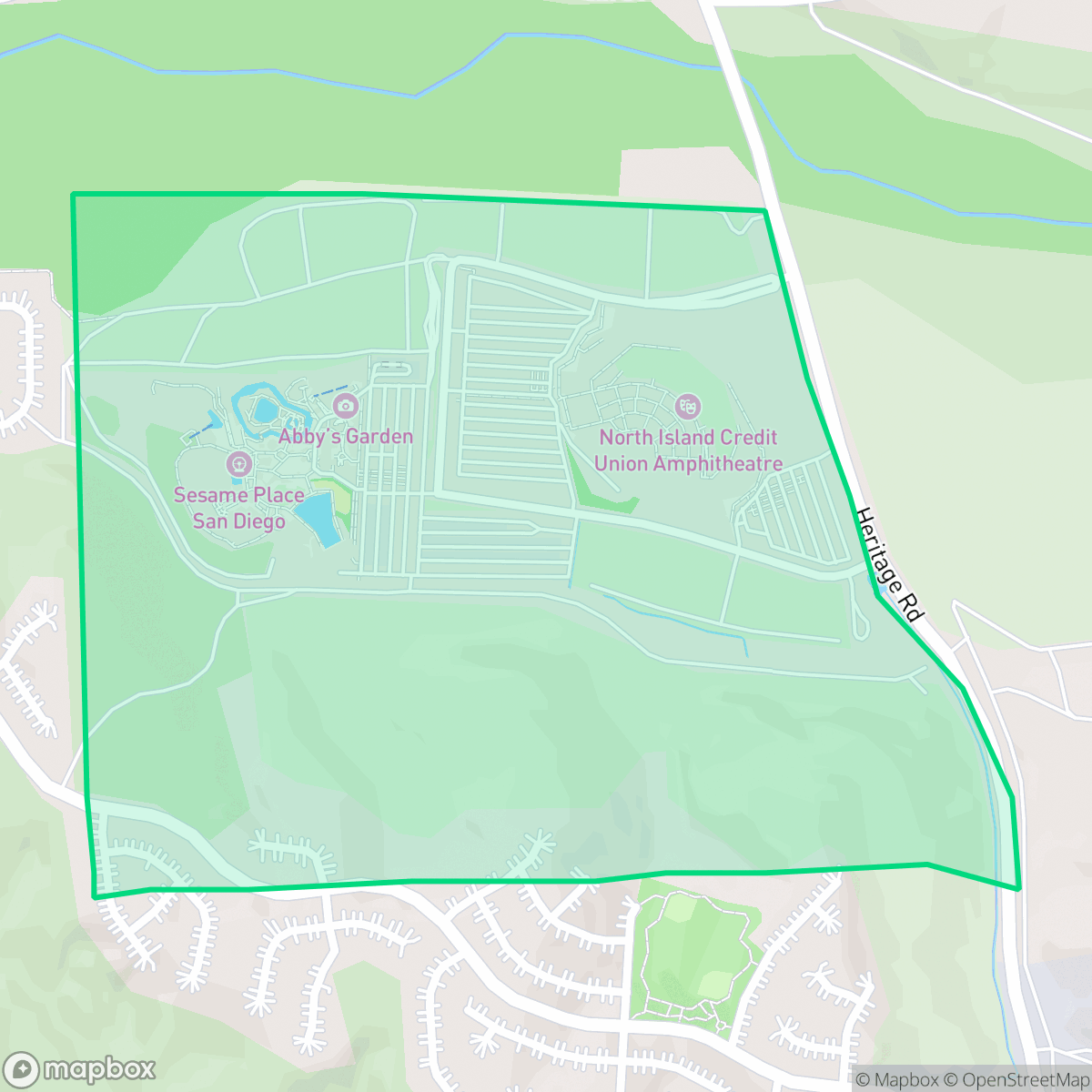
The Amphitheater and Water Park neighborhood in southeast Chula Vista is a distinct entertainment and residential pocket defined by its two namesake regional attractions. Originally part of a large dairy farm, the 72-acre site was later developed into an industrial park that sat abandoned for years. In the late 1990s, the city approved a major redevelopment plan, bulldozing the industrial park to establish a premier entertainment hub. This transformation began with the 1997 opening of the White Water Canyon water park (now Sesame Place San Diego), followed in 1998 by the debut of the Coors Amphitheatre (now the North Island Credit Union Amphitheatre), San Diego County's first major venue of its kind. Today, this low-population suburban enclave blends these bustling, family-friendly landmarks with peaceful residential streets.
The area functions as a unique blend of expansive open space and specialized commercial hubs. While the presence of major attractions defines its identity, the surrounding environment maintains a notably rural aesthetic with high visual appeal. Residents benefit from excellent health insurance coverage and a highly walkable environment that encourages outdoor activity, particularly for dog owners who utilize the open terrain. The neighborhood maintains a low-density atmosphere that stands in contrast to the more congested parts of the city.
Living here involves specific trade-offs, as the neighborhood is exceptionally quiet during non-event periods but faces periodic aviation noise. The area is characterized by a conservative ideological lean and requires residents to remain aware of localized fire safety concerns. It is best suited for those who prioritize access to regional recreational amenities and a peaceful, low-density lifestyle over the typical bustle of an urban center.
Neighborhood Scores Across 15 Qualities
Residential spacing offers a balanced degree of separation between neighbors, providing more seclusion than the typical Chula Vista neighborhood. According to iHuus data, the area features mixed density with some natural buffers between adjacent properties.
Pedestrian movement is supported by sidewalks on one side of the streets and safe crossings, though walkability is slightly lower than the Chula Vista average.
Large residences and frequent upscale amenities characterize the area, offering a more polished aesthetic than the Chula Vista average. According to iHuus data, the neighborhood features wide driveways and well-maintained surroundings.
Expansive green spaces and wide, low-traffic paths provide an environment that is significantly more accommodating for dog owners than the Chula Vista average. According to iHuus data, the area offers safe routes for walking pets away from major roadways.
Characterized by a significant amount of open space, this area features a transition from suburban fringes into hilly scrubland and industrial zones. This level of openness is much higher than the Chula Vista average according to iHuus data.
Minimal commercial activity and vast open spaces create a highly tranquil environment, though this area lacks the social energy found in much of Chula Vista. According to iHuus data, the landscape is characterized by low density and limited access to local services.
Persistent noise from nearby freeway and railroad traffic characterizes this area. According to iHuus data, acoustic comfort is lower than the Chula Vista average.
Air quality levels in this area typically fluctuate between acceptable and unhealthy, matching the general average for Chula Vista. Sensitive groups may experience occasional concern during certain periods, according to iHuus data.
Large logistics warehouses, auto salvage yards, and heavy equipment storage are concentrated in the central area of this neighborhood. According to iHuus data, the level of industrial activity here is higher than the Chula Vista average.
Health insurance access is widespread among residents here, appearing significantly higher than the Chula Vista average according to iHuus data.
Political leanings in this area are predominantly liberal, though they are slightly less pronounced than the average seen across Chula Vista.
A balanced mix of young adults, families, and older residents defines the area. According to iHuus data, this demographic spread is roughly consistent with the broader Chula Vista area.
Flood risk in this area is significantly lower than the Chula Vista average, as most of the neighborhood sits outside the primary flood zones. While some residual risk exists within specific zones, the area is generally considered much safer from flooding than much of the city.
Fire hazard levels in this area are significantly higher than the Chula Vista average. Residents should prepare for extreme fire safety risks and implement maximum protection measures according to iHuus data.
Address-Level Insights for Amphitheater and Water Park


iHuus Neighborhood Intelligence Insights
Get address-level neighborhood insights for Amphitheater and Water Park
- Street-level scores — see how individual blocks compare, not just neighborhood averages
- Micro-zone boundaries — identify quiet pockets, flood boundaries, and walkable clusters before you visit
- 15 dimensions in full — walkability, noise, air quality, school quality, insurance coverage, population age profile, urban/rural index, and more
- Boundary risk alerts — know if your address sits near a block boundary where scores drop, the kind of detail no listing will ever mention
- School insights — individual school ratings and insights, not just district-level data
- Compare before you commit — side-by-side data across neighborhoods, down to block precision
No credit card required
Compare with Any Neighborhood
| Dimension | Amphitheater and Water Park | Bella Lago |
|---|---|---|
| 🚶 Walkabilityavg 8.8 | ||
| 🔊 Acoustic Comfortavg 3.52 | ||
| 🤫 Privacy Indexavg 4.85 | ||
| 🎨 Visual Appealavg 6.83 | ||
| 🐕 Dog Friendlinessavg 6.92 | ||
| 🗺️ Urban-Rural Indexavg 6.8 | ||
| ✨ Neighborhood Vibeavg 5.11 | ||
| 🏥 Health Insurance Coverageavg 7.16 | ||
| 🌿 Air Qualityavg 6 | ||
| 🏭 Industrial Proximityavg 8.97 | ||
| 🌊 Flood Safetyavg 2.79 | ||
| 🗳️ Ideological Leanavg 8.28 | ||
| 👥 Population Age Profileavg 4.75 | ||
| 🔥 Fire Safetyavg 0.51 | ||
| 🏫 School Quality |
Amphitheater and Water Park Rankings
School Districts Serving Amphitheater and Water Park
School Insights for Amphitheater and Water Park
Below average outcomes; significant attendance and academic challenges.
School Insights
See what's really behind every school rating near Amphitheater and Water Park
- Individual school ratings — each school's own score with outcome context, not just a district average
- Enrollment & class size data — student-to-teacher ratio and how it compares to the state average
- Full demographics breakdown — ethnicity and gender composition for every school in the enrollment zone
- Every school in the district — all schools within the enrollment boundary ranked by rating, not just the closest one
- Grade levels & benchmarks — elementary through high school, with below/above state-average flags
No credit card required