South Campus, Chico
Updated · 3,793 residents
South Campus is a highly walkable, dense neighborhood defined by its proximity to California State University, Chico and a vibrant student-centric atmosphere. While residents benefit from easy access to local amenities and a grid-based street layout, the area experiences significant noise from road traffic and has limited privacy due to its high density.
Key Highlights
About South Campus
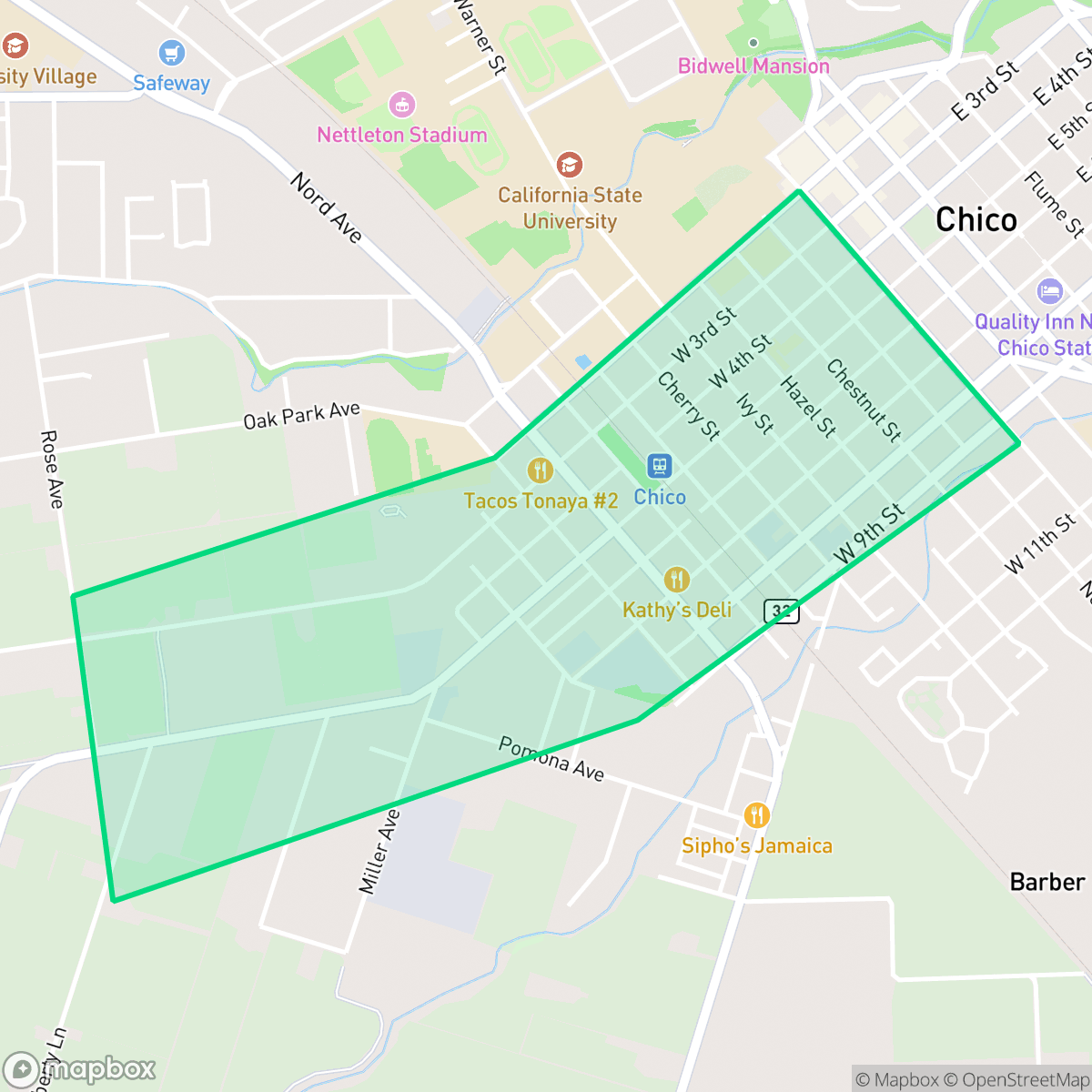
Established as Chico’s first residential area and surveyed in 1860, the South Campus neighborhood is a historically and culturally distinct district. A portion of the neighborhood was added to the National Register of Historic Places in 1991 as the South Campus Historic District, which features Queen Anne, Colonial Revival, and Craftsman Bungalow homes built between 1860 and 1949. Notable local landmarks include the historic Stansbury House, the Southern Pacific Depot, and the "Language Houses"—six restored themed residences on West Third Street. Today, the neighborhood is Chico's most densely populated area, characterized by a vibrant student community, fraternity and sorority houses, and a designated Fraternity/Sorority Overlay Zone. Its commercial heart is centered at the lively intersection of Fifth and Ivy Streets, known locally as "Five and I".
This neighborhood functions as a primary hub for university life, characterized by a mix of low-rise apartments, student housing, and commercial activity. The grid-based street layout and consistent sidewalk coverage make it one of the most walkable areas in Chico, allowing residents to reach daily necessities and social venues on foot. The commercial heart of the area remains a focal point for the community, offering a variety of dining and service options that cater to a younger, transient population.
Prospective residents should consider that the area is notably loud, with road traffic contributing to a high average decibel level. The high density results in limited privacy, as homes and multi-family structures are positioned relatively close to one another. Furthermore, the area faces specific environmental challenges regarding flood and fire safety. It is best suited for students or individuals who prioritize transit accessibility and a high-energy environment over quiet, secluded residential living.
Neighborhood Scores Across 15 Qualities
Residential spacing varies from dense apartment complexes to houses near orchards, resulting in a privacy level comparable to the Chico average. Neighbors are often situated within close proximity, though some buffer zones exist between structures.
Pedestrians benefit from a consistent grid system with wide sidewalks and frequent, manageable crossings. This area offers superior walkability compared to the Chico average, featuring connected pathways and low-traffic residential streets.
Predominantly multi-family apartment blocks and tract housing define the landscape, offering modest yards and shared amenities. This visual environment is slightly below the Chico average for aesthetic variety.
Large orchard areas and expansive sports fields provide ample space for exercise. While sidewalk connectivity is consistent throughout the area, overall dog friendliness is slightly below the Chico average according to iHuus data.
Residential pockets feature a blend of dense urban grids and agricultural orchard plots. This area feels slightly less rural than the rest of Chico due to the presence of apartment complexes and commercial structures.
A noticeable concentration of social hubs and diverse dining options makes this area slightly more active than the Chico average. While some blocks offer a quiet and secluded atmosphere, other parts of the neighborhood feature high energy near local landmarks and transit corridors.
Frequent noise from nearby railroad tracks and heavy traffic is common in this area. According to iHuus data, acoustic comfort is notably lower than the Chico average due to proximity to major transit corridors.
Air quality in this area is consistent with the city average, featuring a mix of acceptable and unhealthy days. Sensitive groups should remain aware of occasional fluctuations in air purity according to iHuus data.
Residential and light commercial uses dominate the area, with only a few warehouses located on the southern and eastern fringes. This lack of heavy industry is largely consistent with the rest of Chico.
Health insurance enrollment in this area is high and remains slightly above the Chico average, according to iHuus data.
Voting patterns and census indicators in South Campus reflect a much more liberal leaning than the Chico city average, according to iHuus data.
Young adults make up the vast majority of the population here, resulting in a significantly younger age profile than the Chico average. Residents will find very few families or older adults living in this area according to iHuus data.
Properties in this area are situated within a designated floodplain, which presents a significantly higher risk of flooding than the Chico average. According to iHuus data, residents should anticipate the likely requirement for flood insurance.
Address-Level Insights for South Campus


iHuus Neighborhood Intelligence Insights
Get address-level neighborhood insights for South Campus
- Street-level scores — see how individual blocks compare, not just neighborhood averages
- Micro-zone boundaries — identify quiet pockets, flood boundaries, and walkable clusters before you visit
- 15 dimensions in full — walkability, noise, air quality, school quality, insurance coverage, population age profile, urban/rural index, and more
- Boundary risk alerts — know if your address sits near a block boundary where scores drop, the kind of detail no listing will ever mention
- School insights — individual school ratings and insights, not just district-level data
- Compare before you commit — side-by-side data across neighborhoods, down to block precision
No credit card required
Compare with Any Neighborhood
| Dimension | South Campus | Chapmantown |
|---|---|---|
| 🚶 Walkabilityavg 8.2 | ||
| 🔊 Acoustic Comfortavg 3.52 | ||
| 🤫 Privacy Indexavg 6.02 | ||
| 🎨 Visual Appealavg 6.83 | ||
| 🐕 Dog Friendlinessavg 7.2 | ||
| 🗺️ Urban-Rural Indexavg 6.97 | ||
| ✨ Neighborhood Vibeavg 5.96 | ||
| 🏥 Health Insurance Coverageavg 7.27 | ||
| 🌿 Air Qualityavg 6 | ||
| 🏭 Industrial Proximityavg 9.02 | ||
| 🌊 Flood Safetyavg 5.17 | ||
| 🗳️ Ideological Leanavg 7.51 | ||
| 👥 Population Age Profileavg 4.64 | ||
| 🔥 Fire Safety | ||
| 🏫 School Quality |
South Campus Rankings
School Districts Serving South Campus
School Insights for South Campus
Below average outcomes; significant attendance and academic challenges.
School Insights
See what's really behind every school rating near South Campus
- Individual school ratings — each school's own score with outcome context, not just a district average
- Enrollment & class size data — student-to-teacher ratio and how it compares to the state average
- Full demographics breakdown — ethnicity and gender composition for every school in the enrollment zone
- Every school in the district — all schools within the enrollment boundary ranked by rating, not just the closest one
- Grade levels & benchmarks — elementary through high school, with below/above state-average flags
No credit card required